1994issue C061-5
Gold as a cycle clock for commodities and yields
Read a long-horizon gold momentum reversal as a calendar mark for the inflation season, then grade it by whether industrial commodities and bond yields later confirm the same shift, instead of treating geopolitical headlines as the cause.
- If gold is read through its inflation-hedge-role, its major swings should anticipate the cycle-season-split between an inflationary half and a deflationary half of the business cycle.
- A reversal in smoothed-rate-of-change, or a nine-month-crossover-alert, is a regime warning rather than a standalone call until industrial commodities and bond yields later confirm the same seasonal shift.
- The intermarket-lead describes sequence only. Lead-lag-dispersion means the warning time changes from cycle to cycle and does not say how large the later commodity or yield move will be.
- Geopolitical shocks have tended to reinforce gold only when the primary-trend-filter was already a bull market. Similar shocks in a primary bear produced rallies that later faded, including the countercyclical-news-spike pattern.
Gold as a calendar, not a headline tape
The working premise is the inflation-hedge-role. If gold is treated as an inflation hedge, its major swings should anticipate the business cycle’s shift between an inflationary half and a deflationary half. The cycle-season-split is that coarse two-season map, used to locate gold, industrial commodities, and bond yields in the same regime.
Because the official gold price was administered from 1935 through 1968, and the following decade was largely a catch-up versus other commodities, cycle-linked comparisons become more interpretable after 1980.
A reversal is an alert, not a finished call
Long-term gold momentum, plotted as a smoothed-rate-of-change, has historically reversed before corresponding peaks and troughs in industrial raw-material price momentum. A nine-month moving-average crossover on gold has been used to mark momentum-regime changes. That mark is the nine-month-crossover-alert. One such alert in spring 1993 preceded a later-year trough in commodity prices.
TradersWeek editorial reading: that reversal is a regime alert for the inflation season, not a standalone call on gold, commodities, or yields.
The observed sequence is the intermarket-lead: gold turns before industrial raw-material prices and high-grade bond yields. That lead describes sequence, not magnitude. It does not specify how large the later commodity move will be, and the length of the lead differs from cycle to cycle. That variability is lead-lag-dispersion.
A turning-point comparison recorded an average gold lead of 12.4 months versus the industrial raw-materials series and 10 months versus the bond-yield series, while still noting exceptions and variable lags.
Gold momentum has also tended to lead high-grade corporate bond-yield momentum. There was at least one cycle in which yield momentum turned first. There was also one mid-1990 gold spike, tied to a war scare rather than the business cycle, that held gold momentum up after the metal’s price had already led yields.
Gold long-term KST leads CRB spot momentum, 1981–1994
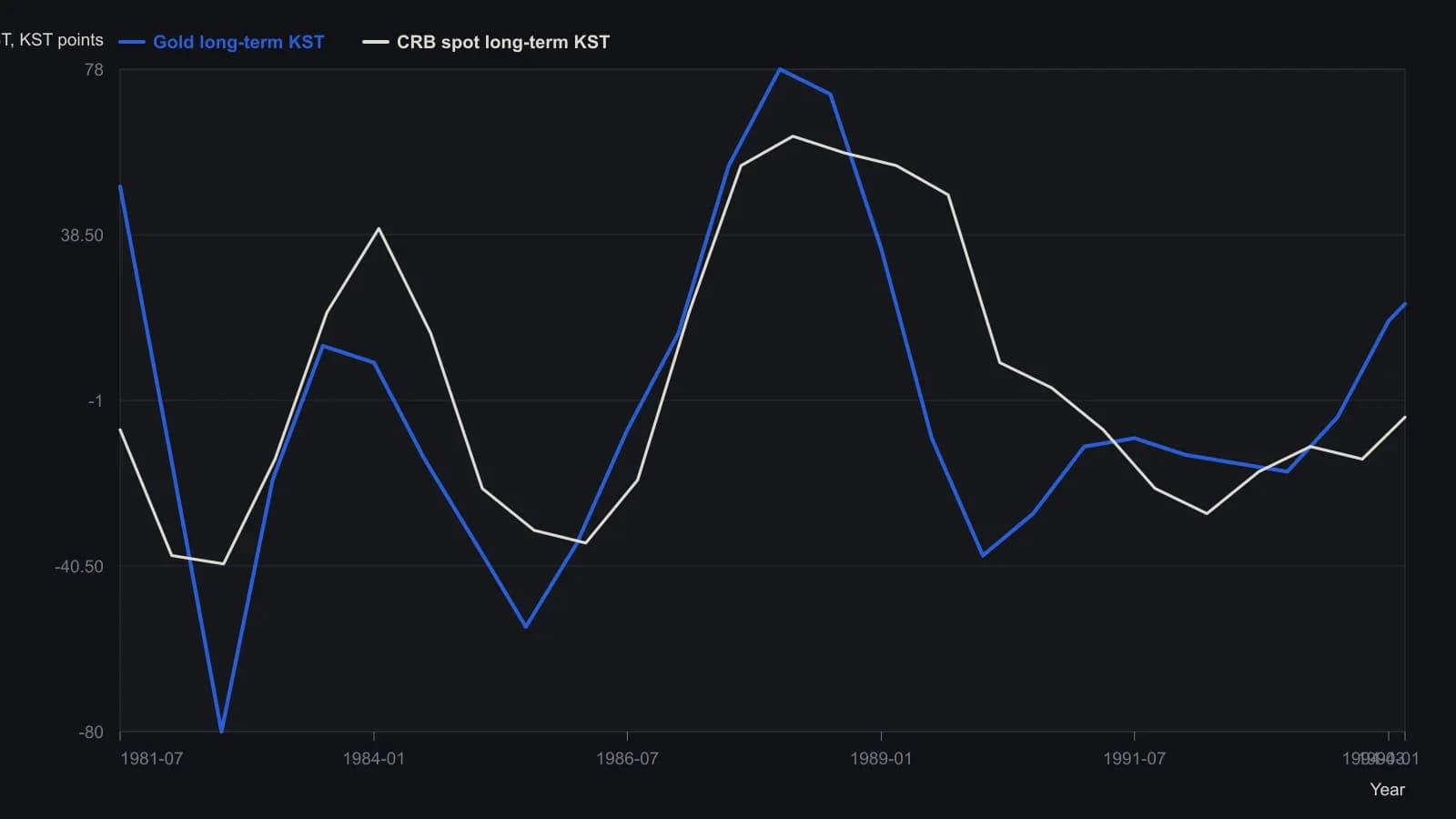
KST is Pring’s summed, smoothed rate-of-change oscillator. A nine-month moving-average crossover is the signaling rule the article cites. Leads and lags differ each cycle; the series do not speak to the size of the next commodity move.
Score shocks against the trend already in force
Geopolitical shocks have tended to reinforce gold only when a primary bull market was already in force. Similar shocks during a primary bear market produced rallies that later proved to be interruptions of the decline. The primary-trend-filter is that prevailing multi-month gold bull or bear phase. It decides whether a shock is likely to extend the move or only interrupt it.
News-driven gold rallies can still appear inside a declining primary trend. When the inflation season is not turning, those advances have been countercyclical rather than the start of a new cycle phase. That pattern is the countercyclical-news-spike.
TradersWeek editorial reading: geopolitical headlines should be scored against the regime already in force, not treated as the cause of the next seasonal shift.
All readings on this track · 46 readings
- 1985Constructing excess and momentum difference-curve oscillators
- 1988Five reading rules for smoothed indicator charts
- 1989Momentum overlays that speed moving-average oscillators
- 1990A laboratory template that constructs Rate of Change as a pane module
- 1991Volume-scaled rate of change as a momentum construction
- 1991Three-indicator market overview from tape, sentiment and rates
- 1991Three-component trend model with rate-of-change filters
- 1992A KST oscillator from a weighted rate-of-change stack
- 1992Four-window weighted rate-of-change composite
- 1992Constructing multi-span smoothed rate-of-change filters
- 1992Constructing a four-horizon summed rate of change
- 1992Constructing KST from four weighted smoothed rates of change
- 1992Constructing a composite from weighted smoothed rates of change
- 1992Three-horizon KST maturity alignment
- 1992Construct a bond-led dividend-to-bond-yield regime first
- 1992Constructing relative-strength KST from weighted rate-of-change
- 1993Constructing a volume oscillator from average ratios and smoothed rate of change
- 1994Gold as a cycle clock for commodities and yields
- 1994Constructing a composite from weighted, smoothed rate-of-change windows
- 1994Constructing gold-mining rate-of-change tripwires for Treasury bonds
- 1994A capacity-stress checklist across commodities, bonds, and breadth
- 1994Rate of change parameters for testable entries
- 1994Constructing rate-of-change midpoints, lookbacks and divergence
- 1994Lead oscillator breaks need price trendline confirmation
- 1994Nested averages for an annual momentum curve
- 1994Evaluating a Coppock-style rate of change as a bottom-regime filter
- 1995A weighted eleven-month Dow rate of change as one testable timing procedure
- 1996Named lookbacks, thresholds, and streaks for entry rules
- 1997A midpoint rate-of-change test for bond trend follow-through
- 1997Constructing a short-rate-adjusted equity momentum filter
- 1998Daily momentum rank-churn as a portfolio-construction problem
- 1999Constructing a lagged rate of change cycle system
- 2000A triple delay line then a one-bar elliptic oscillator
- 2001Confirming rate of change divergences with price
- 2001Momentum trendline breaks need price confirmation
- 2001Market breadth, On-balance volume, and Rate of Change as a combined timing framework
- 2001Know Sure Thing with stacked horizons and trendline confirmation
- 2003Constructing a mechanical system from a rate of change condition
- 2003Constructing momentum from two closes and spotting divergence
- 2003Formula choice tilts which momentum mismatches count as divergences
- 2004RSI and momentum agreement as an asymmetric filter
- 2005Constructing price-normalized moving-slope hybrids
- 2005Unsigned speed gates on a fixed average-cross pair
- 2007Rebuilding rate of change as a path-weighted oscillator
- 2008Construct Special K so short-horizon signals stay inside the primary trend
- 2013Restore volume balance before adding another price-time indicator