2005issue C111-3
Unsigned speed gates on a fixed average-cross pair
Hold one 10-bar entry and 5-bar exit pair fixed, then treat unsigned bar speed as a separate allow-or-block switch. A speed-rise gate and a speed-fall gate can then be compared on identical exits.
- Unsigned speed is the absolute close-to-close change on a bar, so an advance and a same-size decline share one magnitude.
- The control crossover stack enters on 10-bar average crosses and exits on 5-bar average crosses, with no speed comparison.
- A speed-rise gate and a speed-fall gate keep those same exits and only allow or block the 10-bar entry.
- The comparison was framed as an incremental test of a speed condition, not as construction of a complete trading system.
The control crossover stack
The control crossover stack enters long when the close crosses above the 10-bar average of closes and enters short when the close crosses below that average. Longs then exit under the 5-bar average, and shorts exit above the 5-bar average. This pair includes no speed comparison and is used only as the paired baseline.
Unsigned speed as a speed reading
Unsigned speed is the absolute close-to-close change on the current bar, so an advance and a same-size decline share one magnitude. Rate of change is that unsigned one-bar close displacement used as a speed reading rather than a signed oscillator. Signed momentum uses the same distance but can reverse sign when price retraces.
Two speed gates on the same exits
The momentum strategy is a long and short procedure that can accept or reject a directional cross depending on whether that speed reading is rising or falling. The speed-rise gate allows the same 10-bar crosses only when current-bar unsigned speed is greater than the prior bar's unsigned speed. The speed-fall gate allows those crosses only when current-bar unsigned speed is less than the prior bar's unsigned speed. Exits stay on the 5-bar average crosses in both cases.
Rule-based entry is the complete, testable stack: a 10-bar average cross to enter, an optional speed comparison that allows or blocks the order, and a 5-bar average cross to exit.
Net profit of a fixed 10/5 average-cross pair with unsigned speed gates
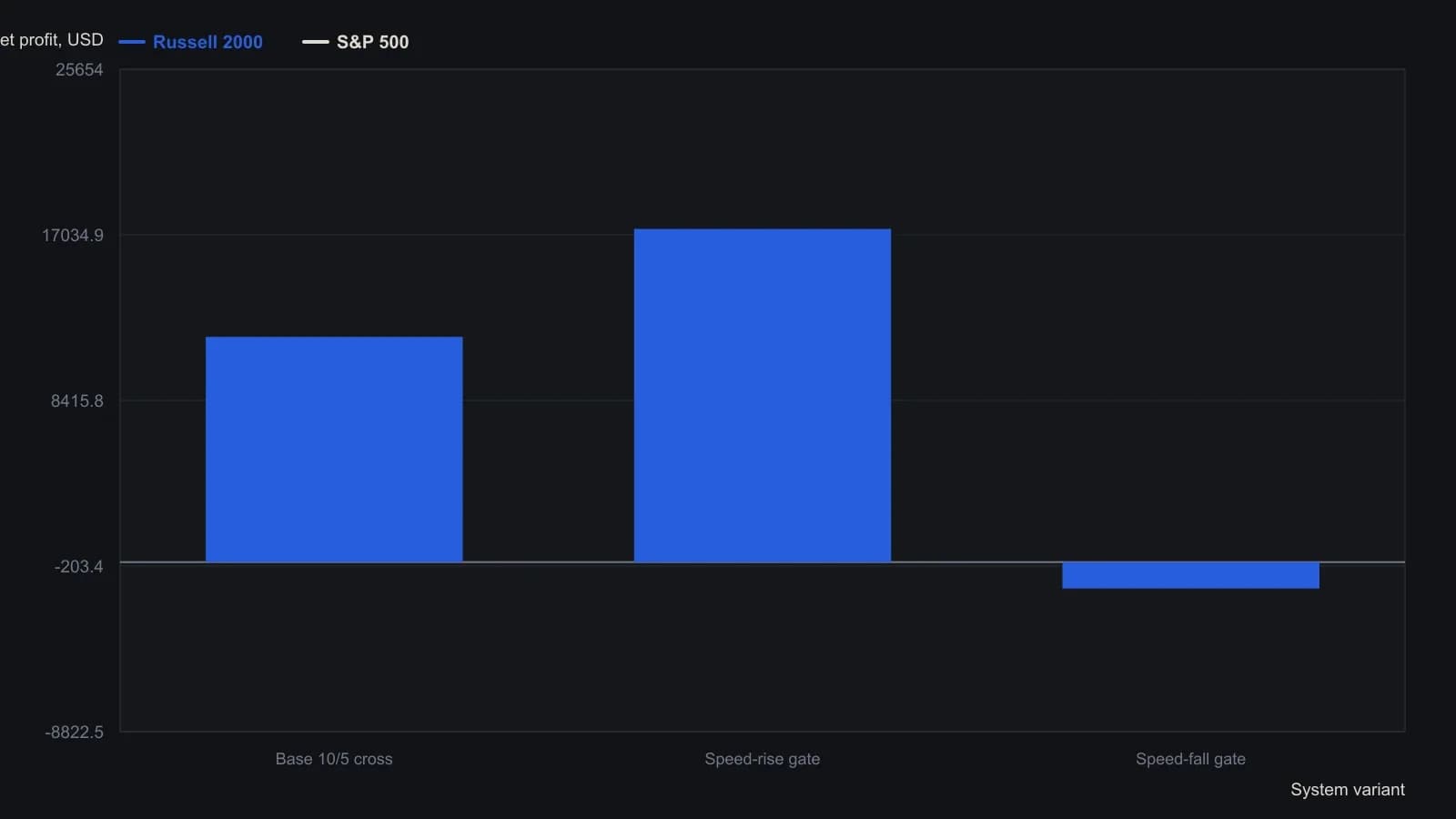
Commissions and slippage were omitted. The body dates the test as 1 January–31 May 2005, but the report headers read 1 January 2001–31 May 2005.
An incremental comparison, not a complete system
The three rule sets were compared on daily Russell 2000 and S&P 500 series. The tests omitted commissions and slippage. The evaluation was framed as an incremental test of a speed condition, not as construction of a complete trading system.
Variants were ranked by profit factor and profitability. The write-up treated rising-speed confirmations as preferable to unfiltered crosses and treated falling-speed confirmations as worse on both series.
The stated test window is not consistent
Figure captions date the daily tests from 1 January 2001 through 31 May 2005, while the methods paragraph dates the same tests from 1 January through 31 May 2005. Editorial: that conflict leaves the intended sample unclear, and the omitted costs mean the ranking is not an execution-level comparison.
Other direction and speed pairings
The write-up treated rising-versus-falling speed as only one pairing and noted that other combinations of price direction and speed remain available for the same style of controlled test.
All readings on this track · 46 readings
- 1985Constructing excess and momentum difference-curve oscillators
- 1988Five reading rules for smoothed indicator charts
- 1989Momentum overlays that speed moving-average oscillators
- 1990A laboratory template that constructs Rate of Change as a pane module
- 1991Volume-scaled rate of change as a momentum construction
- 1991Three-indicator market overview from tape, sentiment and rates
- 1991Three-component trend model with rate-of-change filters
- 1992A KST oscillator from a weighted rate-of-change stack
- 1992Four-window weighted rate-of-change composite
- 1992Constructing multi-span smoothed rate-of-change filters
- 1992Constructing a four-horizon summed rate of change
- 1992Constructing KST from four weighted smoothed rates of change
- 1992Constructing a composite from weighted smoothed rates of change
- 1992Three-horizon KST maturity alignment
- 1992Construct a bond-led dividend-to-bond-yield regime first
- 1992Constructing relative-strength KST from weighted rate-of-change
- 1993Constructing a volume oscillator from average ratios and smoothed rate of change
- 1994Gold as a cycle clock for commodities and yields
- 1994Constructing a composite from weighted, smoothed rate-of-change windows
- 1994Constructing gold-mining rate-of-change tripwires for Treasury bonds
- 1994A capacity-stress checklist across commodities, bonds, and breadth
- 1994Rate of change parameters for testable entries
- 1994Constructing rate-of-change midpoints, lookbacks and divergence
- 1994Lead oscillator breaks need price trendline confirmation
- 1994Nested averages for an annual momentum curve
- 1994Evaluating a Coppock-style rate of change as a bottom-regime filter
- 1995A weighted eleven-month Dow rate of change as one testable timing procedure
- 1996Named lookbacks, thresholds, and streaks for entry rules
- 1997A midpoint rate-of-change test for bond trend follow-through
- 1997Constructing a short-rate-adjusted equity momentum filter
- 1998Daily momentum rank-churn as a portfolio-construction problem
- 1999Constructing a lagged rate of change cycle system
- 2000A triple delay line then a one-bar elliptic oscillator
- 2001Confirming rate of change divergences with price
- 2001Momentum trendline breaks need price confirmation
- 2001Market breadth, On-balance volume, and Rate of Change as a combined timing framework
- 2001Know Sure Thing with stacked horizons and trendline confirmation
- 2003Constructing a mechanical system from a rate of change condition
- 2003Constructing momentum from two closes and spotting divergence
- 2003Formula choice tilts which momentum mismatches count as divergences
- 2004RSI and momentum agreement as an asymmetric filter
- 2005Constructing price-normalized moving-slope hybrids
- 2005Unsigned speed gates on a fixed average-cross pair
- 2007Rebuilding rate of change as a path-weighted oscillator
- 2008Construct Special K so short-horizon signals stay inside the primary trend
- 2013Restore volume balance before adding another price-time indicator