1990issue C061-9
Activity-weighted call-put ratio for options regime context
A headline call-put print is not yet a sentiment object. Orient the scale as calls over puts, ask whether the tape is opening new premium or only recycling open interest, and weight busy sessions before treating the figure as slow regime context.
- A call-put-ratio is oriented so higher readings mark heavier call activity and, under a contrary reading, greater caution, while lower readings mark pessimism and lower caution.
- Volume-to-open-interest asks whether the tape is opening new premium or only recycling existing positions, because a single session cannot isolate which opening and closing combinations produced the print.
- An activity-weighted-window sums volume and open interest across days so high-activity sessions outweigh quiet sessions that can distort a simple average of daily ratios.
- Editorial interpretation: keep the finished composite as a contrarian-overlay around a single trade on a weeks-to-months horizon, not as a same-day trigger, because extremes can persist and neutralize with time as well as with price.
Sentiment as a construction problem
The archive does not treat options sentiment as a ready-made headline. It first orients the scale as calls over puts, then asks what the tape is doing to open interest, then forms a multi-day figure that can sit as market context.
Scale orientation comes before premium-positioning, and premium-positioning comes before any contrary use of the finished reading.
The scale as calls over puts
A call-put-ratio measures calls against puts so that higher readings mark relatively heavier call activity and lower readings mark relatively heavier put activity.
Higher readings are mapped to greater call enthusiasm and, under a contrary reading, greater caution. Lower readings are mapped to pessimism and lower caution. That polarity is a construction choice. It is not yet a statement about whether new premium is being opened.
The option-writer as the other side
Selling a call or put to open is treated as the opposite directional statement from buying that same option. Clustered writing is therefore grouped with other contrary crowd behavior.
The option-writer belongs inside premium-positioning, the mix of newly written versus newly purchased option premium inferred from joint changes in volume and open interest.
What a single session cannot isolate
A single day's options volume and open-interest change cannot isolate which opening and closing long-short combinations produced the observed tape.
The construction does not claim to recover each long and short. It asks a coarser question about how much of the tape looks like new commitment rather than turnover of old positions.
Volume scaled by open interest
Volume-to-open-interest is session volume scaled by existing open interest, used to judge how much of the tape is new commitment versus turnover of old positions.
The sentiment composite is constructed as the call volume-to-open-interest ratio divided by the put volume-to-open-interest ratio. The call-over-put orientation stays in place. The open-interest scaling is what lets premium-positioning enter the same figure.
When volume and the composite disagree
In one gold-futures session a conventional call-put volume ratio near 1.03 coincided with a volume-to-open-interest composite of 0.49 after call open interest expanded more than put open interest on roughly similar volume.
The two readings can part ways when new call commitment dominates a tape that looks almost balanced on volume alone.
An activity-weighted window
An activity-weighted-window forms the multi-day ratio from summed call and put volume and summed open interest. High-activity sessions then receive more weight than quiet sessions that can distort a simple average of daily ratios.
The composite near an intermediate high
At a described intermediate high the composite is said to rise when a late burst of call buying lifts call volume while call open interest stays flat or falls, and put open interest grows slowly relative to put volume.
Editorial interpretation: that pattern reads as recycled call premium with relatively heavier new put commitment, not as confirmation that the crowd's late call buying is fresh opening demand.
Gold options TRIN versus the conventional call/put ratio
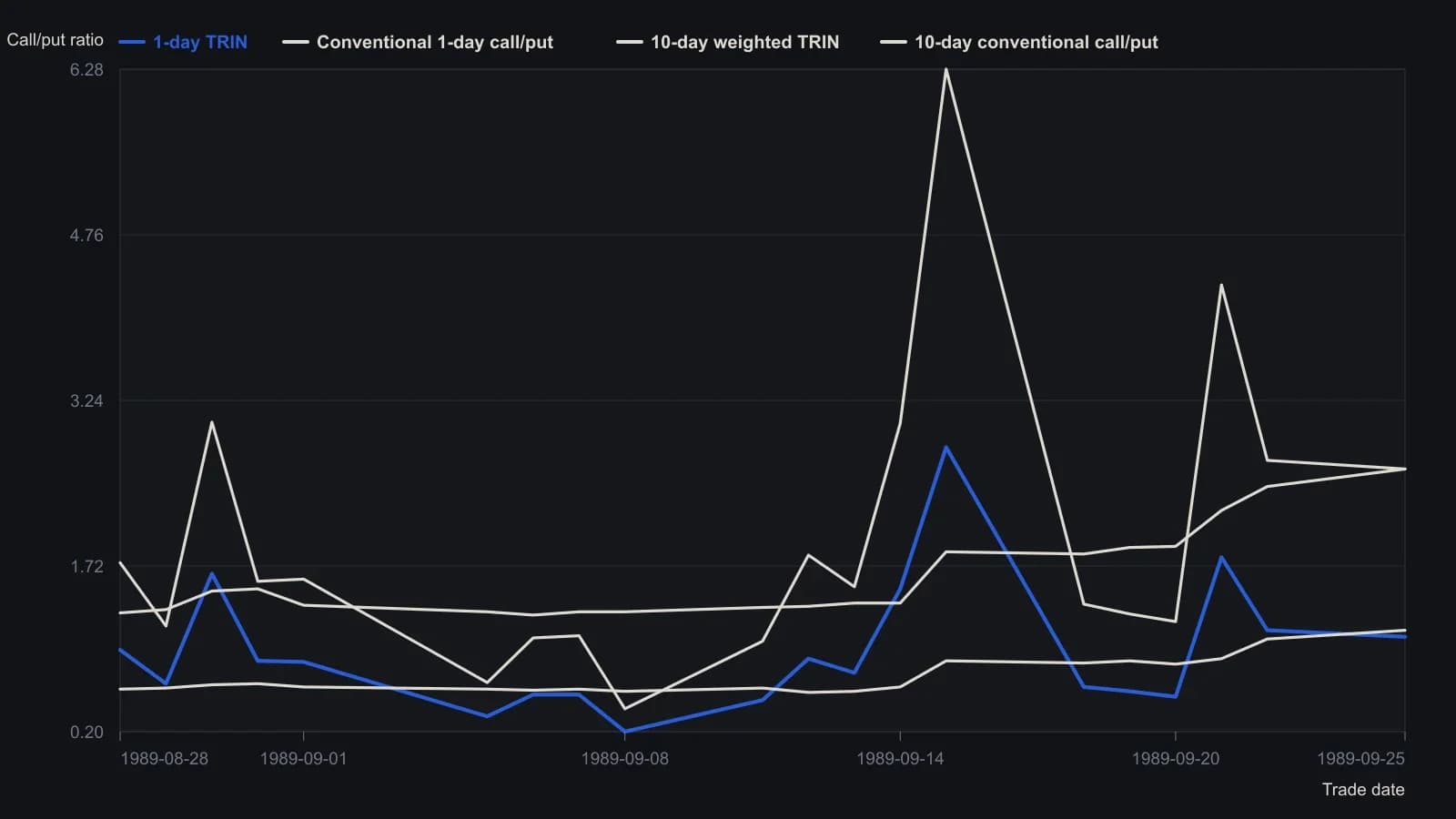
The 10-day TRIN is activity-weighted: Martin sums call volume, call open interest, put volume and put open interest over the window, then forms the ratio of those totals, so busy sessions dominate and a quiet extreme cannot warp the average.
Extremes that persist for weeks
Across equity-index, bond, Eurodollar, and gold examples, 10-day composite readings of 1.60 or higher were discussed as top-side extremes and readings of 0.70 or lower as low-side extremes.
Sentiment extremes are described as able to persist for weeks and to neutralize with time as well as with price, so a purely mechanical reading of the composite is treated as incomplete.
A slow contrary overlay
Editorial interpretation: the finished composite is a contrarian-overlay. Clustered options commitment is held as market-regime context rather than as confirmation of the crowd's stated direction.
That is why the reading belongs around a single trade on a weeks-to-months horizon. It is not rebuilt here as a same-day entry, exit, or abstention rule.
All readings on this track · 31 readings
- 1989Constructing an open-interest-scaled put-call ratio
- 1990Open-interest put/call ratio as an intermediate sentiment overlay
- 1990Activity-weighted call-put ratio for options regime context
- 1990Stacking moving averages, put-call regimes, and double bottoms
- 1991Constructing put-call open-interest regime filters
- 1991Constructing an activity-weighted call-put sentiment reading
- 1991Fund-index regime, put-call confirmation, then the tracking fund
- 1992A seven-vote sentiment score for fund-sleeve regimes
- 1992Construct an activity-weighted call-put ratio before reading crowd conviction
- 1992Pair action with opinion in a composite sentiment index
- 1992Crowd extremes as a three-gate contrary procedure
- 1993Constructing a put-volume average regime filter
- 1993Neural-net inputs and rule trees for mechanical systems
- 1994Failed Treasury put-call signal and a dollar regime shift
- 1994Separate survey, put-call, and premium ledgers before a regime call
- 1994Repeated option-premium prints and a four-zone regime map
- 1995Consecutive-day regimes in the put-call premium ratio
- 1995Construct a put-call ratio for regime-aware contrarian signals
- 1996Treat one options idea as a regime-aware portfolio decision
- 1997Options open interest, put-call sentiment, and contrarian context
- 2000A two-layer put-call construction for intermediate market conditions
- 2002Sentiment confirmation for trend-following options
- 2003Construct a regime overlay from implied volatility and the put-call ratio
- 2004Dollar-weighted Put-call ratio construction
- 2006Debit put spreads inside put-call regimes
- 2011Put-call ratio cycle phases for index context
- 2011Constructing a put-call ratio cycle indicator
- 2011Building a put-call ratio indicator stack
- 2011Put-call ratio regime context with oscillator and band confirmation
- 2018Reading seasonal regimes with put-call divergence and bands
- 2020Treat close-only volume as a hypothesis, then choose regime or phase