2014issue C0414-17
Forex pair ranks from seven cross-currency scores
Eight widely traded currencies produce 28 unique cash pairs. Currency translation turns each pair's smoothed momentum into signed base and quote contributions, those contributions become eight underlying-currency scores, and pair-strength scores then rank the 28 pairs so rank rotation can follow names that climb or fall rather than names already at the extremes.
- Each of the eight currencies appears in exactly seven pairs, so currency translation can add signed pair readings into one underlying-currency score.
- A pair-strength score is the first currency score minus the second, and the 28 differences are ranked against one another.
- Extreme strongest or weakest ranks are treated as late information. The usable object is a change in score momentum or a move up or down in the ranking.
- Two different pairs can encode the same directional exposure to one currency, so simultaneous names need a shared-currency check.
Eight currencies and 28 pairs
Eight widely traded currencies produce 28 unique cash pairs, and each currency appears in exactly seven of those pairs. Intermarket analysis, in this construction, means reading each major through the other seven so a single-pair decision sits inside that full eight-currency, 28-pair context.
Editorial: TradersWeek treats every cash pair as a translated spread. The pair is scored as the difference between two currency scores, not as an isolated momentum reading.
Currency translation into underlying scores
Currency translation converts a pair's momentum into signed base and quote contributions, then adds those signed readings into one currency score. A pair's smoothed momentum is assigned as a positive contribution to the base currency and an equal negative contribution to the quote currency.
An underlying-currency score is the summed, optionally scaled strength of one major versus the other seven majors. The score is the sum of the signed contributions across the seven pairs that contain the currency. Quote-sign reversal subtracts the pair reading when the scored currency is the second symbol, because a decline in that pair is strength for the quote.
One documented scaling step multiplies the seven-pair sum by 1,000 and divides by seven so the eight currency scores can be compared and sorted.
The input momentum reading is a three-bar average of the fractional close change over 13 bars. Both the bar interval and the lookback length can be changed.
Pair-strength scores and the ranking
A pair-strength score is the difference between the two underlying-currency scores that make up a tradable pair. It is the first currency's score minus the second currency's score, and the resulting 28 pair scores are ranked against one another.
The construction is framed as a way to choose among the 28 pairs by relative rank, not as a complete entry-and-exit procedure.
Rotation follows changing ranks
Rank rotation orders the 28 pairs by constructed strength and watches which names climb or fall in that order, instead of acting only on the current top and bottom.
Extreme strongest or weakest ranks are treated as late information, so the usable object is a change in score momentum or a move up or down in the ranking.
Shared exposure and a confirmation rule
Two different pairs can encode the same directional exposure to one underlying currency, so simultaneous positions need a shared-currency check.
One confirmation rule used with the construction is that one currency score is above zero and rising while the other is below zero and falling.
Daily FX strength scores for the eight major currencies
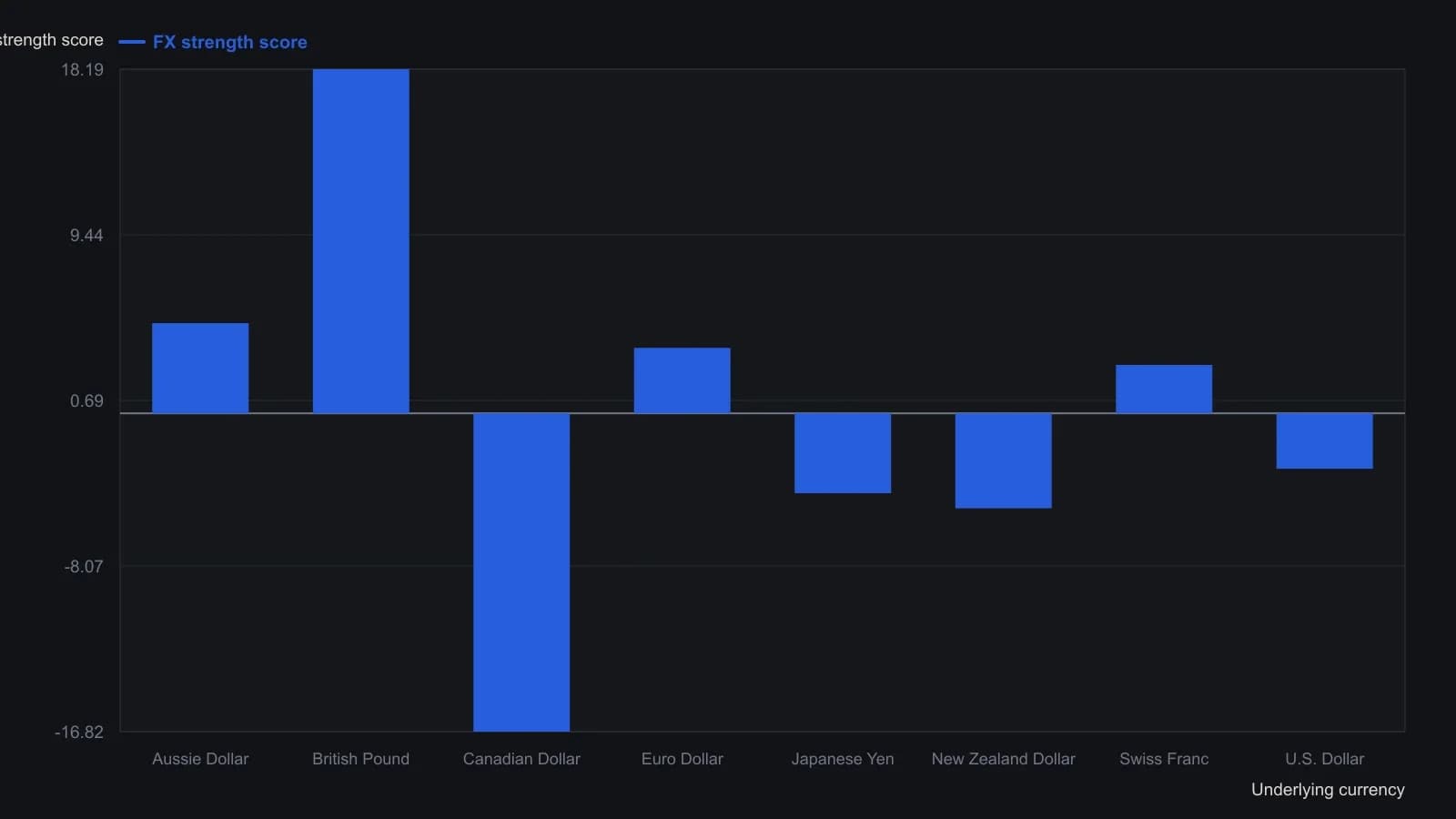
Each score is the sum of seven related-pair readings — a three-bar average of 13-bar close-to-close percent change — then multiplied by 1,000 and divided by seven. The table is labeled as a daily interval.
All readings on this track · 25 readings
- 1989Constructing currency-translated commodity bars
- 1992Gold, the dollar, and a foreign-currency proxy
- 1993Overseas fund translation after the European currency break
- 1995Inflation-ratio overlays, peso breaks and election cycles
- 2002A liquidity filter and intermarket overlay for one currency setup
- 2002Classify a weak-dollar regime before overseas sales and index proxies
- 2003A currency pair as a regime spread with trend and leverage bounds
- 2005Score a currency position as a cross-market portfolio
- 2005CAD/JPY as an oil translation: correlation, carry, and portfolio role
- 2006Placing a currency trade inside a gold, oil, and yield regime
- 2006Classifying the yen regime after Japan's liquidity exit
- 2006Two horizons in the 2006 euro-dollar advance
- 2007Rolling-window tests for gold hedge slogans
- 2010Stacking commission and currency costs on international fills
- 2010A dollar-pivot intermarket regime for currency pairs
- 2010Constructing currency pairs from basket relative strength
- 2012Same-way versus opposite-way currency pair construction
- 2012Signed two-currency session spread construction
- 2012A two-pass reading of listed currency sleeves
- 2013Closed foreign futures still leave a leftover currency line
- 2014Forex pair ranks from seven cross-currency scores
- 2015Currency translation across rate and trade regimes
- 2015Ten-year policy phases and FX capital-flow regimes
- 2016A peaking dollar and the commodity as a two-market case
- 2017S&P 500 energy gauge as a short-horizon regime filter