2004issue C091-3
Always-on delayed-weak and live-strong sector sleeves
The combined procedure holds ten sector-fund positions at a time: five from a delayed-weak rank list and five from a live-strong rank list, with both sleeves kept on. Both lists are rebuilt after the last session of each quarter, and the book is adjusted at the close of the first trading day of the new quarter.
- Hold five delayed-weak and five live-strong sector-fund names together so both sleeves stay funded at every reset.
- Rank the delayed-weak sleeve on the worst, or least positive, 500-day change ending one year before the reset, and rank the live-strong sleeve on the best, or least negative, change over the latest 240 trading days, buying each list in equal weight.
- Rebuild both rank lists after the last session of each quarter and adjust the book at the close of the first trading day of the new quarter.
- Documented rolling twelve-month comparisons had no stable year-by-year winner, and lower annual-return dispersion in the delayed-weak sleeve is used to keep both sleeves on.
A ten-name dual book
The combined procedure holds ten sector-fund positions at a time: five from a delayed-weak rank list and five from a live-strong rank list. Both sleeves are kept on rather than choosing one style.
Rank rotation, in this workflow, means selecting a set number of names from a sorted cross-section and replacing them only at the next scheduled reset.
How each sleeve is specified
The delayed-weak sleeve ranks sector funds by the worst, or least positive, 500-day change ending one year before the reset date, then buys those five names in equal weight. It is a fixed-count list of sector vehicles with the poorest long-window change ending a year earlier, held as a post-washout recovery sleeve.
The live-strong sleeve ranks sector funds by the best, or least negative, change over the latest 240 trading days and buys those five names in equal weight. It is a fixed-count list of sector vehicles with the best intermediate-window change ending at the latest reset, held as a continuation sleeve.
The quarterly rank reset
Both rank lists are rebuilt after the last session of each quarter. The book is adjusted at the close of the first trading day of the new quarter.
Why the weak rank is lagged
The weak-sleeve lag is motivated by a stated industry-group path in which a long decline, often not much longer than about two years, can be followed by a basing stretch of up to about a year before a renewed advance. That washout-and-base window is why the weak rank is lagged rather than taken from the latest print.
What the documented tests reported
Across the documented tests, rolling twelve-month comparisons had the stronger sleeve ahead about 57 percent of the time and the weaker sleeve ahead about 43 percent of the time, with no stable year-by-year winner.
The same tests reported lower annual-return dispersion in the delayed-weak sleeve than in the live-strong sleeve, generally by 40 to 50 percent, which is used to justify keeping both sleeves rather than dropping the quieter one.
The rank-and-hold procedure was examined on more than one industry-group structure as well as on a sector-fund universe, and the same qualitative sleeve tradeoff was reported in each case.
Annual returns of the dual-sleeve Fidelity Select book, 1993–2003
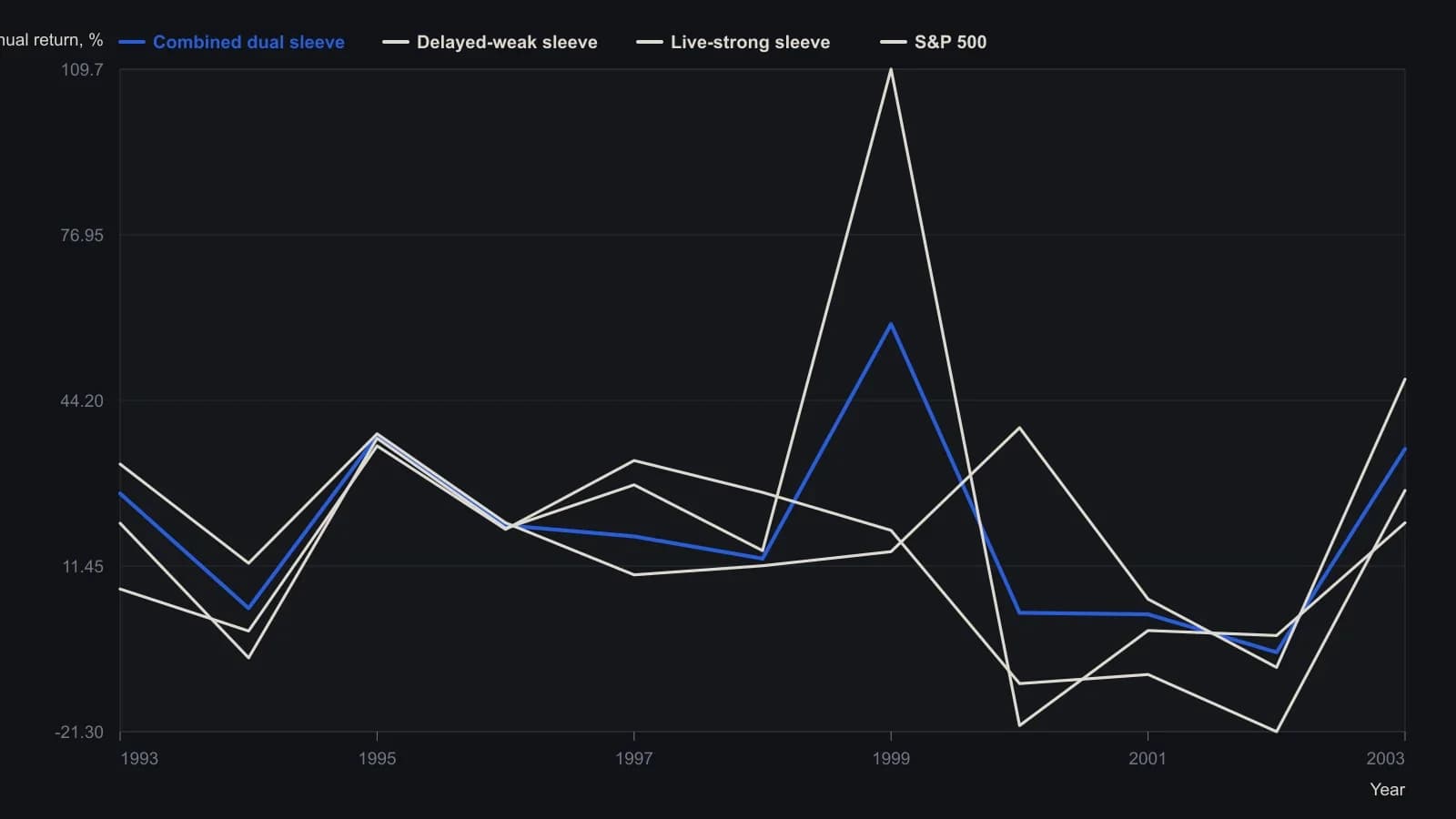
Weak names are the five worst 500-day Fidelity Select performers as of one year earlier; strong names are the five best over the latest 240 trading days. The book is resized at the close of the first session of each quarter.
Editorial reading
Editorial interpretation: treat the two rank rules, the equal-weight counts, and the shared quarterly calendar as one testable procedure. Score the delayed-weak sleeve and the live-strong sleeve together. Do not read the workflow as a contest to name a lasting industry-style winner.
All readings on this track · 10 readings
- 2001Constructing relative-strength ratios for spreads and rotation
- 2001Sector rotation, timing and leverage as a regime case study
- 2004Read one stock idea as a late-cycle puzzle
- 2004Always-on delayed-weak and live-strong sector sleeves
- 2012Building a sector-rotation histogram from rate-of-change spreads
- 2012Constructing a bull-bear sector rotation overlay
- 2012A relative-performance heatmap for pairs trading and sector rotation
- 2014Evaluating an annual contrarian sector rank-rotation
- 2014A ranking workflow that treated sector rotation as an abstention procedure
- 2015A nine-sector sleeve drill on the business-cycle map