1996issue C111-8
Value filter then rank-rotate as one procedure
Popular stock selection often argued from a few favorable examples. This case treats portfolio construction as one mechanical procedure: a cheapness eligibility gate, a fixed-size rank-rotation of the survivors, and an explicit ban on name-level overrides.
- Popular writing on stock selection often argued from a few favorable examples and did not classify issues by the factors that define them.
- A cloning procedure records a manager's holdings, measures how those names deviate from the market on fundamental factors, and screens a broad universe for the same deviations.
- One mechanical construction required a price-to-sales ratio below 1, then rank-rotated into the 50 strongest relative-strength names rather than selecting issues by story or reputation.
- When simple and elaborate decision stories compete, the simplest rule set that meets the stated criteria was treated as the one to keep, and case-by-case overrides were treated as the usual failure mode.
Examples are not a factor map
Popular writing on stock selection often argued from a few favorable examples and did not classify issues by the factors that define them.
A cloning procedure records a manager's holdings, measures how those names deviate from the market on fundamental factors, and screens a broad universe for the same deviations. Within a given style segment, leading portfolios were described as sharing the same few factor tilts even when security names, stated styles, and industries differed.
Style popularity and the style-cycle
Style popularity was attributed to observers overweighting recent years. As more participants adopt a recently successful style, its results were said to revert toward the market mean.
Editorial vocabulary for that pattern is the style-cycle: a factor approach attracts a crowd after a short favorable run and then reverts toward the market mean.
Two mechanical screens after cheapness
The factor tests annually rebalanced two capitalization-defined universes from 1952 through 1994 after ranking names on price-to-sales, price-to-earnings, and related measures.
One mechanical construction required a price-to-sales ratio below 1, then rank-rotated into the 50 strongest relative-strength names rather than selecting issues by story or reputation.
A second multi-step mechanical screen required a price-to-sales ratio below 1.5, five consecutive years of earnings gains regardless of magnitude, then bought the 50 strongest price performers.
Consolidated Stores weekly closes after the Cornerstone Growth screen
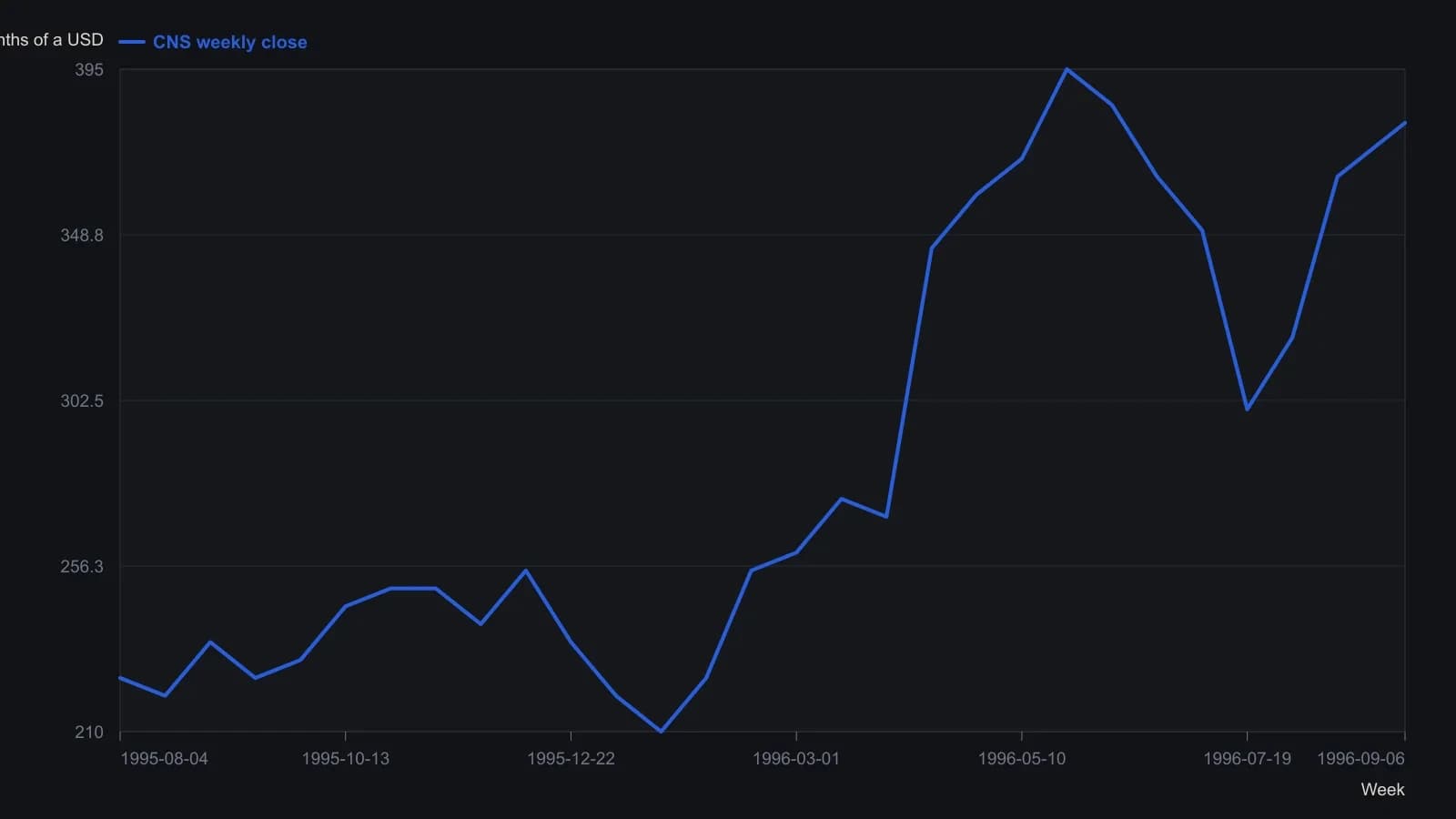
Visual readings of weekly OHLC closes, rounded to 5 points on the printed CQG scale (tenths of a USD). Wicks were not carried over; the last printed quote on the plot is 380.
Width, parsimony, and strategy-indexing
A 50-name list was preferred over a 10-name subset because the narrower sample was expected to raise volatility and make it harder to stay with the procedure.
When simple and elaborate decision stories compete, the simplest rule set that meets the stated criteria was treated as the one to keep, and case-by-case overrides were treated as the usual failure mode. The working term for that preference is parsimony: keeping the simplest rule set that still meets every stated criterion.
Strategy-indexing was defined as passively implementing a pretested active rule set and refusing discretionary overrides based on intuition.
All readings on this track · 16 readings
- 1988A two-rule classroom book of cheapness and new highs
- 1995A supermarket-chain case for yield, trendline, and a written checklist
- 1996Annual normalized-yield rank rotation for cyclical sleeves
- 1996Value filter then rank-rotate as one procedure
- 1997Dow high-yield rank rotation as a testable portfolio procedure
- 1998Low relative P/E plus a trendline reversal for regime-aware stock selection
- 1998Rank rotation, value screens, and ten-stock diversification
- 2001Earnback period ranking for growth-adjusted screens
- 2003Stress-testing calendar yield rotation in a declining tape
- 2003A value overlay and strangle hedge during a growth-led regime
- 2005Unfashionable value versus momentum in the book
- 2007Why premove fundamentals rarely flag tenfold-price moves
- 2012Year-end yield rank rotation with a collapse veto
- 2015A five-name January book from yield and price ranks
- 2017Screening value traps with regime-aware overlays
- 2017A pre-trade fail test for the cheap-looking name