1998issue C121-12
Walk-forward evaluation of recursive yen trend signals
The archive separated a constant-level smoother from a straight-line forecast, gated their gap with dollar thresholds, and accepted the long and short rules only after walk-forward windows kept those thresholds stable on the next unseen year.
- A back-adjusted continuous yen series is assembled from quarterly contracts for research, but it cannot match live trading once rollover costs and execution slippage enter the record.
- A recursive estimate updates the next-day price from a few lagged estimates plus the current close, becoming an exponential moving average under a constant-level model and a one-step recursive trendline under a straight-line model.
- The trend oscillator is the gap between that forecast and the exponential average, and both long and short entries are taken on the close only after the gap clears a dollar threshold.
- Walk-forward windows fitted lookback and both dollar thresholds on successive five-year samples, applied each set to the next unseen year, and kept a candidate only when nearby values were stable and consecutive losses stayed limited.
A single testable procedure
The archive specified a recursive yen trend system as one procedure. A constant-level smoother, a straight-line forecast, and dollar-up and dollar-down thresholds were fitted together rather than judged as separate parts.
Walk-forward evaluation was the acceptance step. Parameters from each in-sample window were applied to the next unseen year before the long and short rules were treated as more than an in-sample curve-fit.
Continuous contracts are not live rolls
A continuous yen futures series was built from quarterly contracts by switching on rollover and back-adjusting the price gap so the history looks smooth. That continuous contract remains different from live rolls.
Results on that series cannot match live trading because of rollover costs and execution slippage. Percentage-of-price rules applied to a back-adjusted continuous series can also be distorted, because each rollover difference is written back into earlier prices.
Recursive estimates instead of daily refits
Recursive polynomial fitting updates the next-day price estimate from a few lagged estimates plus the current close. It does not re-solve a least-squares straight line over a large block of past closes each day. That update is a recursive estimate.
Under a constant-level model the recursion reduces to an exponential moving average, a slowly updating mean that treats price as reverting toward a measured level. Under a degree-one linear model the same recursion produces a recursive trendline, treated as a one-step forecast of price if the recent path is a line with a changing slope.
A trend oscillator gated by dollar thresholds
The system oscillator is the gap between that one-step trendline forecast and the exponential moving average. The gap is the trend oscillator used to decide whether a directional move exceeds ordinary daily noise.
The system goes long when the gap exceeds a dollar-up threshold and short when the gap falls below a negative dollar-down threshold. Both entries are taken on the close. Each dollar threshold is the minimum oscillator displacement, up or down, required before a signal is issued.
Recursive yen trendline versus exponential average, 1988–89
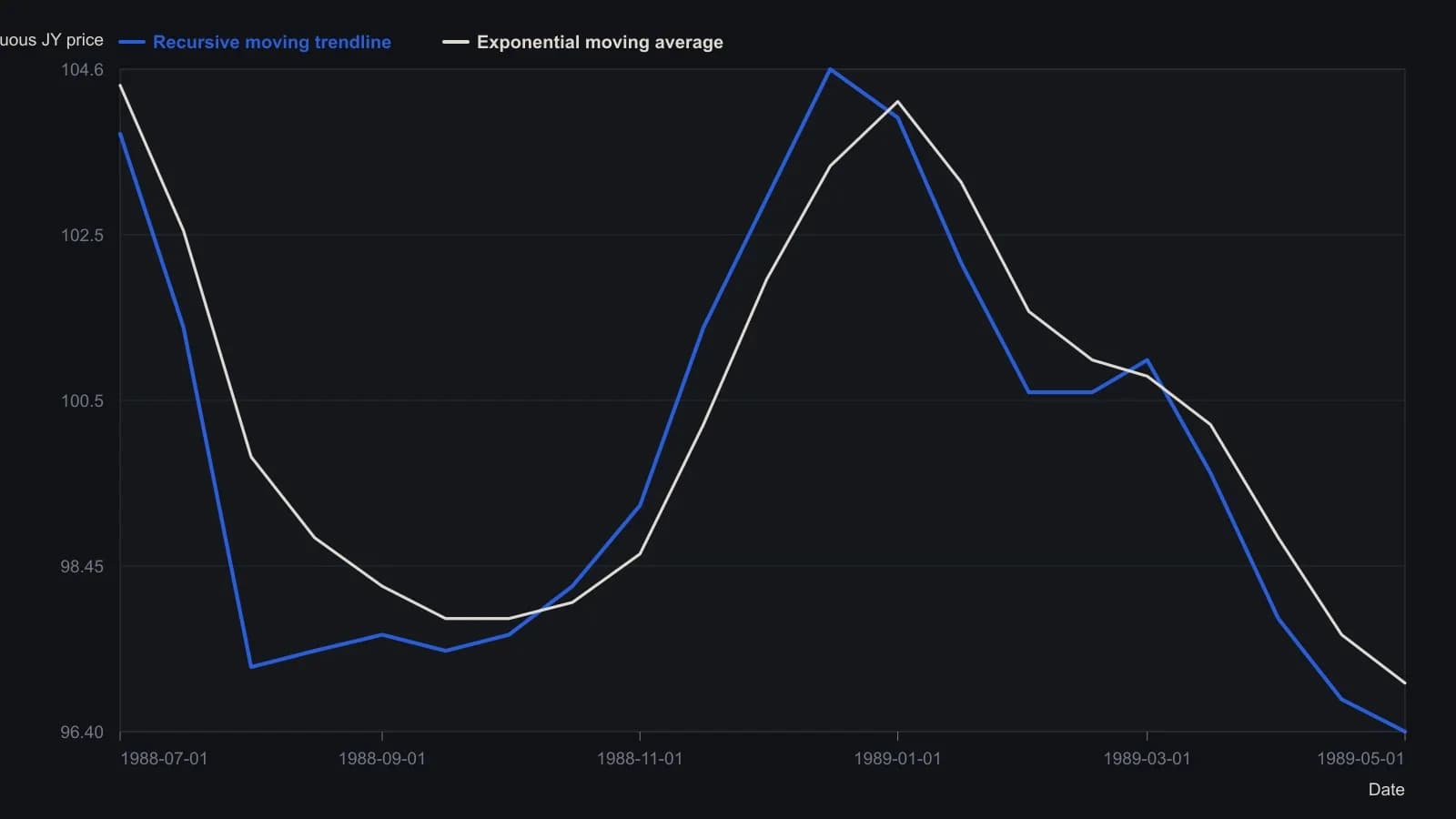
The source uses a back-adjusted continuous JY contract, so these prices are not live exchange quotes and will not match rolled executions. Overlay readings were digitized from the raster to about 0.2 point.
Walk-forward windows and stable parameters
Walk-forward evaluation fitted three parameters: lookback length converted to a smoothing constant, plus the dollar-up and dollar-down thresholds. Each walk-forward window was a fixed-length in-sample segment. The fit from that segment was then applied to the next unseen year, and those years were merged into one out-of-sample record.
The windows themselves were successive five-year samples. Candidate parameter sets were kept only when nearby values left results nearly unchanged and consecutive losses stayed at four or fewer. An in-sample optimum was treated as a curve-fit until the following year was checked.
Across six successive five-year windows the selected lookback and threshold values changed little. That stability was taken as a check that five years of data were enough to stabilize the next out-of-sample year.
How the walk-forward signals behaved
Charted walk-forward signals held established yen trends once those trends had formed. Sudden reversals, gaps, and choppy stretches produced most of the losses.
Reported drawdown and run-up percentages were computed on full contract notional. The same equity move would appear larger if it were restated against futures margin rather than against the full contract.
All readings on this track · 50 readings
- 1990Three-window walk-forward system evaluation
- 1990Building the construction layer of a mechanical trading system
- 1991Constructing walk-forward neural trading rules
- 1991Constructing neural trading systems from facts to walk-forward
- 1992Walk-forward evaluation of stop overlays on average crossovers
- 1992Audit mechanical system tests for fills and regimes
- 1993Walk-forward evaluation of monthly yield and real-rate forecasts
- 1993Constructing walk-forward forecasts with linear and moving-average baselines
- 1993Walk-forward hybrid rules for intermarket forecast stacks
- 1994Neural-net construction as a mechanical trading-system problem
- 1995Constructing an intermarket neural net trading system
- 1996Weekly market breadth as one procedure on an unused window
- 1996Walk-forward evaluation of gold-index bond-fund rules
- 1996Evaluating weekday-in-month filters for index day trades
- 1996Require both a trend filter and a cycle oscillator before entry
- 1997Walk-forward windows as a diagnostic of parameter instability
- 1997Walk-forward validation of a market-breadth timing rule
- 1997Sunspot spikes and walk-forward evaluation of an adaptive cycle rule
- 1997A walk-forward check for bond-breadth timing
- 1998Walk-forward audit of regression trend forecasts
- 1998Evaluating a cubic least-squares currency trend with walk-forward segments
- 1998Walk-forward evaluation of recursive yen trend signals
- 1999Personal system design under crowd psychology
- 1999Walk-forward evaluation of a polynomial price forecast
- 2000Walk-forward optimization of regression-slope-angle rules
- 2001Construct a winter seasonal window as one procedure
- 2001Inspectable rules when system write-ups dry up
- 2002Evaluating mechanical systems before position sizing
- 2003Walk-forward construction of rule-based market-position systems
- 2007Evaluating metal seasonal windows across regimes
- 2007Evaluating mechanical timing systems against hold baselines
- 2011Walk-forward reoptimization as a system design gate
- 2011Evaluate generated systems on holdouts, then add stops
- 2012Walk-forward analysis and out-of-sample tests for a mechanical trading system
- 2012Personality-first trading system design
- 2012Scorecard-first mechanical system construction
- 2012Constructing an advancer-decliner moving average for market breadth
- 2012Formula search as mechanical system construction
- 2013Identity-first system construction
- 2013Construct a swing system from bias rules to walk-forward
- 2014Evaluate mechanical stock systems with stops and walk-forward
- 2014Walk-forward velocity filters on noisy intraday trends
- 2015Event-predictability versus position-constrained rules
- 2015Constructing mechanical systems for walk-forward tests
- 2016When a tested system must be retired
- 2016Walk-forward metric filters and chance-level checks for selected inputs
- 2018Evaluate mechanical trading systems without catalog rankings
- 2019Phased stop construction from entry risk to trailing exit
- 2020Stockpiling simple ideas for mechanical system construction
- 2020A pretty first draft is not a walk-forward waiver