2007issue C131-4
Evaluating mechanical timing systems against hold baselines
A mechanical timing book is evaluated in layers: a taxed passive-hold baseline, a zero-lag reference smoother that can only be a historical ceiling, and a delayed-confirmation rule that is then walked forward. Candlestick-pattern signals are admitted only when regime match says the instrument's trend and volatility favor in-and-out trading rather than holding.
- Score the passive-hold baseline with the same instrument, commissions, omitted dividends, and one-year tax switch used for the active book, so ignored costs cannot flatter timing.
- Treat the zero-lag reference smoother as a non-tradable ceiling, because lookahead uses later closes that were not knowable at the next-open fill.
- Confirm a turn with later sessions, then replay that fixed mechanical timing book in a walk-forward check on later dates and other symbols.
- Use regime match so a candlestick-pattern signal is tested only on names whose trend and volatility suit trading rather than a multi-year hold.
Why the control comes first
Evaluating a mechanical timing book starts with costs and a hold control, not with a finished chart. The archive workflow treated a broad equity index as one tradable instrument, omitted dividends, applied fixed tax rates that switched at a one-year holding period, and deducted commissions so an active book would not be favored merely by ignored costs.
Score the passive-hold baseline
The passive-hold baseline is a multi-year long-only control scored with the same instrument, commissions, and holding-period tax rules used for active books. The archive scan used hold periods longer than two years from 1972 through 2004 and scored each hypothetical round trip from that day's average of high and low in the entry year to the same average in the exit year, after a $30 round-turn commission and a 15% long-term tax.
Different entry and exit year pairs inside that multi-year hold grid produced different after-tax compounded rates. Calendar timing was therefore treated as material even when no intra-year trading was allowed.
Separate the ceiling from a live book
The mechanical reference rule bought when the slope of a six-day smoothed close flipped up and sold when it flipped down, with fills at the next open. Because the smoother needed later closes, that path was an unrealizable historical ceiling rather than a live procedure. The later prices inside the smoother are lookahead: the historical test marks turns that were not knowable at the fill.
A delayed-confirmation variant executed at the open on the third session after the reference turn so two later observations could validate the slope change before the mechanical timing book acted. The active assumptions withdrew estimated 28% short-term tax from the account each quarter, reused proceeds on the next buy signal, paid $30 per round turn, held cash at zero interest between signals, and still excluded dividends.
S&P 500 optimal-timing net ARR, 1972–2004
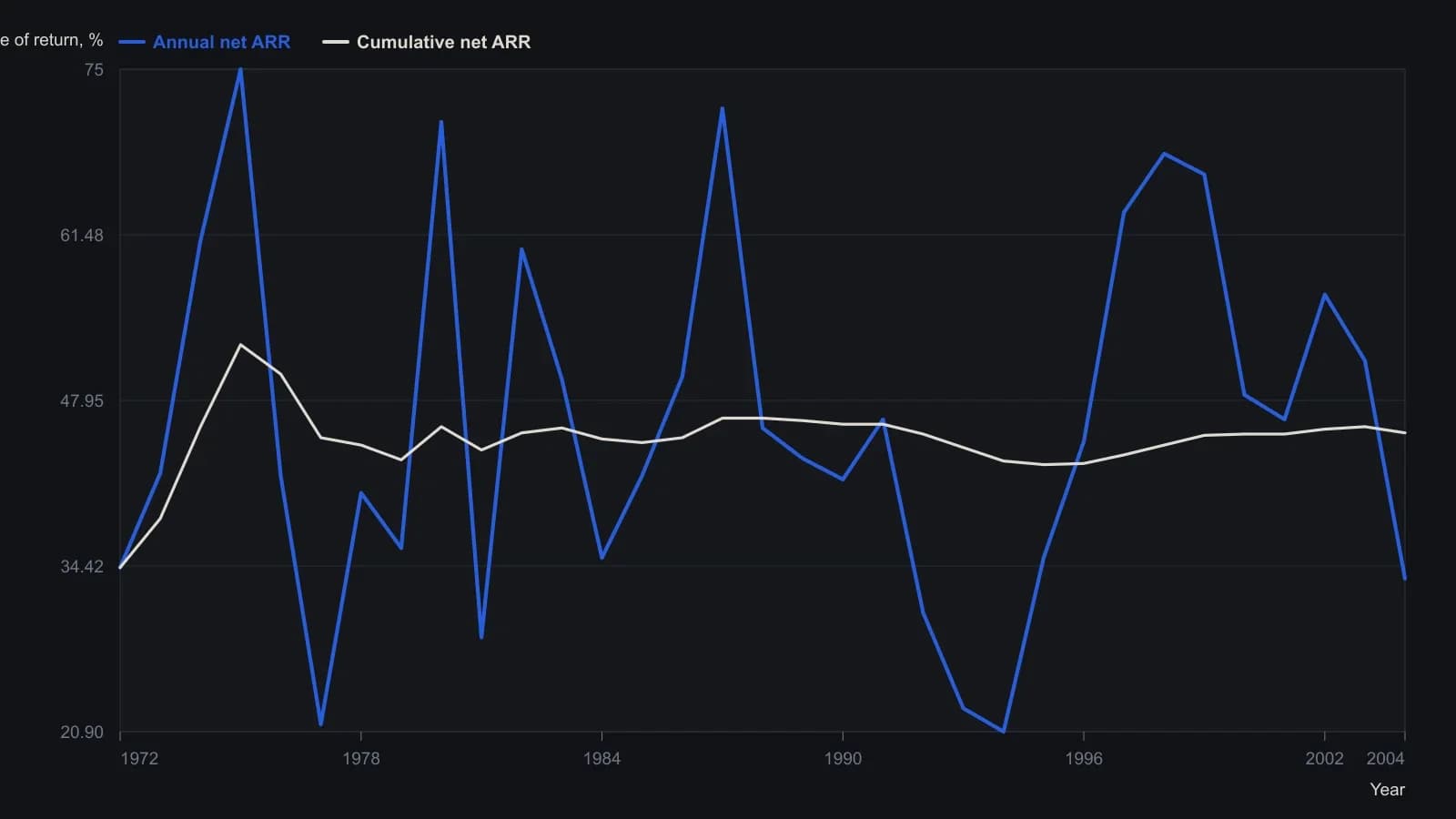
The six-day curve is fitted on the full historical close series, so each turning point uses future prices and cannot be traded in real time. Fills are the next open at 0.10 of the index; cash earns nothing between exits. The source counts 518 trades, 497 winners, and a taxed 1972–2004 terminal value of $1,986,092,018.
Replay the locked procedure
After the reference design was locked, the same three procedures were walked onto a later window from July 2003 to March 2005 and onto two single-stock series. That walk-forward check keeps the mechanical timing book fixed. A low-volatility advance favored the passive hold, while a more volatile name created more in-and-out swings even when its period trend was weaker.
Trend and volatility readings were the filter for which mechanical procedure to apply. That is regime match: choose hold versus in-and-out rules from the instrument's prevailing trend and volatility rather than applying one book to every name.
Live patterns as stand-ins, not ceilings
The evaluation framed oscillators, candlestick patterns, and other chart structures as candidate live signals meant to approximate the reference turning points. A candlestick-pattern signal is a repeatable open-high-low-close structure used as a live, falsifiable stand-in for a turning-point hypothesis.
On end-of-day data, shortening the smoother well below six days increased whipsaw trades, while lengthening it reduced the number of turns and left some swings unused. Editorial reading: a live pattern has to mark turns that delayed confirmation could have taken, in a market that regime match has already judged suitable for a mechanical timing book rather than a passive hold.
All readings on this track · 50 readings
- 1990Three-window walk-forward system evaluation
- 1990Building the construction layer of a mechanical trading system
- 1991Constructing walk-forward neural trading rules
- 1991Constructing neural trading systems from facts to walk-forward
- 1992Walk-forward evaluation of stop overlays on average crossovers
- 1992Audit mechanical system tests for fills and regimes
- 1993Walk-forward evaluation of monthly yield and real-rate forecasts
- 1993Constructing walk-forward forecasts with linear and moving-average baselines
- 1993Walk-forward hybrid rules for intermarket forecast stacks
- 1994Neural-net construction as a mechanical trading-system problem
- 1995Constructing an intermarket neural net trading system
- 1996Weekly market breadth as one procedure on an unused window
- 1996Walk-forward evaluation of gold-index bond-fund rules
- 1996Evaluating weekday-in-month filters for index day trades
- 1996Require both a trend filter and a cycle oscillator before entry
- 1997Walk-forward windows as a diagnostic of parameter instability
- 1997Walk-forward validation of a market-breadth timing rule
- 1997Sunspot spikes and walk-forward evaluation of an adaptive cycle rule
- 1997A walk-forward check for bond-breadth timing
- 1998Walk-forward audit of regression trend forecasts
- 1998Evaluating a cubic least-squares currency trend with walk-forward segments
- 1998Walk-forward evaluation of recursive yen trend signals
- 1999Personal system design under crowd psychology
- 1999Walk-forward evaluation of a polynomial price forecast
- 2000Walk-forward optimization of regression-slope-angle rules
- 2001Construct a winter seasonal window as one procedure
- 2001Inspectable rules when system write-ups dry up
- 2002Evaluating mechanical systems before position sizing
- 2003Walk-forward construction of rule-based market-position systems
- 2007Evaluating metal seasonal windows across regimes
- 2007Evaluating mechanical timing systems against hold baselines
- 2011Walk-forward reoptimization as a system design gate
- 2011Evaluate generated systems on holdouts, then add stops
- 2012Walk-forward analysis and out-of-sample tests for a mechanical trading system
- 2012Personality-first trading system design
- 2012Scorecard-first mechanical system construction
- 2012Constructing an advancer-decliner moving average for market breadth
- 2012Formula search as mechanical system construction
- 2013Identity-first system construction
- 2013Construct a swing system from bias rules to walk-forward
- 2014Evaluate mechanical stock systems with stops and walk-forward
- 2014Walk-forward velocity filters on noisy intraday trends
- 2015Event-predictability versus position-constrained rules
- 2015Constructing mechanical systems for walk-forward tests
- 2016When a tested system must be retired
- 2016Walk-forward metric filters and chance-level checks for selected inputs
- 2018Evaluate mechanical trading systems without catalog rankings
- 2019Phased stop construction from entry risk to trailing exit
- 2020Stockpiling simple ideas for mechanical system construction
- 2020A pretty first draft is not a walk-forward waiver