1998issue C111-13
Evaluating a cubic least-squares currency trend with walk-forward segments
A least-squares cubic forecast is refit each day on recent closes and read one step ahead, then turned into long and short switches. Five successive five-year walk-forward segments selected lookbacks of 40 or 44 days, with most percentage thresholds remaining in a narrow range.
- A least-squares cubic forecast is refit each day on the last stretch of closes and then read one step ahead as the next-day close estimate.
- A percent reversal rule goes long when that curve rises by a set percentage from its prior low and goes short when it falls by a set percentage from its prior high, with an optional jump filter on a two-day change in the forecast.
- Across five successive five-year walk-forward segments, selected lookbacks stayed at 40 or 44 days and most percentage thresholds stayed in a narrow range rather than jumping from window to window.
- A back-adjusted British pound continuous futures series cannot match live rollover costs or execution slippage, and percentage-of-price rules are distorted by that back-adjustment.
The least-squares cubic forecast and the switch rules
A rolling least-squares cubic is refit each day on the last T closes and then evaluated one step ahead. That one-step reading is the least-squares cubic forecast for the next close.
The trading procedure follows that forecast. A percent reversal rule goes long when the curve rises by a stated percentage from its prior low and goes short when the curve falls by a stated percentage from its prior high.
An optional jump filter can override those slower switches. It goes long or short when the forecast itself changes by a stated percentage versus the forecast two days earlier.
Walk-forward segments and parameter range
Five successive five-year walk-forward segments, from 1989-1993 through 1993-1997, selected the lookback and the percentage thresholds and then carried those choices onto the next unseen interval.
Those windows selected lookbacks of 40 or 44 days. Most of the percentage thresholds remained in a narrow range rather than jumping from window to window.
In-window summaries from the first two segments
On the first two in-window summaries, the 1989-1993 segment recorded 66 trades with 53 percent profitable and a 2.079 profit factor. The 1990-1994 segment recorded 83 trades with 57 percent profitable and a 2.047 profit factor.
Those same two summaries reported maximum intraday drawdowns of $9,300 and $9,687.50. Average winning trades lasted longer than average losing trades, 23 versus 13 bars and then 18 versus 11 bars.
Editorial reading: those figures describe the windows that chose the parameters. They are not a substitute for asking whether the next unseen interval still used a nearby lookback and nearby percentage thresholds.
A dated buy that remains checkable
A buy dated September 30, 1992, during the decline from about 185 to 130, produced a loss of $8,988. Excluding that episode reduced drawdowns to about $5,000 and worst trades to about $2,000.
Editorial reading: the point of keeping the episode visible is that an out-of-sample turn can still be checked against the price path. Removing it to tidy a drawdown figure is a separate, weaker claim.
British pound continuous futures and cubic forecast, July 1997–May 1998
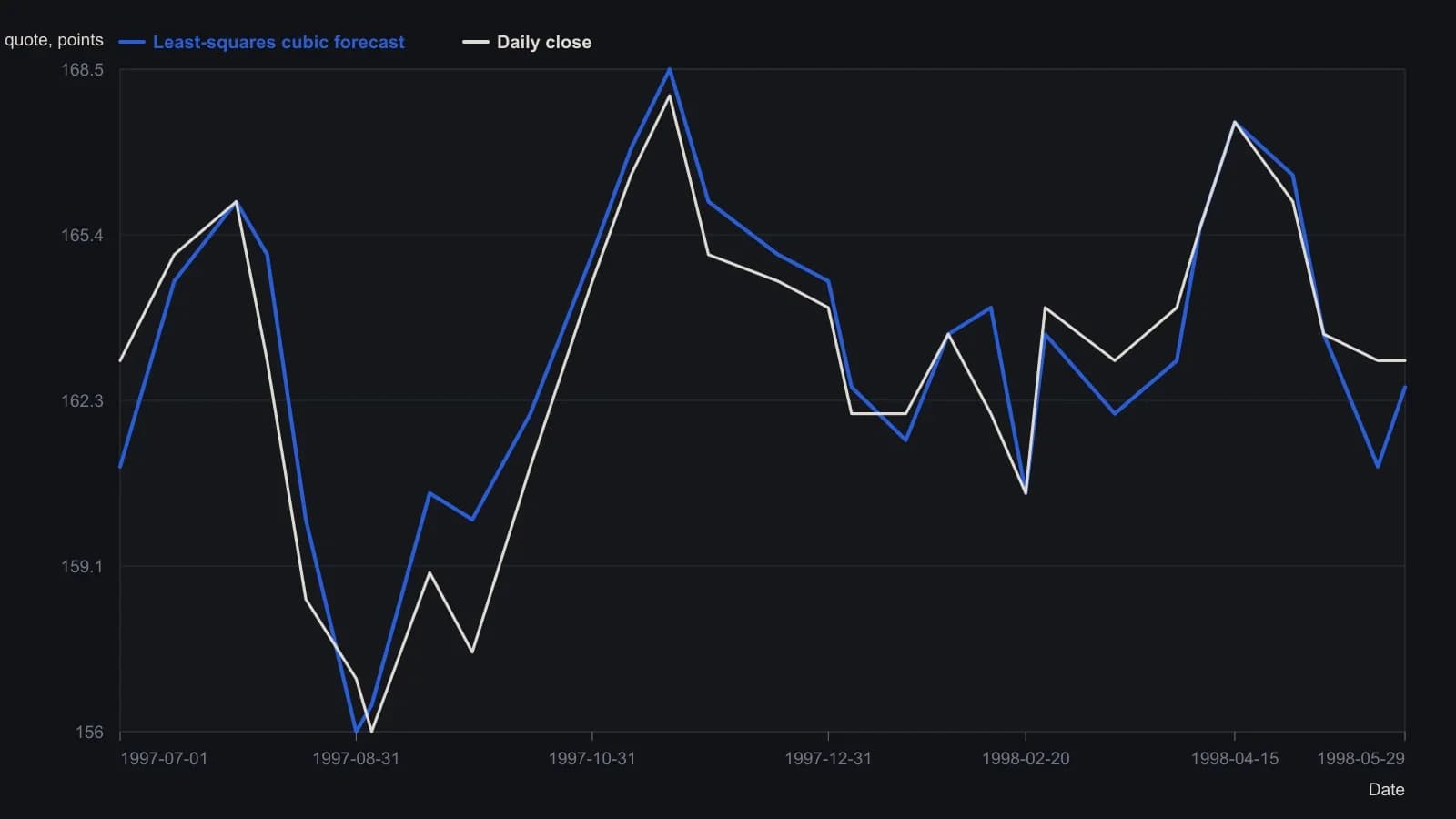
Quotes are Meyers' back-adjusted continuous CME contract, not a single expiry. Raster readings are to the nearest half point. The 1997–98 switches come from the five-year windows that selected a 40-day lookback.
The continuous-contract caveat
The study uses a back-adjusted British pound continuous futures series from January 1, 1989 onward. Such a series cannot match live rollover costs or execution slippage, and percentage-of-price rules are distorted by the back-adjustment.
All readings on this track · 50 readings
- 1990Three-window walk-forward system evaluation
- 1990Building the construction layer of a mechanical trading system
- 1991Constructing walk-forward neural trading rules
- 1991Constructing neural trading systems from facts to walk-forward
- 1992Walk-forward evaluation of stop overlays on average crossovers
- 1992Audit mechanical system tests for fills and regimes
- 1993Walk-forward evaluation of monthly yield and real-rate forecasts
- 1993Constructing walk-forward forecasts with linear and moving-average baselines
- 1993Walk-forward hybrid rules for intermarket forecast stacks
- 1994Neural-net construction as a mechanical trading-system problem
- 1995Constructing an intermarket neural net trading system
- 1996Weekly market breadth as one procedure on an unused window
- 1996Walk-forward evaluation of gold-index bond-fund rules
- 1996Evaluating weekday-in-month filters for index day trades
- 1996Require both a trend filter and a cycle oscillator before entry
- 1997Walk-forward windows as a diagnostic of parameter instability
- 1997Walk-forward validation of a market-breadth timing rule
- 1997Sunspot spikes and walk-forward evaluation of an adaptive cycle rule
- 1997A walk-forward check for bond-breadth timing
- 1998Walk-forward audit of regression trend forecasts
- 1998Evaluating a cubic least-squares currency trend with walk-forward segments
- 1998Walk-forward evaluation of recursive yen trend signals
- 1999Personal system design under crowd psychology
- 1999Walk-forward evaluation of a polynomial price forecast
- 2000Walk-forward optimization of regression-slope-angle rules
- 2001Construct a winter seasonal window as one procedure
- 2001Inspectable rules when system write-ups dry up
- 2002Evaluating mechanical systems before position sizing
- 2003Walk-forward construction of rule-based market-position systems
- 2007Evaluating metal seasonal windows across regimes
- 2007Evaluating mechanical timing systems against hold baselines
- 2011Walk-forward reoptimization as a system design gate
- 2011Evaluate generated systems on holdouts, then add stops
- 2012Walk-forward analysis and out-of-sample tests for a mechanical trading system
- 2012Personality-first trading system design
- 2012Scorecard-first mechanical system construction
- 2012Constructing an advancer-decliner moving average for market breadth
- 2012Formula search as mechanical system construction
- 2013Identity-first system construction
- 2013Construct a swing system from bias rules to walk-forward
- 2014Evaluate mechanical stock systems with stops and walk-forward
- 2014Walk-forward velocity filters on noisy intraday trends
- 2015Event-predictability versus position-constrained rules
- 2015Constructing mechanical systems for walk-forward tests
- 2016When a tested system must be retired
- 2016Walk-forward metric filters and chance-level checks for selected inputs
- 2018Evaluate mechanical trading systems without catalog rankings
- 2019Phased stop construction from entry risk to trailing exit
- 2020Stockpiling simple ideas for mechanical system construction
- 2020A pretty first draft is not a walk-forward waiver