2007issue C021-3
Evaluating metal seasonal windows across regimes
A metal calendar is treated as a disposable hypothesis: encode last-week entry and exit as one seasonal-trading procedure, search buy and sell months as system-optimization inputs, then use walk-forward-analysis and simulated fills to see whether the window still exists.
- Commodity futures are treated as having firmer supply-and-demand calendars than equities, so season is a core design input rather than an optional overlay.
- Each metal has its own drivers, so a seasonal window fitted on one metal is not assumed to transfer to another.
- When months are unknown, system-optimization searches buy-month and sell-month on a last-week rule; walk-forward-analysis then re-tests unused dates and simulated fills.
- If the same calendar test is inconsistent across date windows, the candidate is discarded. If a fitted buy date arrives on new highs, confirming technicals decide whether to act.
Season as a core design input
Commodity futures are presented as having firmer supply-and-demand calendars than equities, so timing by season is treated as a core design input rather than an optional overlay. Weather-linked recovery and seasonal demand, for example year-end jewelry demand, are given as reasons metals have calendars, while each metal is said to have its own drivers, so one metal's seasonal window is not assumed to fit another.
A published gold seasonal that looked different
A published gold seasonal with lows in late April and late July to early August, fitted on a 15-year sample, looked different on a 2000 to 2005 window, where a late-April low and a late-July low were followed by strength into year-end.
The last-week rule as one procedure
A last-week rule on weekly bars is encoded as buy when the month matches and day-of-month is at least 23, and sell under the same day rule in the exit month, so the program can locate the final week. Seasonal-trading is a calendar procedure that buys and sells in specified months, and optionally days, so the holding period itself is the signal.
Bounded search over month pairs
When the months are unknown, buy-month and sell-month are treated as system-optimization inputs over that last-week rule, producing a 12-by-12 grid of 144 backtests. Adding day-of-month variables and stepping every other day expands the search to 32,400 runs, or the search can be staged as months first, then days.
Metal-specific windows on one sample
The metals evaluation used weekly series from 4 January 1995 through 30 December 2005 (573 weeks, 4,011 days) and reported metal-specific windows: gold July to December, silver August to March, palladium November to March, platinum September to February, and copper April to February.
Weekly Engelhard gold, 1995–2005
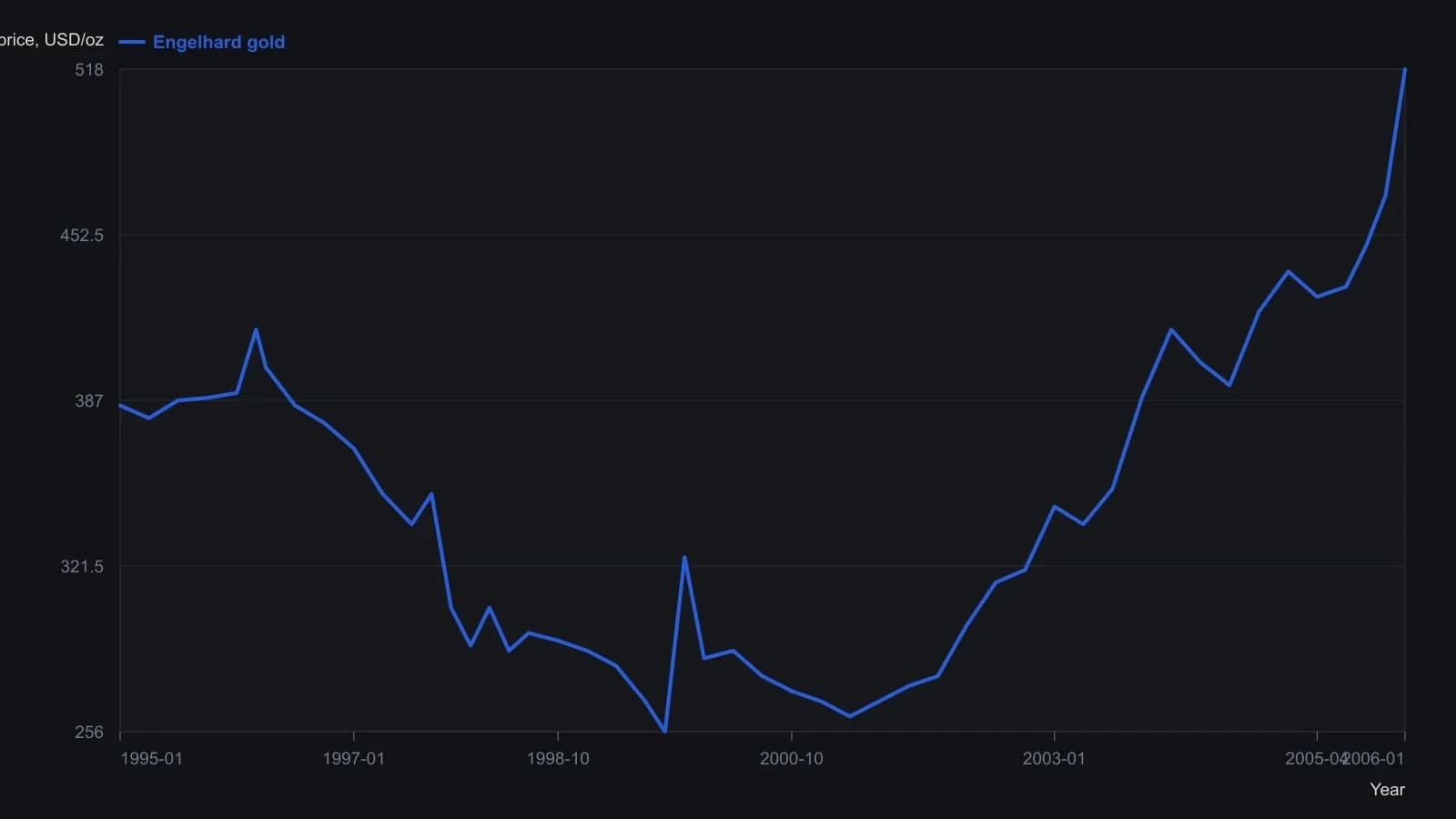
Digitized from the weekly price pane only. Readings are approximate to about five dollars; swings shorter than a quarter-year are not resolved. The source also draws a separate seasonal-system equity curve in the upper pane on a different scale, which is not included.
Unused dates, fills, and discard rules
After in-sample fitting, the procedure requires a separate out-of-sample window. If that holds, the next gate is simulated execution on live data and fills, because a rule that only works on the design sample is treated as overfit. Walk-forward-analysis re-tests a fitted calendar on unused dates, then under simulated live fills, to see whether the seasonal window survives a new regime.
If repeating the same calendar test across different date windows fails to produce consistent results, the market is treated as having no usable cycle or a cycle that changes too often, and the candidate is discarded.
Confirming technicals when the date conflicts
If a fitted seasonal buy date arrives while the market is making new highs, the calendar is not used alone: trend and support checks decide whether to act, with a break of support ending the trade. Those confirming technicals are independent trend or support checks used when the calendar date arrives in a conflicting market state.
All readings on this track · 50 readings
- 1990Three-window walk-forward system evaluation
- 1990Building the construction layer of a mechanical trading system
- 1991Constructing walk-forward neural trading rules
- 1991Constructing neural trading systems from facts to walk-forward
- 1992Walk-forward evaluation of stop overlays on average crossovers
- 1992Audit mechanical system tests for fills and regimes
- 1993Walk-forward evaluation of monthly yield and real-rate forecasts
- 1993Constructing walk-forward forecasts with linear and moving-average baselines
- 1993Walk-forward hybrid rules for intermarket forecast stacks
- 1994Neural-net construction as a mechanical trading-system problem
- 1995Constructing an intermarket neural net trading system
- 1996Weekly market breadth as one procedure on an unused window
- 1996Walk-forward evaluation of gold-index bond-fund rules
- 1996Evaluating weekday-in-month filters for index day trades
- 1996Require both a trend filter and a cycle oscillator before entry
- 1997Walk-forward windows as a diagnostic of parameter instability
- 1997Walk-forward validation of a market-breadth timing rule
- 1997Sunspot spikes and walk-forward evaluation of an adaptive cycle rule
- 1997A walk-forward check for bond-breadth timing
- 1998Walk-forward audit of regression trend forecasts
- 1998Evaluating a cubic least-squares currency trend with walk-forward segments
- 1998Walk-forward evaluation of recursive yen trend signals
- 1999Personal system design under crowd psychology
- 1999Walk-forward evaluation of a polynomial price forecast
- 2000Walk-forward optimization of regression-slope-angle rules
- 2001Construct a winter seasonal window as one procedure
- 2001Inspectable rules when system write-ups dry up
- 2002Evaluating mechanical systems before position sizing
- 2003Walk-forward construction of rule-based market-position systems
- 2007Evaluating metal seasonal windows across regimes
- 2007Evaluating mechanical timing systems against hold baselines
- 2011Walk-forward reoptimization as a system design gate
- 2011Evaluate generated systems on holdouts, then add stops
- 2012Walk-forward analysis and out-of-sample tests for a mechanical trading system
- 2012Personality-first trading system design
- 2012Scorecard-first mechanical system construction
- 2012Constructing an advancer-decliner moving average for market breadth
- 2012Formula search as mechanical system construction
- 2013Identity-first system construction
- 2013Construct a swing system from bias rules to walk-forward
- 2014Evaluate mechanical stock systems with stops and walk-forward
- 2014Walk-forward velocity filters on noisy intraday trends
- 2015Event-predictability versus position-constrained rules
- 2015Constructing mechanical systems for walk-forward tests
- 2016When a tested system must be retired
- 2016Walk-forward metric filters and chance-level checks for selected inputs
- 2018Evaluate mechanical trading systems without catalog rankings
- 2019Phased stop construction from entry risk to trailing exit
- 2020Stockpiling simple ideas for mechanical system construction
- 2020A pretty first draft is not a walk-forward waiver