1997issue C081-10
Walk-forward validation of a market-breadth timing rule
This archive article restates a 1990s NYSE breadth workflow that used advancing and declining issues, volume, and new highs and new lows. Editorial reading: the case is taught here as a reminder that a market-timing rule is only as trustworthy as the walk-forward procedure that produced it.
- A relative-strength breadth model can stall in a lockout when the price-strength series reaches its bound before the advance-decline series, leaving the relative measure near zero and blocking later entries.
- Choosing indicator parameters by searching for the best in-sample result is treated as the same activity as curve-fitting, and an in-sample best fit is not a proof of later signal quality.
- Showcasing only selected historical episodes, or treating a single optimization over the entire sample as evidence of future behavior, is rejected as validation.
- After the rules were fixed, later walk-forward windows were inspected on out-of-sample segments, with buy and sell marks overlaid on the S&P 500 and on the breadth series used as inputs.
When a relative-strength breadth model locked out
A prior relative-strength breadth model could stall in a lockout when the price-strength series reached its bound before the advance-decline series. The relative measure then sat near zero and later entries were blocked.
A fully mechanical replacement
The replacement model was specified as a fully mechanical procedure. It used advancing and declining issues and volume plus new highs and new lows, rather than a relative-strength difference of two bounded oscillators.
In-sample search is treated as curve-fitting
In this construction, choosing indicator parameters by searching for the best in-sample result is treated as the same activity as curve-fitting. An in-sample best fit is not a proof of later signal quality.
Two common validation shortcuts are rejected. One is showcasing only selected historical episodes. The other is treating a single optimization over the entire sample as evidence of future behavior.
The same historical record, two rule sets
The turbo rule set was compared with the earlier relative-strength version on the same historical record. The newer version avoided the lockout that kept the older version out of the market from early October through year-end 1996.
Walk-forward windows after the rules were fixed
Charts of the later walk-forward windows overlay buy and sell marks on the S&P 500 together with the advancing-declining, volume, and new-high/new-low strength series used as inputs.
Out-of-sample segments were inspected after the rules were fixed. One window covered 1978-82 and used previously unseen data. Another covered 1982-86, in which the model stayed with the dominant advance while losing about 6% in the 1983-84 decline.
In the January 1996-to-publication out-of-sample stretch, the model stayed long except for brief exits around the July 1996 and March 1997 declines.
S&P 500 at each turbo A/D–NH–NL signal, 1978–1997
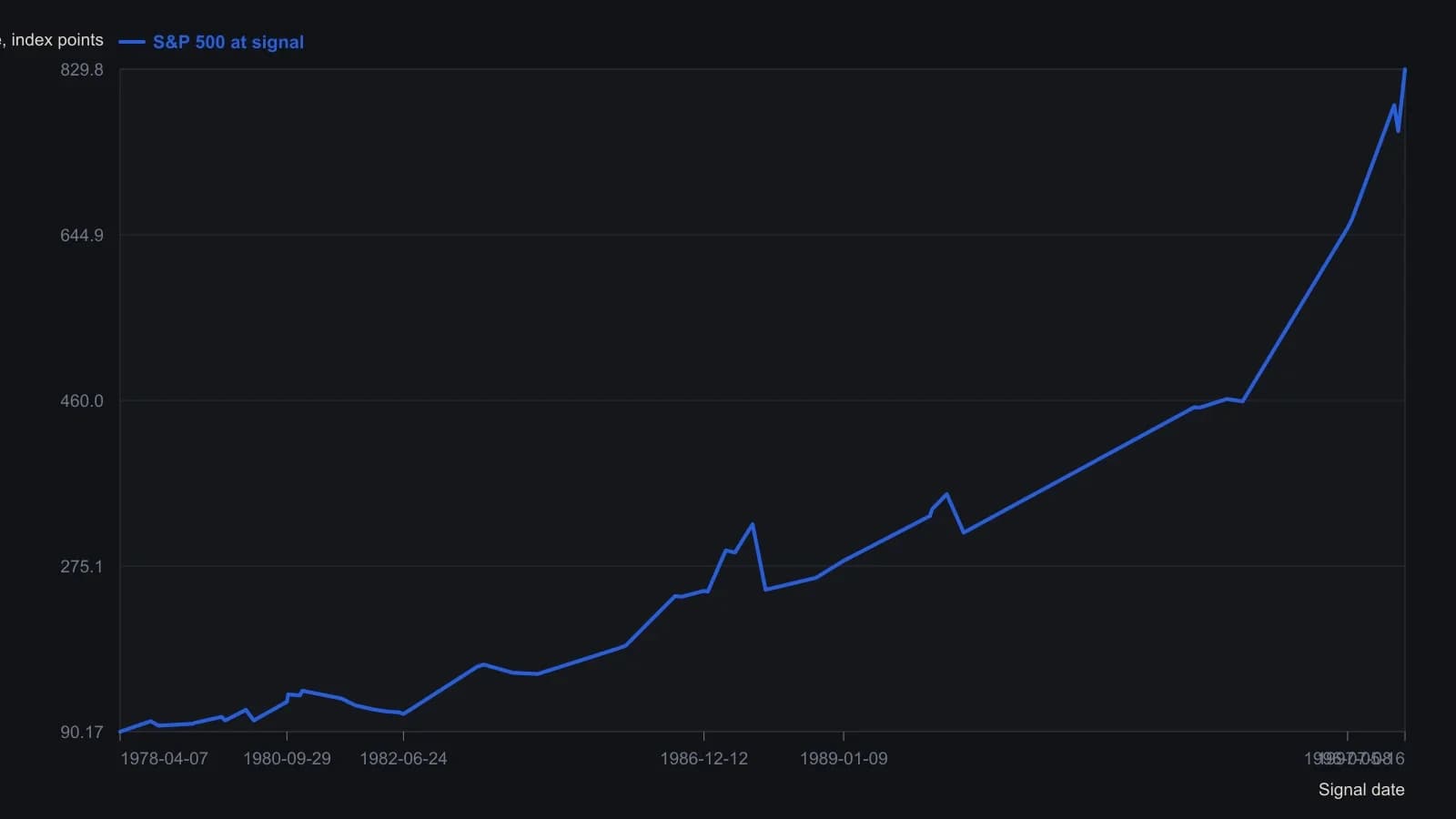
Parameters were fit on 1 Jan 1987–31 Dec 1995. Segment 2 (3 Jan 1978–27 Feb 1987) and segment 3 (1 Jan 1996–16 May 1997) are walk-forward. Sixteen free parameters, so the middle stretch is curve-fit by construction.
All readings on this track · 50 readings
- 1990Three-window walk-forward system evaluation
- 1990Building the construction layer of a mechanical trading system
- 1991Constructing walk-forward neural trading rules
- 1991Constructing neural trading systems from facts to walk-forward
- 1992Walk-forward evaluation of stop overlays on average crossovers
- 1992Audit mechanical system tests for fills and regimes
- 1993Walk-forward evaluation of monthly yield and real-rate forecasts
- 1993Constructing walk-forward forecasts with linear and moving-average baselines
- 1993Walk-forward hybrid rules for intermarket forecast stacks
- 1994Neural-net construction as a mechanical trading-system problem
- 1995Constructing an intermarket neural net trading system
- 1996Weekly market breadth as one procedure on an unused window
- 1996Walk-forward evaluation of gold-index bond-fund rules
- 1996Evaluating weekday-in-month filters for index day trades
- 1996Require both a trend filter and a cycle oscillator before entry
- 1997Walk-forward windows as a diagnostic of parameter instability
- 1997Walk-forward validation of a market-breadth timing rule
- 1997Sunspot spikes and walk-forward evaluation of an adaptive cycle rule
- 1997A walk-forward check for bond-breadth timing
- 1998Walk-forward audit of regression trend forecasts
- 1998Evaluating a cubic least-squares currency trend with walk-forward segments
- 1998Walk-forward evaluation of recursive yen trend signals
- 1999Personal system design under crowd psychology
- 1999Walk-forward evaluation of a polynomial price forecast
- 2000Walk-forward optimization of regression-slope-angle rules
- 2001Construct a winter seasonal window as one procedure
- 2001Inspectable rules when system write-ups dry up
- 2002Evaluating mechanical systems before position sizing
- 2003Walk-forward construction of rule-based market-position systems
- 2007Evaluating metal seasonal windows across regimes
- 2007Evaluating mechanical timing systems against hold baselines
- 2011Walk-forward reoptimization as a system design gate
- 2011Evaluate generated systems on holdouts, then add stops
- 2012Walk-forward analysis and out-of-sample tests for a mechanical trading system
- 2012Personality-first trading system design
- 2012Scorecard-first mechanical system construction
- 2012Constructing an advancer-decliner moving average for market breadth
- 2012Formula search as mechanical system construction
- 2013Identity-first system construction
- 2013Construct a swing system from bias rules to walk-forward
- 2014Evaluate mechanical stock systems with stops and walk-forward
- 2014Walk-forward velocity filters on noisy intraday trends
- 2015Event-predictability versus position-constrained rules
- 2015Constructing mechanical systems for walk-forward tests
- 2016When a tested system must be retired
- 2016Walk-forward metric filters and chance-level checks for selected inputs
- 2018Evaluate mechanical trading systems without catalog rankings
- 2019Phased stop construction from entry risk to trailing exit
- 2020Stockpiling simple ideas for mechanical system construction
- 2020A pretty first draft is not a walk-forward waiver