2013issue C0146-48
Identity-first system construction
Construction starts with trading identity, writes a complete rule set, and treats that set as finished only when walk-forward checks and the trader who must sit through the drawdowns still agree.
- Start construction by naming trading identity so later parameters stay aligned with intention, personality, and risk tolerance.
- A minimum rule set classifies market environment, then specifies setups, entries and exits, initial trade management, and money-management guidelines.
- Treat system optimization as valid only after walk-forward analysis, and only when the sample is not small and not confined to one regime.
- Keep the live system aligned through technical implementation of results and emotional implementation of the trader's conduct.
Construction as a fitness test
Editorial view: treat construction as a fitness test. A system is finished only when its entry, exit, and abstention rules can be explained simply, survive walk-forward analysis, and still match the trader who must sit through the drawdowns.
The archive describes a historical construction sequence. It starts with trader intention and personality, writes a complete rule set, records the performance of that full procedure, and only then treats optimization as something to check outside the fitted window.
Name trading identity first
System construction is started by identifying trader intention and personality so later rule parameters can be aligned with those constraints.
That order is the trading psychology process: a construction sequence that first names intention, identity, and emotional constraints, then writes rules the trader can actually execute.
Trading identity is the mix of motive, personality, and risk tolerance that system parameters are supposed to reflect. Editorial view: if the parameters ignore that mix, later testing can approve a procedure the trader will not sit through.
Write the minimum construction set
A minimum construction set includes rules for classifying the market environment, environment-specific setups, entries and exits, initial trade management, and money-management guidelines.
Market environment is a classified regime, such as trending or consolidating, against which setups and later rules are written. Those setups are environment-specific.
Use price-action construction first
A classroom construction drill writes rules from price action over time without moving averages, indicators, or volume, on the premise that many indicators are derived readings of price, volume, and time.
That drill is price-action construction: writing the first rule set from price behavior over time before adding derived indicators.
XLF weekly price with 10- and 40-week moving averages, 2011–2012
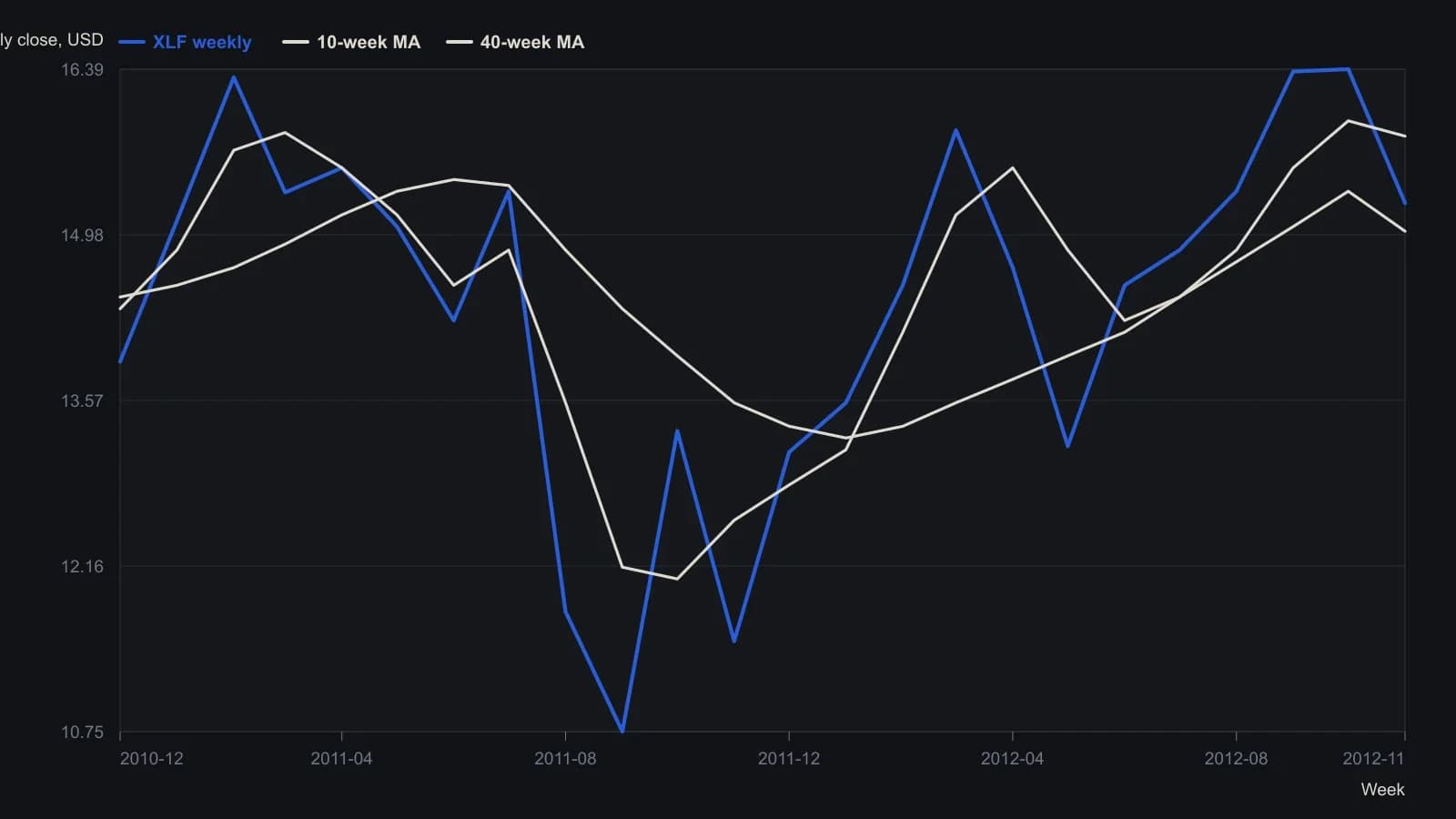
Values are approximate readings off the 16 Nov 2012 weekly chart. Price path is sampled from labeled highs/lows plus intermediate weekly closes; moving-average traces follow the plotted curves, not a recalculation. Snapshot OHLC that day: open 15.57, high 15.63, low 15.06, last 15.25.
Test the full procedure
After rules exist, historical testing records performance of the full procedure.
Manual testing is kept alongside that record. Manual testing means reading historical charts and recording rule outcomes by hand so environment-specific behavior is inspected, not only summarized. Chart review is kept because it trains visual memory and can surface environment-specific behavior that a computer summary may omit.
Read performance metrics as a keep-or-abandon check
Metric review covers profitability, positive expectancy, average win/loss, and drawdowns. Those performance metrics are historical measures used to keep or abandon a rule set.
The same review then asks whether the trader could tolerate those historical drawdowns and a larger one later. Editorial view: this is the point where a fully written procedure can still fail the fitness test if the person who must execute it cannot live with the path.
Check system optimization with walk-forward analysis
System optimization is searching parameter values for a finished rule set, then checking whether those values remain usable outside the fitted window.
Optimization is treated as valid only when its efficiency is checked with walk-forward analysis, and when testers avoid using a small sample or skipping mixed market conditions.
Walk-forward analysis is a sequential out-of-sample check of whether optimized parameters continue to behave after the fitting period.
Classroom testing guidance requires at least 50 to 100 trades and a data set that includes bullish, bearish, and consolidating conditions, because price velocity differs by regime.
Watch live results and live conduct
Implementation is split into technical monitoring of live deviation from tested results and emotional monitoring of live deviation from intended behavior, so the system remains aligned with the trader who must execute it.
Technical implementation is the ongoing comparison of live system results with previously tested behavior. Emotional implementation is the ongoing comparison of the trader's live conduct with the behaviors the system assumes.
Editorial view: construction is not complete at the last historical test. It stays complete only while both monitors still show the same system the trader agreed to sit through.
All readings on this track · 50 readings
- 1990Three-window walk-forward system evaluation
- 1990Building the construction layer of a mechanical trading system
- 1991Constructing walk-forward neural trading rules
- 1991Constructing neural trading systems from facts to walk-forward
- 1992Walk-forward evaluation of stop overlays on average crossovers
- 1992Audit mechanical system tests for fills and regimes
- 1993Walk-forward evaluation of monthly yield and real-rate forecasts
- 1993Constructing walk-forward forecasts with linear and moving-average baselines
- 1993Walk-forward hybrid rules for intermarket forecast stacks
- 1994Neural-net construction as a mechanical trading-system problem
- 1995Constructing an intermarket neural net trading system
- 1996Weekly market breadth as one procedure on an unused window
- 1996Walk-forward evaluation of gold-index bond-fund rules
- 1996Evaluating weekday-in-month filters for index day trades
- 1996Require both a trend filter and a cycle oscillator before entry
- 1997Walk-forward windows as a diagnostic of parameter instability
- 1997Walk-forward validation of a market-breadth timing rule
- 1997Sunspot spikes and walk-forward evaluation of an adaptive cycle rule
- 1997A walk-forward check for bond-breadth timing
- 1998Walk-forward audit of regression trend forecasts
- 1998Evaluating a cubic least-squares currency trend with walk-forward segments
- 1998Walk-forward evaluation of recursive yen trend signals
- 1999Personal system design under crowd psychology
- 1999Walk-forward evaluation of a polynomial price forecast
- 2000Walk-forward optimization of regression-slope-angle rules
- 2001Construct a winter seasonal window as one procedure
- 2001Inspectable rules when system write-ups dry up
- 2002Evaluating mechanical systems before position sizing
- 2003Walk-forward construction of rule-based market-position systems
- 2007Evaluating metal seasonal windows across regimes
- 2007Evaluating mechanical timing systems against hold baselines
- 2011Walk-forward reoptimization as a system design gate
- 2011Evaluate generated systems on holdouts, then add stops
- 2012Walk-forward analysis and out-of-sample tests for a mechanical trading system
- 2012Personality-first trading system design
- 2012Scorecard-first mechanical system construction
- 2012Constructing an advancer-decliner moving average for market breadth
- 2012Formula search as mechanical system construction
- 2013Identity-first system construction
- 2013Construct a swing system from bias rules to walk-forward
- 2014Evaluate mechanical stock systems with stops and walk-forward
- 2014Walk-forward velocity filters on noisy intraday trends
- 2015Event-predictability versus position-constrained rules
- 2015Constructing mechanical systems for walk-forward tests
- 2016When a tested system must be retired
- 2016Walk-forward metric filters and chance-level checks for selected inputs
- 2018Evaluate mechanical trading systems without catalog rankings
- 2019Phased stop construction from entry risk to trailing exit
- 2020Stockpiling simple ideas for mechanical system construction
- 2020A pretty first draft is not a walk-forward waiver