2011issue C1151-55
Evaluate generated systems on holdouts, then add stops
Automated rule search invents a mechanical trading system. It does not prove that system. Freeze the same entry-exit package, score it on bars withheld from the hunt, and only then attach a stop-loss the search was not allowed to optimize away.
- A mechanical procedure can be searched from a catalog of 23 indicators and 9 order types rather than from an unconstrained rule language.
- Partition the series into a construction sample and a reserved sample before the hunt, then score the frozen package on both with the same metric list.
- After the historical search window ended, later unseen bars were used as a forward check.
- A fixed-dollar stop of 500 was attached only in that later phase.
Search invents a procedure
A mechanical trading system is a complete, repeatable set of entry, exit, and stay-out rules run as one procedure on historical bars. A mechanical procedure can be searched from a catalog of 23 indicators and 9 order types rather than from an unconstrained rule language.
Search objectives can be reduced to a small weighted set that raises profitability, trade count, and equity-path correlation while lowering rule complexity. Those build-metrics steer the hunt. They do not replace a later score on bars the hunt never used.
Partition the series first
Before the search starts, the price series can be partitioned into a construction sample and a reserved sample, and the reserved block can sit at either end of the series. The construction sample is the in-sample period used to search for or fit the rules. The reserved sample is the out-of-sample period. It is not used to invent the rules and is scored after the search is frozen.
Candidate procedures can be scored on both the construction sample and the reserved sample with the same metric list, including trade count, drawdown, correlation, and significance.
Judge the frozen package on withheld bars
Walk-forward analysis is a validation pattern that judges a frozen procedure on bars withheld from construction, then on later unseen bars. In the historical workflow, candidates were scored on the reserved sample after the search was frozen.
One demonstration used five-minute bars, a fixed session window, symmetric long and short logic, and a mandatory flatten at the session close. The demonstration entries compared two directional-movement readings of different lengths, and the timed exit fired after a fixed number of bars in the position.
After the historical search window ended, later unseen bars were used as a forward check, and a fixed-dollar stop of 500 was attached only in that later phase.
Closed-trade equity of a generated e-mini S&P day-trading system
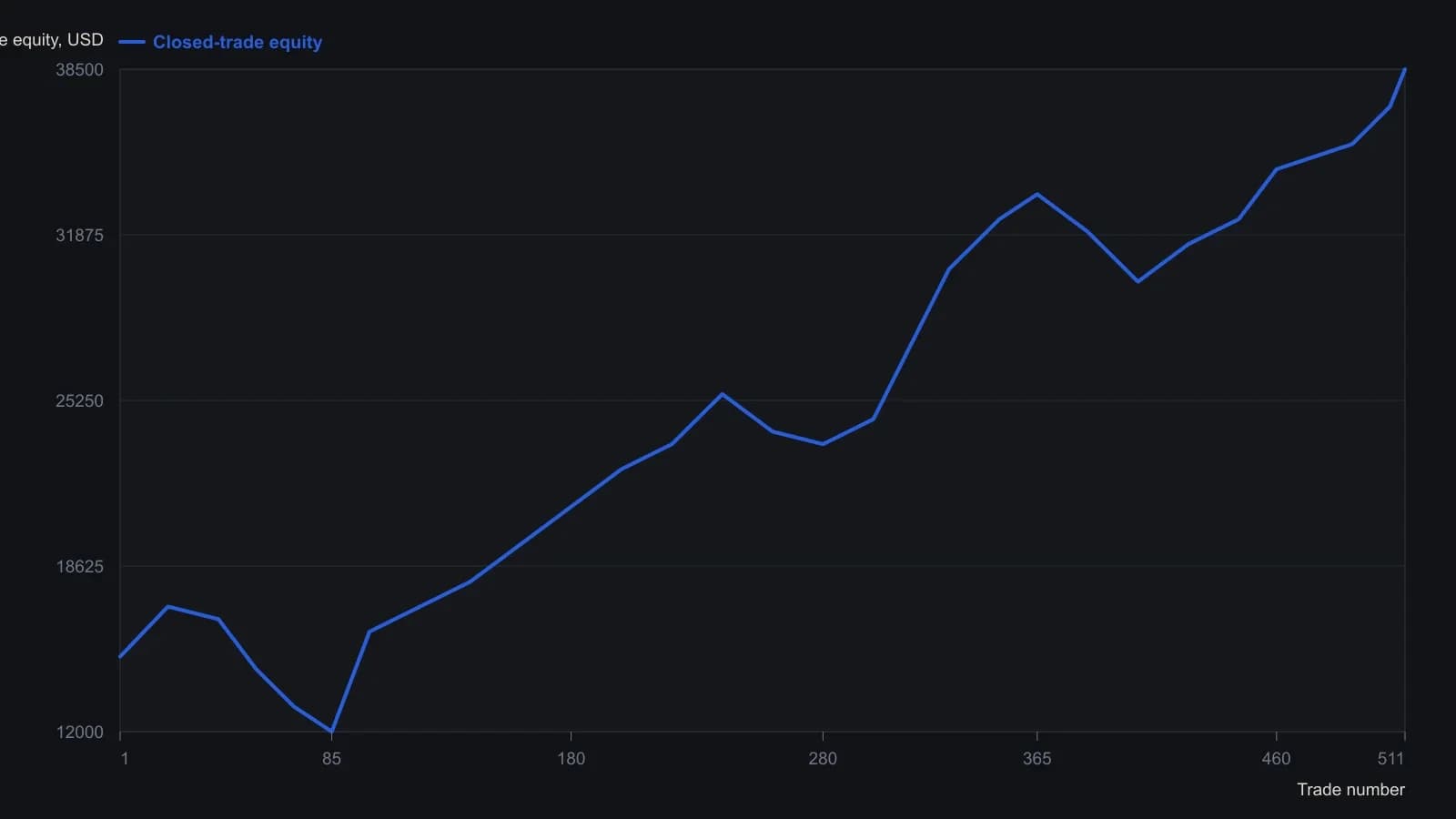
The plotted backtest used no fixed dollar stop; a $500 stop was attached only on the later ten-trade holdout. The run used one e-mini contract, $25 round-trip costs, and the 07:05–13:45 CT session.
Add a stop after the hunt
A stop-loss is a precommitted exit that bounds loss or exposure before or during a position. In the demonstration, that bound was a fixed-dollar stop of 500, attached only after the historical search window ended.
A separate sample procedure expressed a trailing exit as a 3 percent retreat from the highest close over a 15-bar lookback. A trailing-stop follows a recent extreme and exits when price retreats by a set fraction or distance.
All readings on this track · 50 readings
- 1990Three-window walk-forward system evaluation
- 1990Building the construction layer of a mechanical trading system
- 1991Constructing walk-forward neural trading rules
- 1991Constructing neural trading systems from facts to walk-forward
- 1992Walk-forward evaluation of stop overlays on average crossovers
- 1992Audit mechanical system tests for fills and regimes
- 1993Walk-forward evaluation of monthly yield and real-rate forecasts
- 1993Constructing walk-forward forecasts with linear and moving-average baselines
- 1993Walk-forward hybrid rules for intermarket forecast stacks
- 1994Neural-net construction as a mechanical trading-system problem
- 1995Constructing an intermarket neural net trading system
- 1996Weekly market breadth as one procedure on an unused window
- 1996Walk-forward evaluation of gold-index bond-fund rules
- 1996Evaluating weekday-in-month filters for index day trades
- 1996Require both a trend filter and a cycle oscillator before entry
- 1997Walk-forward windows as a diagnostic of parameter instability
- 1997Walk-forward validation of a market-breadth timing rule
- 1997Sunspot spikes and walk-forward evaluation of an adaptive cycle rule
- 1997A walk-forward check for bond-breadth timing
- 1998Walk-forward audit of regression trend forecasts
- 1998Evaluating a cubic least-squares currency trend with walk-forward segments
- 1998Walk-forward evaluation of recursive yen trend signals
- 1999Personal system design under crowd psychology
- 1999Walk-forward evaluation of a polynomial price forecast
- 2000Walk-forward optimization of regression-slope-angle rules
- 2001Construct a winter seasonal window as one procedure
- 2001Inspectable rules when system write-ups dry up
- 2002Evaluating mechanical systems before position sizing
- 2003Walk-forward construction of rule-based market-position systems
- 2007Evaluating metal seasonal windows across regimes
- 2007Evaluating mechanical timing systems against hold baselines
- 2011Walk-forward reoptimization as a system design gate
- 2011Evaluate generated systems on holdouts, then add stops
- 2012Walk-forward analysis and out-of-sample tests for a mechanical trading system
- 2012Personality-first trading system design
- 2012Scorecard-first mechanical system construction
- 2012Constructing an advancer-decliner moving average for market breadth
- 2012Formula search as mechanical system construction
- 2013Identity-first system construction
- 2013Construct a swing system from bias rules to walk-forward
- 2014Evaluate mechanical stock systems with stops and walk-forward
- 2014Walk-forward velocity filters on noisy intraday trends
- 2015Event-predictability versus position-constrained rules
- 2015Constructing mechanical systems for walk-forward tests
- 2016When a tested system must be retired
- 2016Walk-forward metric filters and chance-level checks for selected inputs
- 2018Evaluate mechanical trading systems without catalog rankings
- 2019Phased stop construction from entry risk to trailing exit
- 2020Stockpiling simple ideas for mechanical system construction
- 2020A pretty first draft is not a walk-forward waiver