1993issue C041-10
Walk-forward evaluation of monthly yield and real-rate forecasts
A historical bond-yield study specified two forecast problems in advance. This article reads them as separate evaluation designs: a one-month map scored as an always-in walk-forward rule, and a ten-month real-yield map judged only as a trend check.
- Two forecast problems were specified in advance: the next month-end bond yield, and the real yield ten months ahead.
- The one-month map used ordered recent yields, the deficit-to-output ratio, and consumer-price inflation, then became an always-in walk-forward rule at month-end prices.
- Holdout grading reserved a user-defined test set, including a final 17-month unseen block, so the fit could not memorize sample quirks.
- The ten-month map used inflation and the budget-balance-to-output ratio as a general-trend evaluation and was not framed as a trading signal.
Two forecast problems, two scoreboards
The historical workflow specified two forecast problems in advance. One target was the next month-end bond yield. The other was the real yield ten months ahead. Real yield means the interest rate for a stated period minus the inflation rate for that same period.
Editorial reading: treat these as two evaluation designs rather than one fitted story. The first design is a one-month linear-style map from ordered yields and macro series into the next month-end level, then converted into a walk-forward always-in rule. The second design is a ten-month real-yield map judged only as a trend check.
The one-month map
The one-month map used ordered recent yields, the deficit-to-output ratio, and consumer-price inflation as inputs. The deficit-to-output ratio is the combined government budget balance, deficit or surplus, scaled by total output and used as a lagged macro input to the yield maps. The target was the following month-end yield.
As defined for this article, linear regression is an explicit quantitative baseline that maps ordered yield, inflation, or breadth-style observations over a stated lookback and sampling interval onto a next-period forecast, then is compared with a result computed outside the fitting sample. The sampling interval is monthly. The prediction is a month-end forecast: a one-step prediction of the next month-end yield, or of the signed change implied by that prediction, evaluated at month-end marks only.
Fitting, local minima, and holdout grading
Fitting searched for connection weights that reduced forecast error. The bond-prediction error surface was described as having many local minima that a run can settle into depending on its starting weights. If a fit cannot reduce error through repeatable input-output relationships, it tends to memorize sample quirks that fail on new observations.
Holdout grading was used to limit that memorization. Holdout grading means scoring forecast error on a user-defined test window whose inputs are withheld from training passes. The final 17 months were excluded from both fitting and internal testing and then scored separately as unseen cases.
A uniform 30-year yield series was available only from 1978, which shortened the monthly sample relative to a preferred window of two to three hundred months for a one-month forecast.
From month-end forecast to an always-in rule
The one-month forecast was turned into an always-in walk-forward signal at month-end prices. An always-in rule is long or short at every month-end decision point and never stands aside. A higher predicted yield implied a short. A lower predicted yield implied a long.
As defined for this article, walk-forward analysis turns rule inputs, market state, and execution constraints into a single testable sequence of entry, exit, and remaining-in-market decisions over the system holding period, scored on windows the fitting step did not use. Transaction costs were omitted from the score. Interest income was omitted from the score. Long and short legs were reported apart against a predominantly rising price path in a volatile training window.
Month-end price of the 7-5/8% 30-year Treasury, Feb 1978–Feb 1990
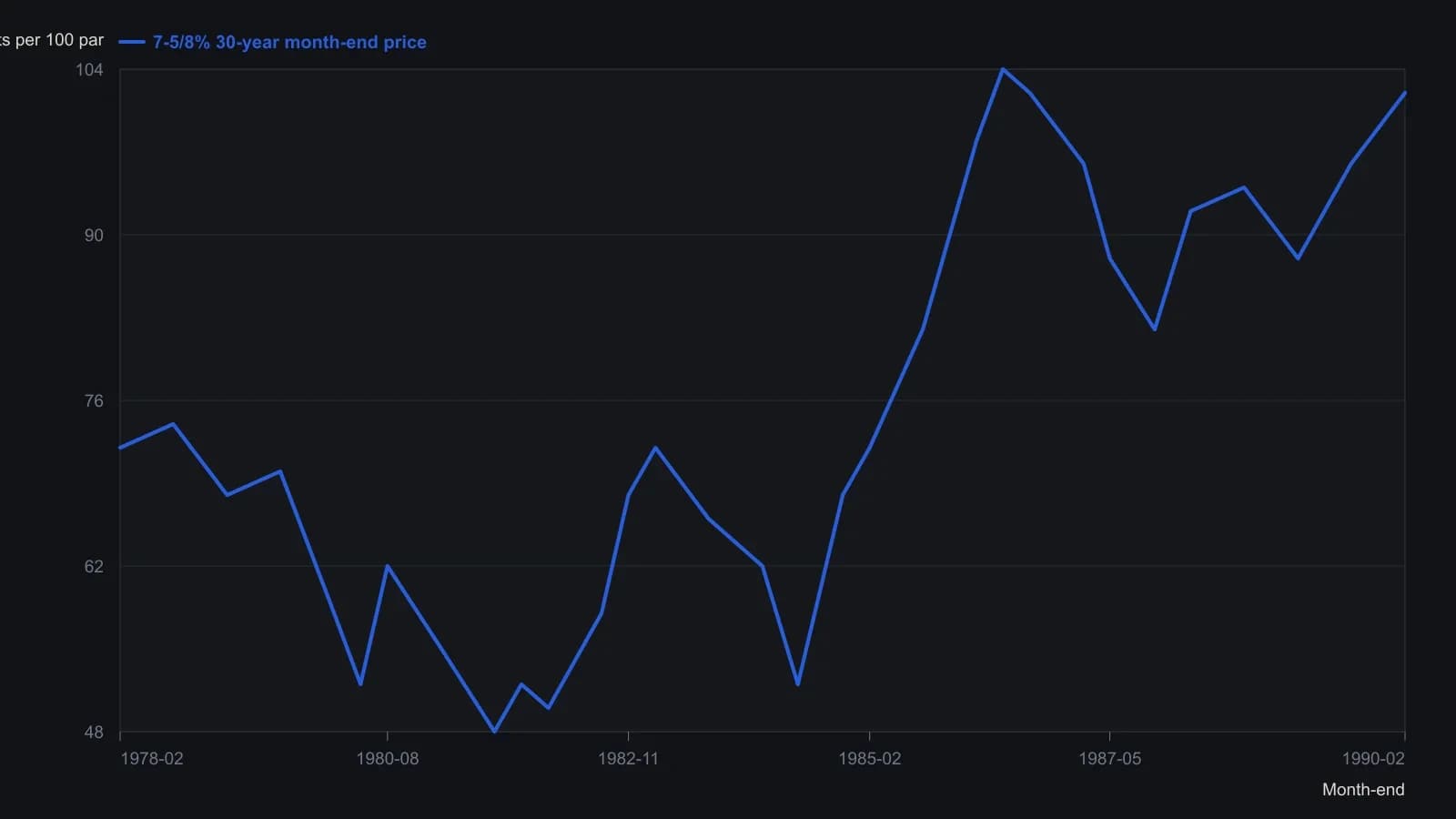
Coupon was chosen only because it was then the longest Treasury. Trading later scored price change only; coupon income was excluded.
The ten-month real-yield check
The budget-balance-to-output ratio was treated as leading real bond yields by about ten months. The longer-horizon map used inflation together with that ratio as inputs. The ten-month real-yield outlook was presented as a general-trend evaluation over a long horizon and was explicitly not framed as a trading signal.
All readings on this track · 50 readings
- 1990Three-window walk-forward system evaluation
- 1990Building the construction layer of a mechanical trading system
- 1991Constructing walk-forward neural trading rules
- 1991Constructing neural trading systems from facts to walk-forward
- 1992Walk-forward evaluation of stop overlays on average crossovers
- 1992Audit mechanical system tests for fills and regimes
- 1993Walk-forward evaluation of monthly yield and real-rate forecasts
- 1993Constructing walk-forward forecasts with linear and moving-average baselines
- 1993Walk-forward hybrid rules for intermarket forecast stacks
- 1994Neural-net construction as a mechanical trading-system problem
- 1995Constructing an intermarket neural net trading system
- 1996Weekly market breadth as one procedure on an unused window
- 1996Walk-forward evaluation of gold-index bond-fund rules
- 1996Evaluating weekday-in-month filters for index day trades
- 1996Require both a trend filter and a cycle oscillator before entry
- 1997Walk-forward windows as a diagnostic of parameter instability
- 1997Walk-forward validation of a market-breadth timing rule
- 1997Sunspot spikes and walk-forward evaluation of an adaptive cycle rule
- 1997A walk-forward check for bond-breadth timing
- 1998Walk-forward audit of regression trend forecasts
- 1998Evaluating a cubic least-squares currency trend with walk-forward segments
- 1998Walk-forward evaluation of recursive yen trend signals
- 1999Personal system design under crowd psychology
- 1999Walk-forward evaluation of a polynomial price forecast
- 2000Walk-forward optimization of regression-slope-angle rules
- 2001Construct a winter seasonal window as one procedure
- 2001Inspectable rules when system write-ups dry up
- 2002Evaluating mechanical systems before position sizing
- 2003Walk-forward construction of rule-based market-position systems
- 2007Evaluating metal seasonal windows across regimes
- 2007Evaluating mechanical timing systems against hold baselines
- 2011Walk-forward reoptimization as a system design gate
- 2011Evaluate generated systems on holdouts, then add stops
- 2012Walk-forward analysis and out-of-sample tests for a mechanical trading system
- 2012Personality-first trading system design
- 2012Scorecard-first mechanical system construction
- 2012Constructing an advancer-decliner moving average for market breadth
- 2012Formula search as mechanical system construction
- 2013Identity-first system construction
- 2013Construct a swing system from bias rules to walk-forward
- 2014Evaluate mechanical stock systems with stops and walk-forward
- 2014Walk-forward velocity filters on noisy intraday trends
- 2015Event-predictability versus position-constrained rules
- 2015Constructing mechanical systems for walk-forward tests
- 2016When a tested system must be retired
- 2016Walk-forward metric filters and chance-level checks for selected inputs
- 2018Evaluate mechanical trading systems without catalog rankings
- 2019Phased stop construction from entry risk to trailing exit
- 2020Stockpiling simple ideas for mechanical system construction
- 2020A pretty first draft is not a walk-forward waiver