2011issue C0779-81
Walk-forward reoptimization as a system design gate
A generated mechanical rule set stays unfinished laboratory work until walk-forward analysis, not a single static-parameter test, decides whether periodic reoptimization still holds the same entry, exit, and abstention procedure together.
- A mechanical trading system is a fully specified set of entry, exit, and abstention rules that can be run as one procedure from market state and execution constraints.
- System optimization searches those rule inputs and is useful only when the chosen values are then tested after they leave the fitting window.
- Walk-forward analysis re-estimates the same inputs on a later reoptimization cycle and scores the unchanged procedure on unseen segments, including walk-forward efficiency.
- The write-up treated continual reoptimization, stress testing, and out-of-sample forward tests, not one fitted window, as the process that decides whether the candidate can leave the modeling stage.
The laboratory rule set
The illustrated mechanical trading system exposed three tunable inputs: a long-entry lookback length, a long-entry fraction of a recent price range, and a clock time used to flatten shorts. Those inputs sat inside a fully specified procedure, not a loose collection of chart ideas.
Long entries were next-bar limit orders taken a fraction of a recent high-to-low range below the session high. Short entries were next-bar market orders. Shorts were covered at market after a specified clock time except at the session close, and a fixed initial stop of 600 currency units was attached to open risk.
The procedure allowed at most one entry per session except at the session close. Most bars were therefore an explicit abstention rather than a forced trade.
The first static window
The first evaluation window was a six-month static-parameter test. It was presented only as a foundation for later robustness work, not as a finished verdict on the rule set.
System optimization over the three inputs could produce a fitted window. That search remained unfinished laboratory work until the chosen values were tested after they left the fitting window.
Reestimation on a later cycle
Walk-forward analysis periodically re-estimated the same inputs to test whether the rule set remained usable or was only numerical debris from one fitting run. The procedure itself did not change: entry, exit, and abstention rules stayed one mechanical trading system.
Inputs were reoptimized on a cycle of about 700 price bars on an intraday gold-market series instead of being left frozen after the original development window. That bar count is the reoptimization cycle: after it elapses, the procedure selects a new input set before the next unseen test.
The five-category scorecard
The walk-forward scorecard judged the candidate on five categories: overall profitability, walk-forward efficiency, consistency of profits, distribution of profits, and maximum drawdown. Walk-forward efficiency compares unseen-segment results with the fitting windows used to choose the inputs.
An out-of-sample stress test evaluates data that were not used to choose the current inputs. In this workflow it functions as a pass-or-fail design filter, not as a second look at the original fitting run.
Static-window net profit by trade side
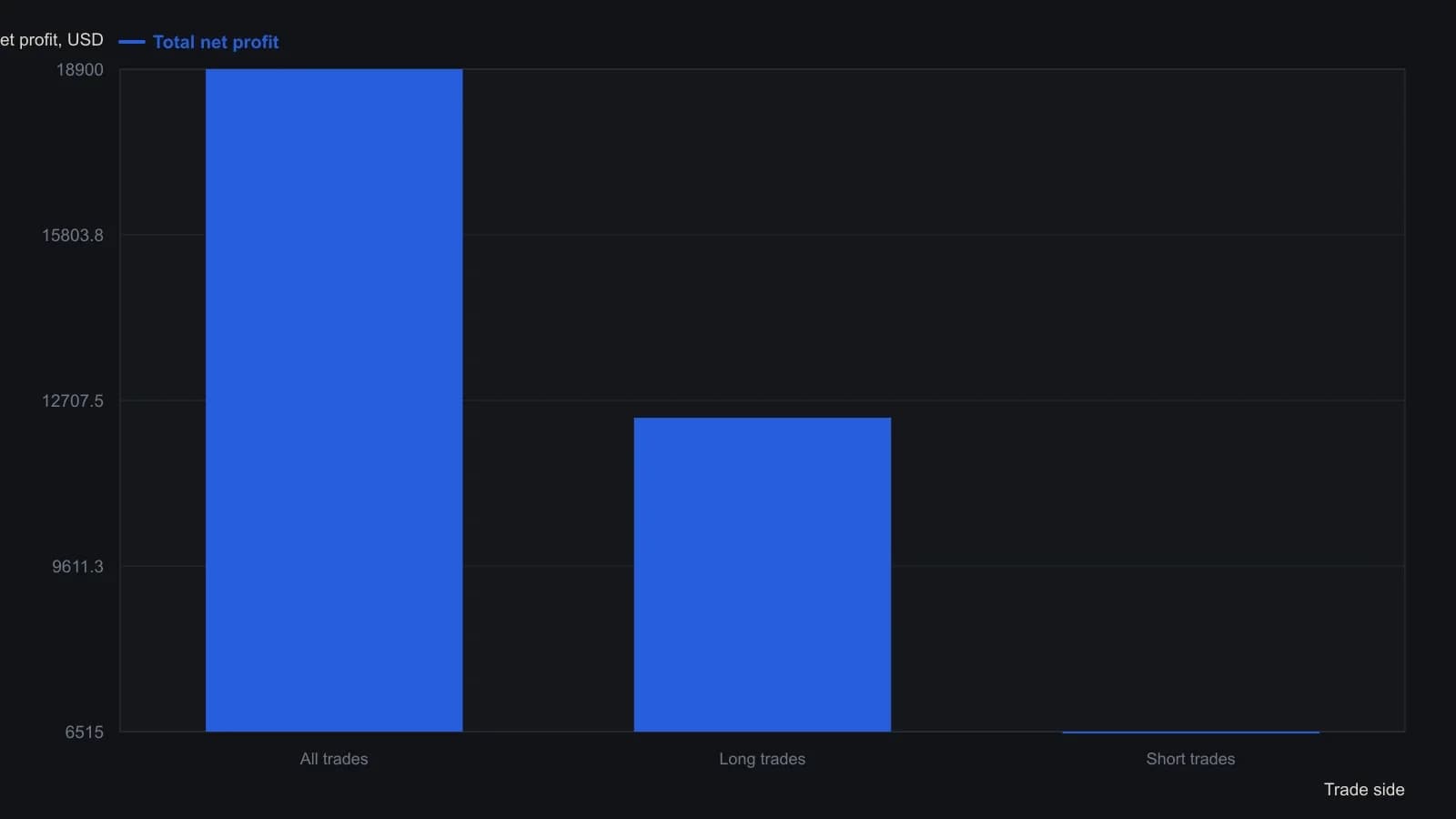
Single static parameter set on 5 November 2010 to 5 May 2011; the $600 initial stop held on every trade. This is the fitted laboratory window, not the later walk-forward run.
Leaving the modeling stage
The write-up treated continual reoptimization, stress testing, and out-of-sample forward tests as the process that decides whether a mechanical trading system can leave the modeling stage. A single static backtest was not that process.
The archive facts describe this historical workflow. They do not turn the laboratory rule set into a finished trading recommendation.
All readings on this track · 50 readings
- 1990Three-window walk-forward system evaluation
- 1990Building the construction layer of a mechanical trading system
- 1991Constructing walk-forward neural trading rules
- 1991Constructing neural trading systems from facts to walk-forward
- 1992Walk-forward evaluation of stop overlays on average crossovers
- 1992Audit mechanical system tests for fills and regimes
- 1993Walk-forward evaluation of monthly yield and real-rate forecasts
- 1993Constructing walk-forward forecasts with linear and moving-average baselines
- 1993Walk-forward hybrid rules for intermarket forecast stacks
- 1994Neural-net construction as a mechanical trading-system problem
- 1995Constructing an intermarket neural net trading system
- 1996Weekly market breadth as one procedure on an unused window
- 1996Walk-forward evaluation of gold-index bond-fund rules
- 1996Evaluating weekday-in-month filters for index day trades
- 1996Require both a trend filter and a cycle oscillator before entry
- 1997Walk-forward windows as a diagnostic of parameter instability
- 1997Walk-forward validation of a market-breadth timing rule
- 1997Sunspot spikes and walk-forward evaluation of an adaptive cycle rule
- 1997A walk-forward check for bond-breadth timing
- 1998Walk-forward audit of regression trend forecasts
- 1998Evaluating a cubic least-squares currency trend with walk-forward segments
- 1998Walk-forward evaluation of recursive yen trend signals
- 1999Personal system design under crowd psychology
- 1999Walk-forward evaluation of a polynomial price forecast
- 2000Walk-forward optimization of regression-slope-angle rules
- 2001Construct a winter seasonal window as one procedure
- 2001Inspectable rules when system write-ups dry up
- 2002Evaluating mechanical systems before position sizing
- 2003Walk-forward construction of rule-based market-position systems
- 2007Evaluating metal seasonal windows across regimes
- 2007Evaluating mechanical timing systems against hold baselines
- 2011Walk-forward reoptimization as a system design gate
- 2011Evaluate generated systems on holdouts, then add stops
- 2012Walk-forward analysis and out-of-sample tests for a mechanical trading system
- 2012Personality-first trading system design
- 2012Scorecard-first mechanical system construction
- 2012Constructing an advancer-decliner moving average for market breadth
- 2012Formula search as mechanical system construction
- 2013Identity-first system construction
- 2013Construct a swing system from bias rules to walk-forward
- 2014Evaluate mechanical stock systems with stops and walk-forward
- 2014Walk-forward velocity filters on noisy intraday trends
- 2015Event-predictability versus position-constrained rules
- 2015Constructing mechanical systems for walk-forward tests
- 2016When a tested system must be retired
- 2016Walk-forward metric filters and chance-level checks for selected inputs
- 2018Evaluate mechanical trading systems without catalog rankings
- 2019Phased stop construction from entry risk to trailing exit
- 2020Stockpiling simple ideas for mechanical system construction
- 2020A pretty first draft is not a walk-forward waiver