2019issue C0828-29
Phased stop construction from entry risk to trailing exit
A risk process is specified as covering initial-risk identification, in-trade management, and the exit, not only instrument selection and entry. Percentage stops are retuned through the opening, middle, and ending of a position, then a walk-forward check applies the same settings as later prices unfold.
- A risk process is specified as covering initial-risk identification, in-trade management, and the exit, rather than only instrument selection and entry.
- Percentage stops are organized into five adjustable categories so the bound can be retuned across the opening, middle, and ending phases of a position.
- A default construction pairs a percentage target with a fixed initial stop that becomes a volatility stop after a favorable move, then an end trail if the target is reached without an exit.
- A historically tested stop configuration is treated as incomplete until a walk-forward check moves the same settings into a subsequent book as later prices unfold.
What the risk process covers
A risk process is specified as covering initial-risk identification, in-trade management, and the exit, rather than only instrument selection and entry.
The initial stop is a percentage distance from the entry close that bounds the first loss if price never advances as planned. It is a percentage below or above the entry, taken from the close of the daily bar or of the intraday bar in use.
Five categories and a default pair
Percentage stops are organized into five adjustable categories so the bound can be retuned across the opening, middle, and ending phases of a position.
A default construction pairs a percentage target with a fixed initial stop that becomes a volatility-sensitive stop after price moves in the intended direction. The target is a percentage price objective the construction treats as the intended level of the trade.
The volatility stop begins to follow price fluctuation after the position has moved in the intended direction. As price approaches the target the volatility stop is specified to tighten, and if the target is reached without an exit the construction converts to a trailing stop.
Room, transition, and the end trail
A room-for-price percentage, used here as the room parameter, narrows or widens the live stop. It sets how much ongoing price movement is allowed before the live stop is hit. A smaller value takes profits sooner, and a larger value leaves more space for continued movement.
A separate trailing stop, the end trail, is applied only after the target is reached. A transition percentage decides when an unhit initial stop becomes volatility-based. The transition is the favorable-move threshold at which a still-open initial stop is replaced by a volatility-adjusting stop.
One illustrated transition keeps the initial stop in a sideways entry until price has advanced 5 percent, then switches to a volatility-adjusting stop.
Templates and the walk-forward check
Template variants lengthen target and stop distance for longer intended holdings and shorten them for holds measured in days or weeks, so the same architecture can be tested as one procedure.
A historically tested stop configuration is treated as incomplete until the same settings are moved into a subsequent book that continues to apply them as later prices unfold. That completeness step is the walk-forward check: applying a historically tested stop configuration to a subsequent book so the same bounds are observed on later prices.
Forward-test open return by ProfitLocker holding
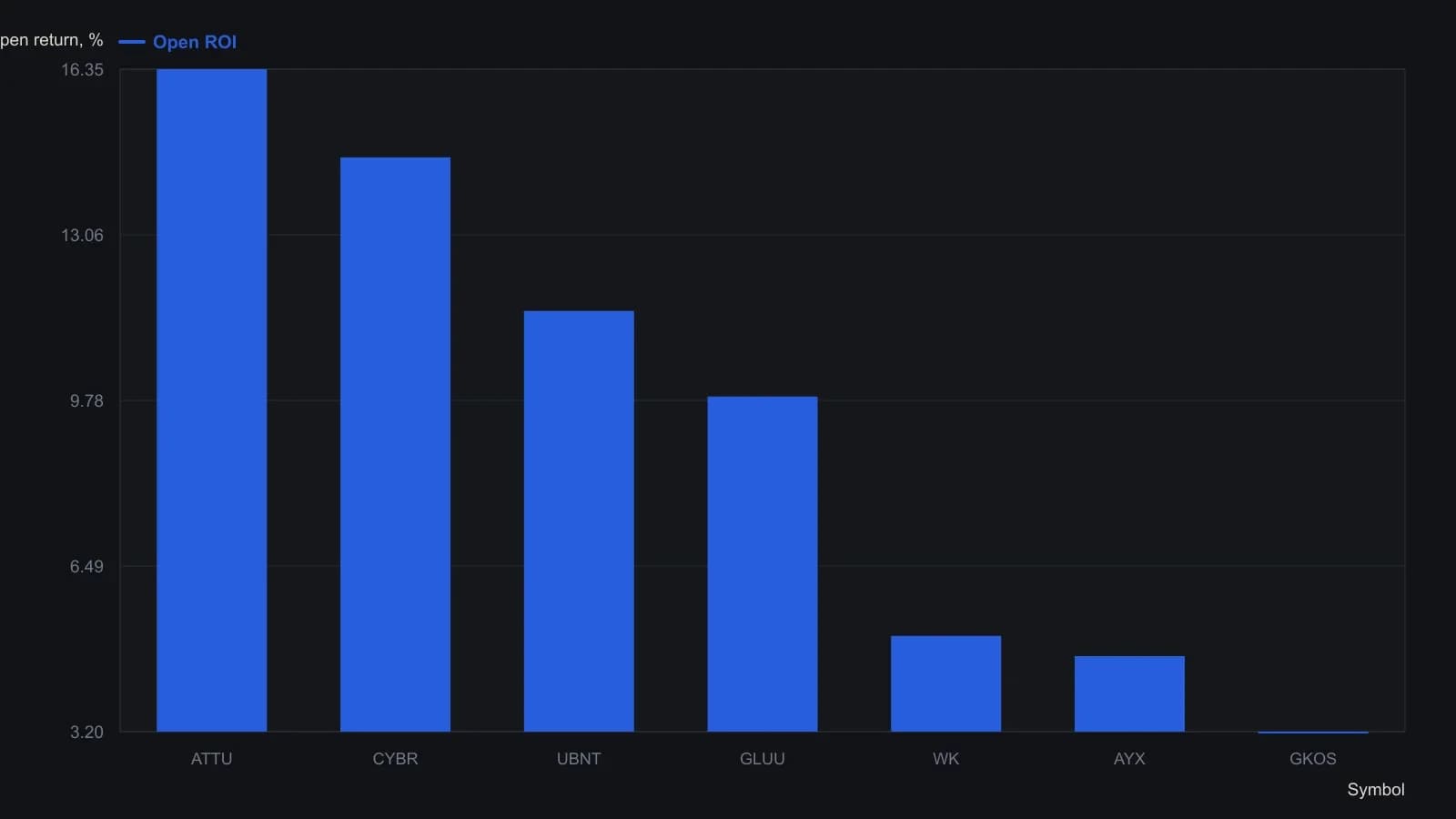
Every row uses the same ProfitLocker percentages: 28 percent target, 7 percent initial stop, 35 percent greed, 1 percent end trail, and 0 percent transition.
All readings on this track · 50 readings
- 1990Three-window walk-forward system evaluation
- 1990Building the construction layer of a mechanical trading system
- 1991Constructing walk-forward neural trading rules
- 1991Constructing neural trading systems from facts to walk-forward
- 1992Walk-forward evaluation of stop overlays on average crossovers
- 1992Audit mechanical system tests for fills and regimes
- 1993Walk-forward evaluation of monthly yield and real-rate forecasts
- 1993Constructing walk-forward forecasts with linear and moving-average baselines
- 1993Walk-forward hybrid rules for intermarket forecast stacks
- 1994Neural-net construction as a mechanical trading-system problem
- 1995Constructing an intermarket neural net trading system
- 1996Weekly market breadth as one procedure on an unused window
- 1996Walk-forward evaluation of gold-index bond-fund rules
- 1996Evaluating weekday-in-month filters for index day trades
- 1996Require both a trend filter and a cycle oscillator before entry
- 1997Walk-forward windows as a diagnostic of parameter instability
- 1997Walk-forward validation of a market-breadth timing rule
- 1997Sunspot spikes and walk-forward evaluation of an adaptive cycle rule
- 1997A walk-forward check for bond-breadth timing
- 1998Walk-forward audit of regression trend forecasts
- 1998Evaluating a cubic least-squares currency trend with walk-forward segments
- 1998Walk-forward evaluation of recursive yen trend signals
- 1999Personal system design under crowd psychology
- 1999Walk-forward evaluation of a polynomial price forecast
- 2000Walk-forward optimization of regression-slope-angle rules
- 2001Construct a winter seasonal window as one procedure
- 2001Inspectable rules when system write-ups dry up
- 2002Evaluating mechanical systems before position sizing
- 2003Walk-forward construction of rule-based market-position systems
- 2007Evaluating metal seasonal windows across regimes
- 2007Evaluating mechanical timing systems against hold baselines
- 2011Walk-forward reoptimization as a system design gate
- 2011Evaluate generated systems on holdouts, then add stops
- 2012Walk-forward analysis and out-of-sample tests for a mechanical trading system
- 2012Personality-first trading system design
- 2012Scorecard-first mechanical system construction
- 2012Constructing an advancer-decliner moving average for market breadth
- 2012Formula search as mechanical system construction
- 2013Identity-first system construction
- 2013Construct a swing system from bias rules to walk-forward
- 2014Evaluate mechanical stock systems with stops and walk-forward
- 2014Walk-forward velocity filters on noisy intraday trends
- 2015Event-predictability versus position-constrained rules
- 2015Constructing mechanical systems for walk-forward tests
- 2016When a tested system must be retired
- 2016Walk-forward metric filters and chance-level checks for selected inputs
- 2018Evaluate mechanical trading systems without catalog rankings
- 2019Phased stop construction from entry risk to trailing exit
- 2020Stockpiling simple ideas for mechanical system construction
- 2020A pretty first draft is not a walk-forward waiver