1997issue C051-7
Walk-forward windows as a diagnostic of parameter instability
Walk-forward analysis makes a mechanical rule set testable as one procedure. This TradersWeek editorial argues that moving windows should be read as a check on parameter stability, not as a trophy for a finished system.
- Entry, exit and abstention belong in one mechanical procedure, not in separate untested steps.
- A walk-forward window is useful when it shows whether those rules keep the same parameters as conditions change.
- Intermarket context can change the regime around a trade even when the local rules look unchanged.
- TradersWeek editorial view: unstable parameters are a finding. They are not a reason to keep only the windows that flatter a preferred rule set.
What is being tested
A mechanical trading system is a single procedure. Entry rules, exit rules and the choice to stand aside are tested together, using the rule inputs, the state of the market and the execution constraints that decide whether a signal can be taken. The relevant horizon is the system's holding period.
Walk-forward analysis advances that whole procedure through successive windows. The point of the move is to see whether the same rules still describe the same behaviour, not to collect a final parameter set and stop.
How instability shows up
Parameter instability is present when later windows need different settings to express the same intended rules. The procedure has not stayed coherent. The useful output is that observation.
Designers often treat the last acceptable window as proof that the system is finished. TradersWeek editorial reading: that habit turns a diagnostic into a trophy. The windows that forced a rewrite are part of the evaluation, not noise to be dropped.
Walk-forward XAU jump thresholds by six-year window
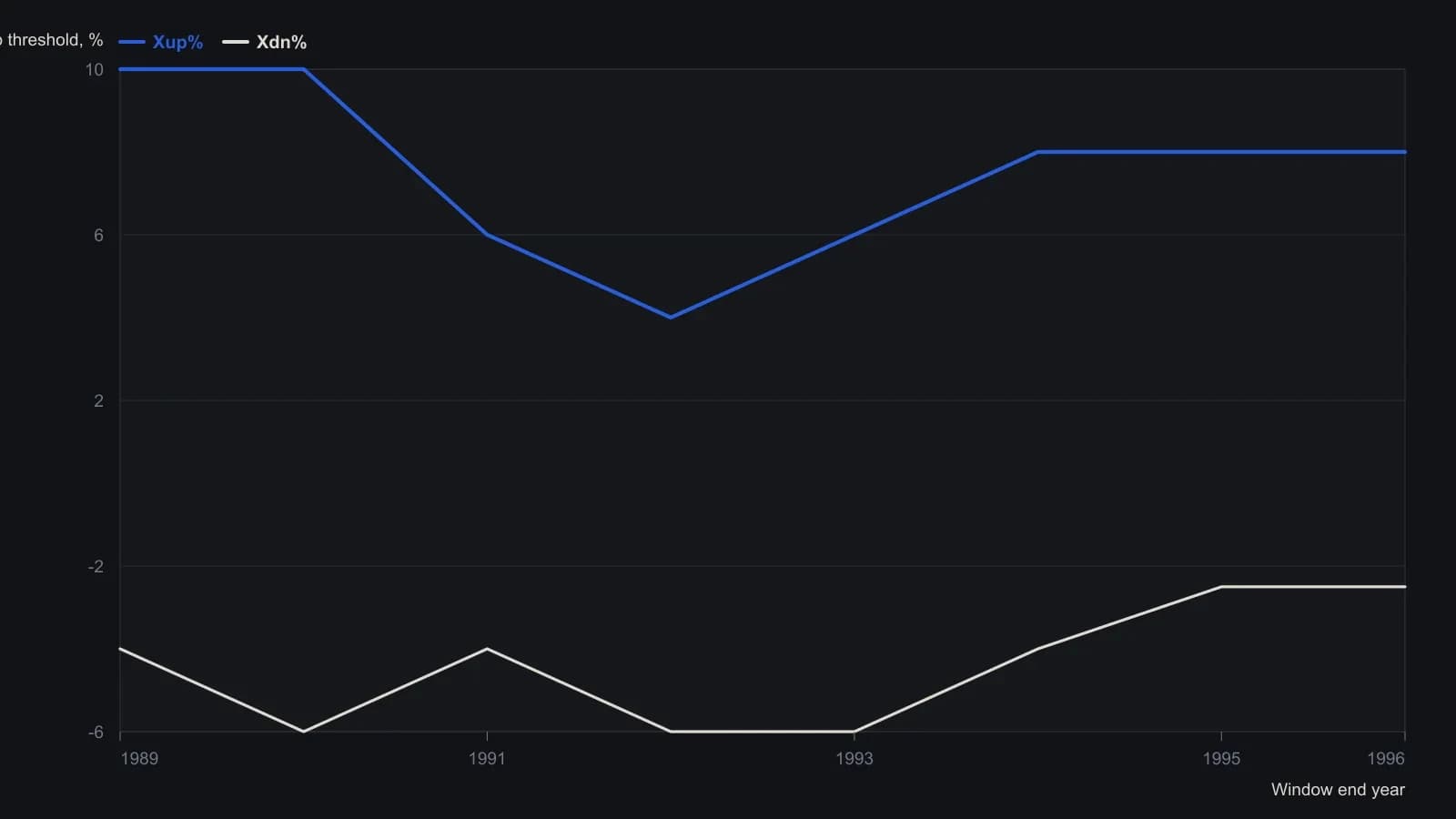
In-sample windows last six years and each optimum is applied to the next calendar year. Meyers used a 6-to-1 ratio after two-year windows failed to hold up out of sample.
Keep regime inside the same procedure
Intermarket analysis asks a different question: whether a single trade still sits in a supporting context. Cross-market prices, volatility, carry and portfolio weights can shift the regime around a signal while the local rules look unchanged.
A mechanical system that ignores that context can appear internally consistent and still be answering a different market than the designer thinks. TradersWeek editorial view: regime belongs in the walk-forward test, because stability of parameters is not the same thing as stability of the setting in which those parameters are used.
All readings on this track · 50 readings
- 1990Three-window walk-forward system evaluation
- 1990Building the construction layer of a mechanical trading system
- 1991Constructing walk-forward neural trading rules
- 1991Constructing neural trading systems from facts to walk-forward
- 1992Walk-forward evaluation of stop overlays on average crossovers
- 1992Audit mechanical system tests for fills and regimes
- 1993Walk-forward evaluation of monthly yield and real-rate forecasts
- 1993Constructing walk-forward forecasts with linear and moving-average baselines
- 1993Walk-forward hybrid rules for intermarket forecast stacks
- 1994Neural-net construction as a mechanical trading-system problem
- 1995Constructing an intermarket neural net trading system
- 1996Weekly market breadth as one procedure on an unused window
- 1996Walk-forward evaluation of gold-index bond-fund rules
- 1996Evaluating weekday-in-month filters for index day trades
- 1996Require both a trend filter and a cycle oscillator before entry
- 1997Walk-forward windows as a diagnostic of parameter instability
- 1997Walk-forward validation of a market-breadth timing rule
- 1997Sunspot spikes and walk-forward evaluation of an adaptive cycle rule
- 1997A walk-forward check for bond-breadth timing
- 1998Walk-forward audit of regression trend forecasts
- 1998Evaluating a cubic least-squares currency trend with walk-forward segments
- 1998Walk-forward evaluation of recursive yen trend signals
- 1999Personal system design under crowd psychology
- 1999Walk-forward evaluation of a polynomial price forecast
- 2000Walk-forward optimization of regression-slope-angle rules
- 2001Construct a winter seasonal window as one procedure
- 2001Inspectable rules when system write-ups dry up
- 2002Evaluating mechanical systems before position sizing
- 2003Walk-forward construction of rule-based market-position systems
- 2007Evaluating metal seasonal windows across regimes
- 2007Evaluating mechanical timing systems against hold baselines
- 2011Walk-forward reoptimization as a system design gate
- 2011Evaluate generated systems on holdouts, then add stops
- 2012Walk-forward analysis and out-of-sample tests for a mechanical trading system
- 2012Personality-first trading system design
- 2012Scorecard-first mechanical system construction
- 2012Constructing an advancer-decliner moving average for market breadth
- 2012Formula search as mechanical system construction
- 2013Identity-first system construction
- 2013Construct a swing system from bias rules to walk-forward
- 2014Evaluate mechanical stock systems with stops and walk-forward
- 2014Walk-forward velocity filters on noisy intraday trends
- 2015Event-predictability versus position-constrained rules
- 2015Constructing mechanical systems for walk-forward tests
- 2016When a tested system must be retired
- 2016Walk-forward metric filters and chance-level checks for selected inputs
- 2018Evaluate mechanical trading systems without catalog rankings
- 2019Phased stop construction from entry risk to trailing exit
- 2020Stockpiling simple ideas for mechanical system construction
- 2020A pretty first draft is not a walk-forward waiver