1999issue C051-6
Personal system design under crowd psychology
Social influence and fashion effects can move public-market prices beyond a fundamentals-only story. A personal Mechanical trading system, a Trading psychology process, and Walk-forward analysis keep entry, exit, and abstention rules independent of the crowd.
- Social influence and fashion effects can push public-market price swings past what a fundamentals-only information model would predict.
- Without an independent price anchor, peer pressure can mute dissent, and rumor can spread like an epidemic into a blowoff and a sharp decline.
- A personal Mechanical trading system keeps entry, exit, and abstention rules independent of group discussion.
- A model is treated as reliable only after unused-data checks, including Walk-forward analysis and simulated rehearsal when capital, volatility, drawdowns, or costs are large.
Crowd effects on public-market prices
Price swings in public markets can exceed what a fundamentals-only information model would predict because social influence and fashion effects also move prices.
High-visibility markets can show abrupt slope changes in trend, as in the petroleum futures episode tied to the Gulf War.
Peer pressure, rumor, and contagion
When traders lack an independent price anchor, peer pressure can suppress dissenting views and slow the spread of contrary information.
Rumor and news can spread like an epidemic process, producing steep chart uptrends and then a sharp decline after a blowoff when support fades.
A price-contagion bubble can feed on observed gains until further rises fail to sustain demand, after which price can drop sharply.
A personal mechanical procedure
Group discussion can polarize risk-taking and mute challenge, so a personal mechanical procedure is a way to keep entry, exit, and abstention rules independent of the crowd.
That procedure is a Mechanical trading system: entry, exit, and abstention rules written so they stay independent of the crowd. A Trading psychology process keeps those same sit-out and dissent rules from being rewritten once group discussion has already moved.
Weekly NY light crude, 1984–1997
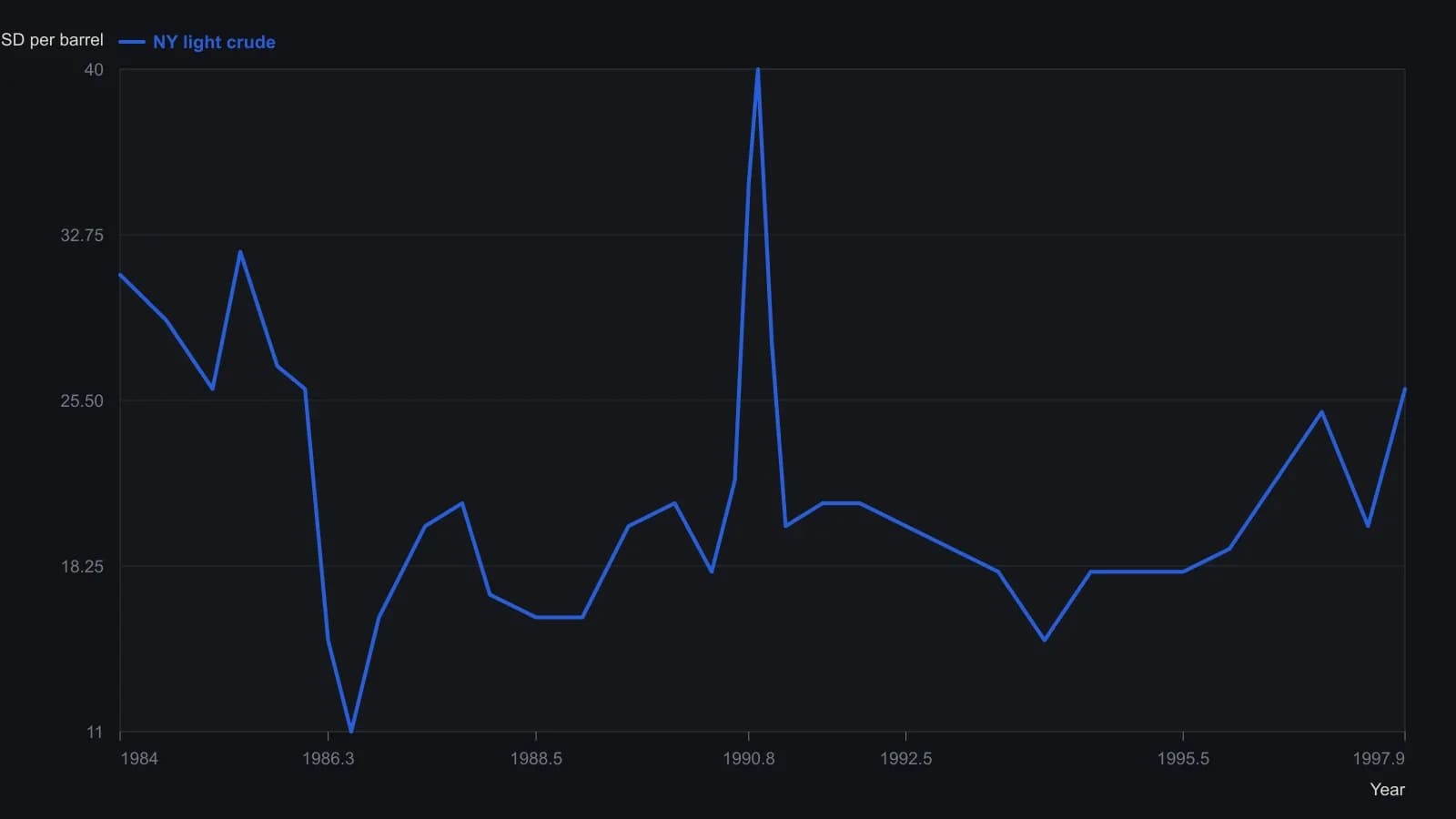
Approximate readings from a weekly OHLC raster, rounded to the nearest dollar. Sampling is denser around the 1990–91 spike highlighted on the source figure.
Checking the model on unused data
A trading model is treated as reliable only after it is checked on data not used to build it, including Walk-forward analysis and simulated rehearsal when capital, volatility, drawdowns, or costs are large.
Mass-psychology effects on price give a reason to treat a personal, testable system as an educational edge for spotting opportunities rather than as a promise of results.
All readings on this track · 50 readings
- 1990Three-window walk-forward system evaluation
- 1990Building the construction layer of a mechanical trading system
- 1991Constructing walk-forward neural trading rules
- 1991Constructing neural trading systems from facts to walk-forward
- 1992Walk-forward evaluation of stop overlays on average crossovers
- 1992Audit mechanical system tests for fills and regimes
- 1993Walk-forward evaluation of monthly yield and real-rate forecasts
- 1993Constructing walk-forward forecasts with linear and moving-average baselines
- 1993Walk-forward hybrid rules for intermarket forecast stacks
- 1994Neural-net construction as a mechanical trading-system problem
- 1995Constructing an intermarket neural net trading system
- 1996Weekly market breadth as one procedure on an unused window
- 1996Walk-forward evaluation of gold-index bond-fund rules
- 1996Evaluating weekday-in-month filters for index day trades
- 1996Require both a trend filter and a cycle oscillator before entry
- 1997Walk-forward windows as a diagnostic of parameter instability
- 1997Walk-forward validation of a market-breadth timing rule
- 1997Sunspot spikes and walk-forward evaluation of an adaptive cycle rule
- 1997A walk-forward check for bond-breadth timing
- 1998Walk-forward audit of regression trend forecasts
- 1998Evaluating a cubic least-squares currency trend with walk-forward segments
- 1998Walk-forward evaluation of recursive yen trend signals
- 1999Personal system design under crowd psychology
- 1999Walk-forward evaluation of a polynomial price forecast
- 2000Walk-forward optimization of regression-slope-angle rules
- 2001Construct a winter seasonal window as one procedure
- 2001Inspectable rules when system write-ups dry up
- 2002Evaluating mechanical systems before position sizing
- 2003Walk-forward construction of rule-based market-position systems
- 2007Evaluating metal seasonal windows across regimes
- 2007Evaluating mechanical timing systems against hold baselines
- 2011Walk-forward reoptimization as a system design gate
- 2011Evaluate generated systems on holdouts, then add stops
- 2012Walk-forward analysis and out-of-sample tests for a mechanical trading system
- 2012Personality-first trading system design
- 2012Scorecard-first mechanical system construction
- 2012Constructing an advancer-decliner moving average for market breadth
- 2012Formula search as mechanical system construction
- 2013Identity-first system construction
- 2013Construct a swing system from bias rules to walk-forward
- 2014Evaluate mechanical stock systems with stops and walk-forward
- 2014Walk-forward velocity filters on noisy intraday trends
- 2015Event-predictability versus position-constrained rules
- 2015Constructing mechanical systems for walk-forward tests
- 2016When a tested system must be retired
- 2016Walk-forward metric filters and chance-level checks for selected inputs
- 2018Evaluate mechanical trading systems without catalog rankings
- 2019Phased stop construction from entry risk to trailing exit
- 2020Stockpiling simple ideas for mechanical system construction
- 2020A pretty first draft is not a walk-forward waiver