1996issue C121-6
Require both a trend filter and a cycle oscillator before entry
Trend-following rules and range-oriented oscillators fail in opposite market states. A combined system takes a new position only when a simple moving average and a least-squares slope oscillator agree, then applies the same fixed lengths to a later unused window.
- Trend-following averages and range-oriented oscillators fail in opposite market states, so a combined system waits for both a moving-average trend filter and a regression-slope oscillator to agree before entry.
- A long is taken only when the close is above the simple moving average and the regression slope is above its trigger. A short requires the opposite pair of conditions. When the two indicators disagree on direction, no new trade is taken.
- Exits are less selective than entries. A long is closed if either the close crosses below the average or the slope crosses below its trigger.
- Find lengths on one period, test the same rules on a later unused window, and prefer understanding why the two models cancel each other's failure modes over trusting a historically optimized black box.
Opposite failure modes call for agreement
Trend-following and range-oriented oscillators fail in opposite market states, so a combined system requires both a moving-average trend filter and a regression-slope oscillator to agree before entry.
The moving average is a simple average of closes. It is used as a trend filter that must agree with the oscillator before a new position is allowed.
How the oscillator and its trigger are defined
The oscillator is the least-squares slope of recent closes, used as a cycle and momentum reading. A second, slower linear regression of that slope supplies the trigger line used for confirmation.
When a new position is allowed
A long is taken only when the close is above the simple moving average and the regression slope is above its trigger. A short requires the opposite pair of conditions.
Exits are less selective than entries. A long is closed if either the close crosses below the average or the slope crosses below its trigger.
When the two indicators disagree on direction, no new trade is taken.
Weekly yen futures close, 1991–1996
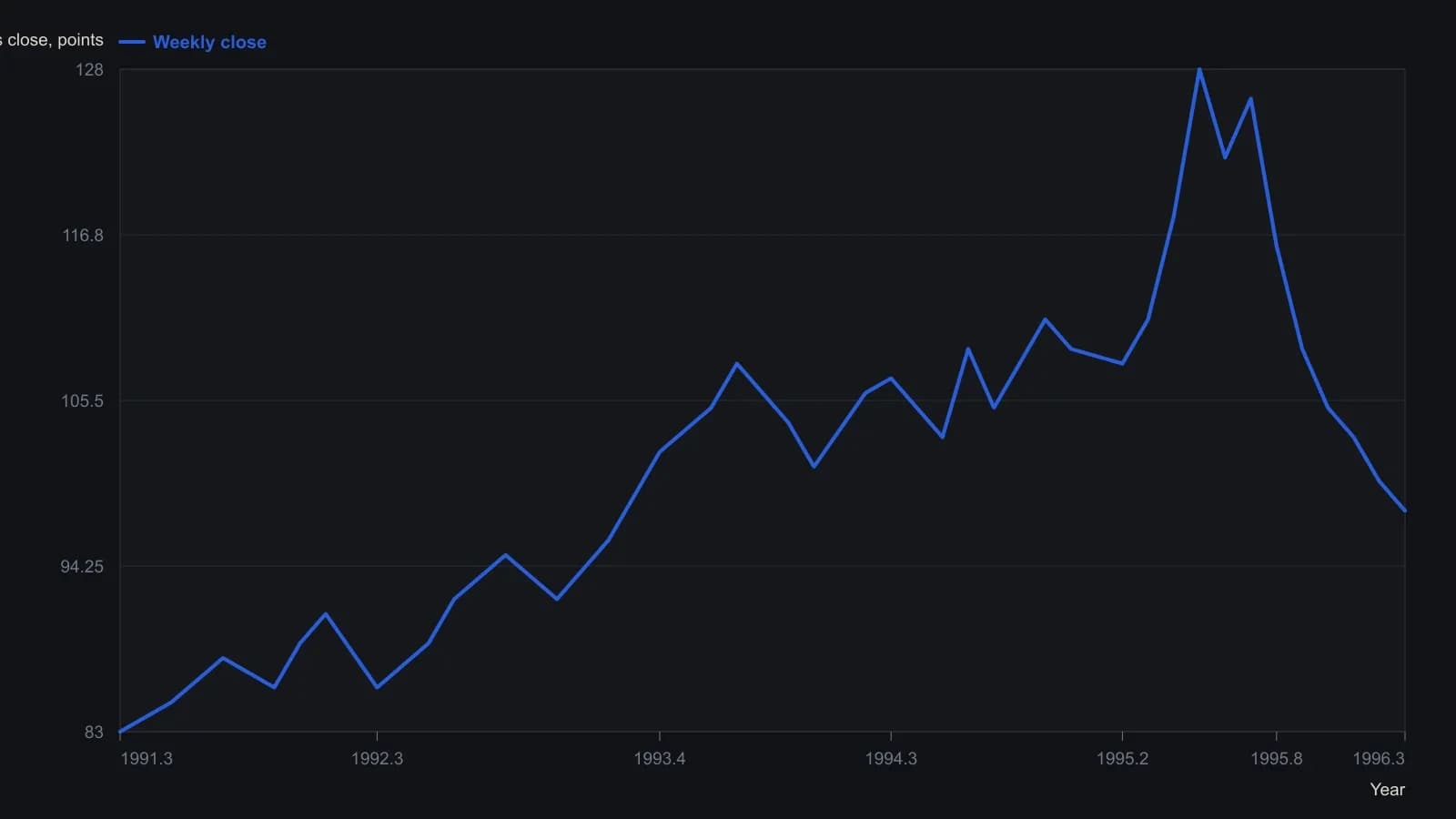
Levels are approximate to about one point on a coarse magazine raster. The five-week least-squares slope and its 50-week trigger sit in the lower pane on a −3 to +3 scale and cannot share this axis. The series is the nearest-continuous back-adjusted contract, so earlier prints are not raw session quotes.
Hold the training lengths fixed on a later window
Walk-forward analysis here means optimize rule lengths on one historical window, then apply those fixed lengths to a later unused window to test whether the combined procedure still behaves as designed.
Parameter search and later unused-window checks were run on weekly yen and Treasury-bond futures with a fixed $50 round-turn cost.
The Treasury-bond training window used lengths of 20 for the average, 10 for the slope, and 30 for the trigger. Those same lengths were then applied to a later unused window.
Unused windows were weaker and more uneven
Walk-forward checks showed weaker or more uneven results than the optimized training windows, including larger drawdown and a poorer split between long and short trades.
A prolonged Treasury-bond uptrend in the later window left short-sale results weak. That outcome illustrates that regime shape still dominates the combined rules.
The intended lesson is procedural
The intended lesson is procedural: find lengths on one period, test the same rules on another, and prefer understanding why the two models cancel each other's failure modes over trusting a historically optimized black box.
All readings on this track · 50 readings
- 1990Three-window walk-forward system evaluation
- 1990Building the construction layer of a mechanical trading system
- 1991Constructing walk-forward neural trading rules
- 1991Constructing neural trading systems from facts to walk-forward
- 1992Walk-forward evaluation of stop overlays on average crossovers
- 1992Audit mechanical system tests for fills and regimes
- 1993Walk-forward evaluation of monthly yield and real-rate forecasts
- 1993Constructing walk-forward forecasts with linear and moving-average baselines
- 1993Walk-forward hybrid rules for intermarket forecast stacks
- 1994Neural-net construction as a mechanical trading-system problem
- 1995Constructing an intermarket neural net trading system
- 1996Weekly market breadth as one procedure on an unused window
- 1996Walk-forward evaluation of gold-index bond-fund rules
- 1996Evaluating weekday-in-month filters for index day trades
- 1996Require both a trend filter and a cycle oscillator before entry
- 1997Walk-forward windows as a diagnostic of parameter instability
- 1997Walk-forward validation of a market-breadth timing rule
- 1997Sunspot spikes and walk-forward evaluation of an adaptive cycle rule
- 1997A walk-forward check for bond-breadth timing
- 1998Walk-forward audit of regression trend forecasts
- 1998Evaluating a cubic least-squares currency trend with walk-forward segments
- 1998Walk-forward evaluation of recursive yen trend signals
- 1999Personal system design under crowd psychology
- 1999Walk-forward evaluation of a polynomial price forecast
- 2000Walk-forward optimization of regression-slope-angle rules
- 2001Construct a winter seasonal window as one procedure
- 2001Inspectable rules when system write-ups dry up
- 2002Evaluating mechanical systems before position sizing
- 2003Walk-forward construction of rule-based market-position systems
- 2007Evaluating metal seasonal windows across regimes
- 2007Evaluating mechanical timing systems against hold baselines
- 2011Walk-forward reoptimization as a system design gate
- 2011Evaluate generated systems on holdouts, then add stops
- 2012Walk-forward analysis and out-of-sample tests for a mechanical trading system
- 2012Personality-first trading system design
- 2012Scorecard-first mechanical system construction
- 2012Constructing an advancer-decliner moving average for market breadth
- 2012Formula search as mechanical system construction
- 2013Identity-first system construction
- 2013Construct a swing system from bias rules to walk-forward
- 2014Evaluate mechanical stock systems with stops and walk-forward
- 2014Walk-forward velocity filters on noisy intraday trends
- 2015Event-predictability versus position-constrained rules
- 2015Constructing mechanical systems for walk-forward tests
- 2016When a tested system must be retired
- 2016Walk-forward metric filters and chance-level checks for selected inputs
- 2018Evaluate mechanical trading systems without catalog rankings
- 2019Phased stop construction from entry risk to trailing exit
- 2020Stockpiling simple ideas for mechanical system construction
- 2020A pretty first draft is not a walk-forward waiver