1995issue C011-8
Constructing an intermarket neural net trading system
A historical construction workflow trained a network on daily futures histories, searched intermarket inputs, and mapped range forecasts into a mechanical payoff table. Editorial: treat the network as a factory floor, not an oracle, and lock the data transform, the input search, the probability-to-order map, and a held-out significance gate before any signal may fire.
- Daily futures histories trained the network, while interpolated ticks were reserved for later hypothetical buy and sell tests.
- Every other series in the multi-group database was offered as a candidate input, and only series judged useful were kept after log-change and mean-location transforms were scaled into a fixed interval.
- High and low forecasts across several horizons fed a Mechanical trading system payoff table that ranked entries, targets, and stops by expected economic consequence, not by indicator crossovers.
- After System optimization of those rules, Walk-forward analysis simulated the assembled procedure on prices withheld from training and kept it only if a t-test rejected a luck-only null at a 95 percent confidence level.
The historical workflow built a Mechanical trading system in which a network was only one stage. Daily date, open, high, low, and close futures histories were used for training, while a shortest-path interpolation from open to close through that day’s high and low created simulated ticks used only for later hypothetical buy and sell tests.
Intermarket input search
When a network was trained for one futures market, every other series in the multi-group database was offered as a candidate input, both inside and outside that market’s group, and training kept only the series judged useful.
Locked data transforms
Raw prices were not fed in unchanged. Change was expressed as a logarithm of the move between two times, location versus a recent mean was expressed in standard-deviation units, and both transforms were then scaled into the continuous interval from -1 to +1.
Range forecasts, not a binary call
The networks were trained to emit point estimates of highs and lows over several horizons so that a range of up and down move sizes, not only a binary direction, could be turned into probabilities, targets, and stops.
Forecast skill was judged from at least 30 recent prediction-versus-outcome pairs, with average error expected near zero. The standard deviation of those errors, not their absolute size, was used to place the point estimate on a normal curve, with about 68 percent of outcomes expected inside one standard deviation and about 95 percent inside two.
A mechanical payoff table
Entry, target, and stop choices were framed as a mechanical payoff table. Actions were ranked by long-run expected economic consequence given event probabilities rather than by indicator crossovers, and a very close stop was treated as likely to be hit and therefore a near-certain loss.
After expected return was computed from target, stop, commission, and stop slippage, candidates with negative expectation or unacceptable ruin risk were dropped. Remaining trades were scored by expected return times the chance the entry would print, then the best score across look-ahead horizons was chosen by enumerating a large decision tree.
Editorial: that ranking and horizon search is the System optimization step. The network supplies probabilities; the Mechanical trading system decides whether an order is allowed.
A held-out significance gate
After training and rule definition, the assembled procedure was simulated on historical prices not shown during training, under a pessimistic null that any positive sample mean was luck until a t-test against a zero-mean random-selection distribution rejected that null at a 95 percent confidence level, with a critical t near 1.645 when the simulation had 30 or more trades.
Editorial: that check is the Walk-forward analysis gate. No signal is allowed to fire until the assembled procedure, not the network alone, clears it.
What construction did not promise
Building the software and trading procedure was described as requiring substantial research, design, programming, and testing. No method, including this one, was expected to produce near-certain winning trades, and relationships used in past rules can stop working when market dynamics change.
Payoff product at each forecast price level
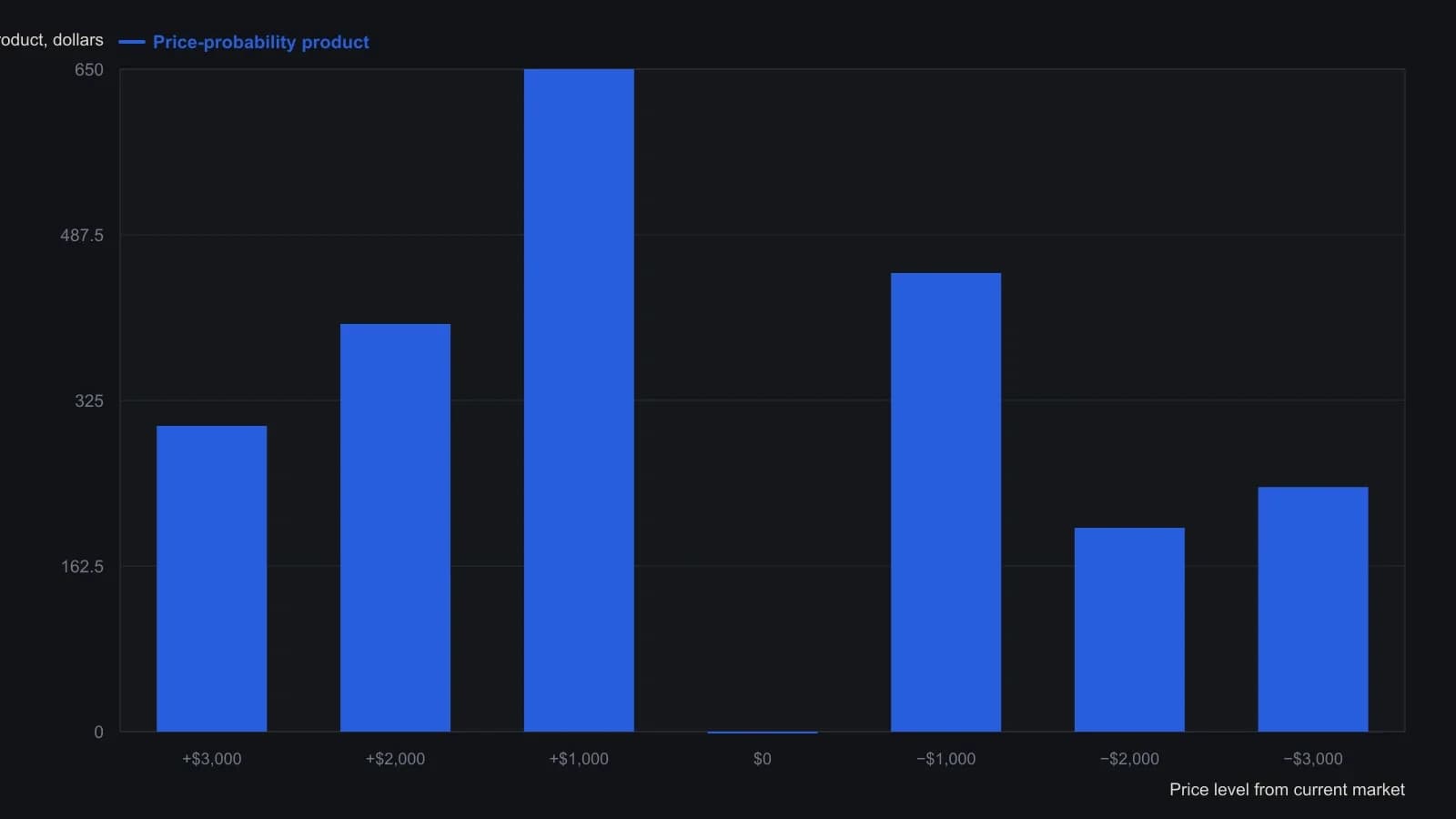
The same example applied $100 stop-loss slippage at a 10% probability and a $30 round-turn commission, giving a $410 long-run expected outcome for the +$1,000 target and −$2,000 stop.
All readings on this track · 50 readings
- 1990Three-window walk-forward system evaluation
- 1990Building the construction layer of a mechanical trading system
- 1991Constructing walk-forward neural trading rules
- 1991Constructing neural trading systems from facts to walk-forward
- 1992Walk-forward evaluation of stop overlays on average crossovers
- 1992Audit mechanical system tests for fills and regimes
- 1993Walk-forward evaluation of monthly yield and real-rate forecasts
- 1993Constructing walk-forward forecasts with linear and moving-average baselines
- 1993Walk-forward hybrid rules for intermarket forecast stacks
- 1994Neural-net construction as a mechanical trading-system problem
- 1995Constructing an intermarket neural net trading system
- 1996Weekly market breadth as one procedure on an unused window
- 1996Walk-forward evaluation of gold-index bond-fund rules
- 1996Evaluating weekday-in-month filters for index day trades
- 1996Require both a trend filter and a cycle oscillator before entry
- 1997Walk-forward windows as a diagnostic of parameter instability
- 1997Walk-forward validation of a market-breadth timing rule
- 1997Sunspot spikes and walk-forward evaluation of an adaptive cycle rule
- 1997A walk-forward check for bond-breadth timing
- 1998Walk-forward audit of regression trend forecasts
- 1998Evaluating a cubic least-squares currency trend with walk-forward segments
- 1998Walk-forward evaluation of recursive yen trend signals
- 1999Personal system design under crowd psychology
- 1999Walk-forward evaluation of a polynomial price forecast
- 2000Walk-forward optimization of regression-slope-angle rules
- 2001Construct a winter seasonal window as one procedure
- 2001Inspectable rules when system write-ups dry up
- 2002Evaluating mechanical systems before position sizing
- 2003Walk-forward construction of rule-based market-position systems
- 2007Evaluating metal seasonal windows across regimes
- 2007Evaluating mechanical timing systems against hold baselines
- 2011Walk-forward reoptimization as a system design gate
- 2011Evaluate generated systems on holdouts, then add stops
- 2012Walk-forward analysis and out-of-sample tests for a mechanical trading system
- 2012Personality-first trading system design
- 2012Scorecard-first mechanical system construction
- 2012Constructing an advancer-decliner moving average for market breadth
- 2012Formula search as mechanical system construction
- 2013Identity-first system construction
- 2013Construct a swing system from bias rules to walk-forward
- 2014Evaluate mechanical stock systems with stops and walk-forward
- 2014Walk-forward velocity filters on noisy intraday trends
- 2015Event-predictability versus position-constrained rules
- 2015Constructing mechanical systems for walk-forward tests
- 2016When a tested system must be retired
- 2016Walk-forward metric filters and chance-level checks for selected inputs
- 2018Evaluate mechanical trading systems without catalog rankings
- 2019Phased stop construction from entry risk to trailing exit
- 2020Stockpiling simple ideas for mechanical system construction
- 2020A pretty first draft is not a walk-forward waiver