2012issue C0112-17
Walk-forward analysis and out-of-sample tests for a mechanical trading system
Historical evaluation reserved unseen slices at the start and at the end of a dataset before treating a mechanical trading system as ready. Walk-forward analysis and those out-of-sample checks were still treated as unable to guarantee live-trading results.
- A mechanical trading system was treated as unfinished until it was forced to trade periods withheld from development, first at the start of the sample and then at the end.
- One design reserved the first 15 percent of a dataset and built the system on the remaining 85 percent; another developed on the first 80 percent and reserved the final 20 percent.
- Larger trade counts in these withheld-data tests were treated as making conclusions about whether a mechanical trading system is tradable more trustworthy.
- Walk-forward analysis and pre- or post-out-of-sample testing were treated as unable to guarantee that a system will make money in live trading.
A check at the start of the sample
One evaluation design reserved the first 15 percent of a dataset for out-of-sample testing and built the mechanical trading system on the remaining 85 percent as if that later slice were a new problem.
Editorial: Keep System optimization inside that later 85 percent. The first 15 percent is the period the rules are not allowed to see while they are being built.
A check at the end of the sample
A second evaluation design limited development to the first 80 percent of the original dataset and reserved the final 20 percent as previously unseen out-of-sample data.
Editorial: The same limit applies in reverse. System optimization may use only the earlier window. The final 20 percent is held back until the mechanical trading system is already specified.
What the withheld slices showed
In the first-15-percent out-of-sample check, an intraday emini Russell futures system produced hypothetical gains on data withheld from development. The accompanying equity path was described as having a low drawdown and no wild swings.
In the final-20-percent out-of-sample check, a 10-year emini Russell swing-trade system produced hypothetical gains on data it had not been developed with and had not previously encountered.
Larger trade counts in these withheld-data tests were treated as making conclusions about whether a mechanical trading system is tradable more trustworthy.
Editorial: Treat Walk-forward analysis as another withheld-data check in the same sequence, not as a separate kind of proof.
Closed-trade equity after holding back the last fifth of the sample
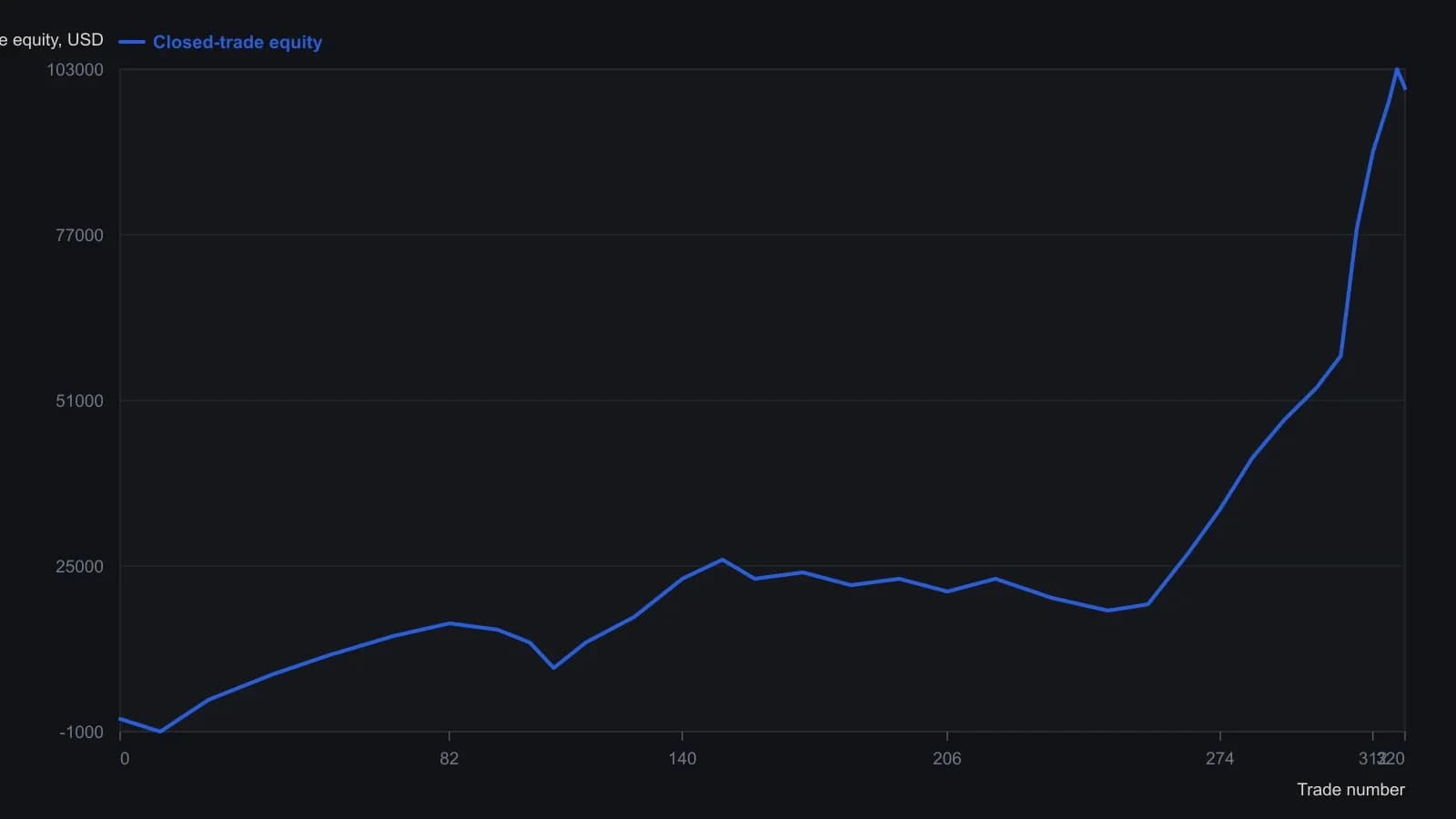
Development used only the first 80 percent of 31 October 2001–1 November 2011. The extracted raster does not resolve a line inside the reserved band, so those trades are omitted rather than guessed.
All readings on this track · 50 readings
- 1990Three-window walk-forward system evaluation
- 1990Building the construction layer of a mechanical trading system
- 1991Constructing walk-forward neural trading rules
- 1991Constructing neural trading systems from facts to walk-forward
- 1992Walk-forward evaluation of stop overlays on average crossovers
- 1992Audit mechanical system tests for fills and regimes
- 1993Walk-forward evaluation of monthly yield and real-rate forecasts
- 1993Constructing walk-forward forecasts with linear and moving-average baselines
- 1993Walk-forward hybrid rules for intermarket forecast stacks
- 1994Neural-net construction as a mechanical trading-system problem
- 1995Constructing an intermarket neural net trading system
- 1996Weekly market breadth as one procedure on an unused window
- 1996Walk-forward evaluation of gold-index bond-fund rules
- 1996Evaluating weekday-in-month filters for index day trades
- 1996Require both a trend filter and a cycle oscillator before entry
- 1997Walk-forward windows as a diagnostic of parameter instability
- 1997Walk-forward validation of a market-breadth timing rule
- 1997Sunspot spikes and walk-forward evaluation of an adaptive cycle rule
- 1997A walk-forward check for bond-breadth timing
- 1998Walk-forward audit of regression trend forecasts
- 1998Evaluating a cubic least-squares currency trend with walk-forward segments
- 1998Walk-forward evaluation of recursive yen trend signals
- 1999Personal system design under crowd psychology
- 1999Walk-forward evaluation of a polynomial price forecast
- 2000Walk-forward optimization of regression-slope-angle rules
- 2001Construct a winter seasonal window as one procedure
- 2001Inspectable rules when system write-ups dry up
- 2002Evaluating mechanical systems before position sizing
- 2003Walk-forward construction of rule-based market-position systems
- 2007Evaluating metal seasonal windows across regimes
- 2007Evaluating mechanical timing systems against hold baselines
- 2011Walk-forward reoptimization as a system design gate
- 2011Evaluate generated systems on holdouts, then add stops
- 2012Walk-forward analysis and out-of-sample tests for a mechanical trading system
- 2012Personality-first trading system design
- 2012Scorecard-first mechanical system construction
- 2012Constructing an advancer-decliner moving average for market breadth
- 2012Formula search as mechanical system construction
- 2013Identity-first system construction
- 2013Construct a swing system from bias rules to walk-forward
- 2014Evaluate mechanical stock systems with stops and walk-forward
- 2014Walk-forward velocity filters on noisy intraday trends
- 2015Event-predictability versus position-constrained rules
- 2015Constructing mechanical systems for walk-forward tests
- 2016When a tested system must be retired
- 2016Walk-forward metric filters and chance-level checks for selected inputs
- 2018Evaluate mechanical trading systems without catalog rankings
- 2019Phased stop construction from entry risk to trailing exit
- 2020Stockpiling simple ideas for mechanical system construction
- 2020A pretty first draft is not a walk-forward waiver