1992issue C071-8
Walk-forward evaluation of stop overlays on average crossovers
A historical walk-forward-window locked a triple-average-offset rule on a completed year and then scored stop and fill-timing overlays on the unused quarter. Editorial reading treats those overlays as a second locked decision, not as extra knobs on the window that chose the averages.
- The triple-average-offset rule entered only when the short, intermediate and long averages lined up in one direction and returned to flat on a later short-versus-intermediate cross.
- An in-sample-lock selected one combination on the training year and held it fixed on the unused quarter of each walk-forward-window.
- Entry-stop, trailing-stop, profit-stop and fill-timing-overlay constructions were compared with the same locked rule run without a money-management overlay.
- Editorial reading: judge stop distance and fill timing as a second locked decision, not as extra knobs on the same window that chose the averages.
Two decisions, not one search
The archive workflow separated the entry rule from the overlay that bounded or timed it. A triple-average-offset procedure was chosen first on a completed year. Stop and fill-timing overlays were then applied to that already locked rule and scored on the next unused quarter.
The same three-average rule was also run without a money-management overlay so that each overlay could be compared with an otherwise identical benchmark.
The locked entry rule
The triple-average-offset ranking used a short, an intermediate and a long simple average. The rule went long only when the short average was above the intermediate and the intermediate was above the long. It went short on the inverse ranking.
It did not stay continuously positioned. After entry it returned to flat when a later short-versus-intermediate cross appeared.
Average lengths were taken from a predeclared search grid of short, intermediate and long spans. That search belonged to the training year, not to the unused quarter.
The walk-forward-window
Each walk-forward-window was a completed optimization year followed by one unused quarter. An in-sample-lock selected one parameter combination on the training year with a predeclared objective and then held that combination fixed on the unused quarter.
Both segments then advanced by one quarter and the search was repeated. The unused quarter therefore received only parameters that had already been locked.
Stop and fill-timing overlays
Several stop-loss constructions were overlaid on the same locked entry rule. An entry-stop closed the position if a precommitted adverse-move distance from the fill was reached. A trailing-stop matched that bound on an immediate adverse move and otherwise ratcheted with the most favorable daily settlement. A profit-stop closed the position once a precommitted favorable-move distance from the fill was reached. One search joined an entry-stop with a profit-stop.
A fill-timing-overlay constrained whether a generated signal was executed on the close, on the next open, or only after a confirming or contrary price move.
The standalone entry-stop search added a grid of stop distances to the already defined average-length grid. The combined parameter set was still locked on the training year before it was scored on unused time.
Fills, rollovers and the unused-quarter score
Default fills were taken at the next session's open after a signal. Expiration-month rollovers were closed on the first session of the delivery month. Other overlays required a same-session close or a next-open fill only after a favorable or unfavorable price confirmation.
The unused-quarter score was quarterly net return on a contract. That figure subtracted a round-turn charge and interest on exchange margin at the prevailing Treasury bill rate. There was no interest credit on equity above the exchange minimum margin.
Those overlays were compared with a benchmark that used the same triple-average-offset rule and no money-management overlay.
Mean quarterly net return by overlay on the locked triple-average rule
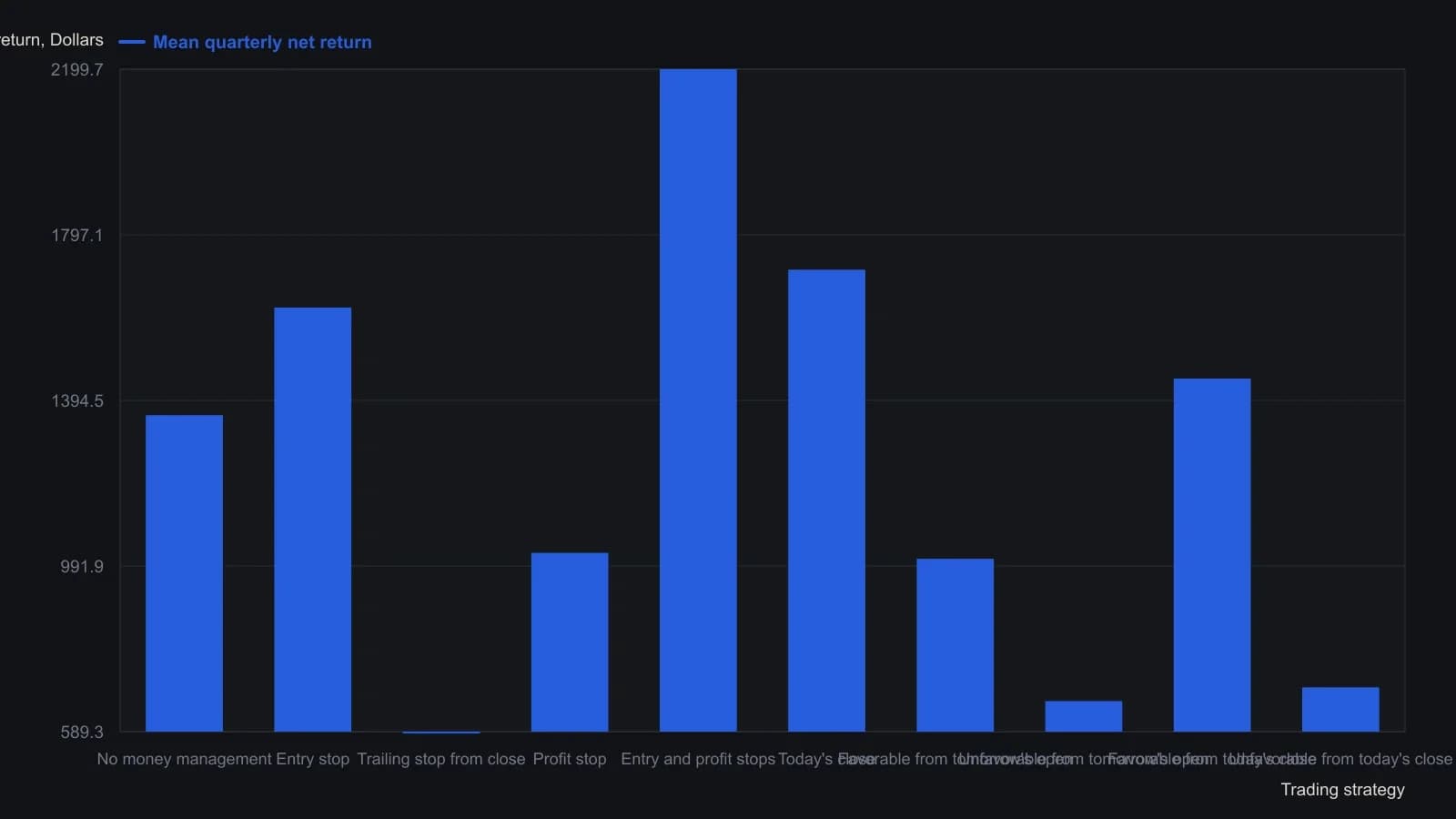
Each observation is one unused quarter after a one-year in-sample lock of the three-average parameters, rolled from 2 March 1978 to 1 September 1987. Returns are for one contract after a $47.50 round-turn charge and interest on a $3,500 margin; the authors called that cost stack unrealistically high.
All readings on this track · 50 readings
- 1990Three-window walk-forward system evaluation
- 1990Building the construction layer of a mechanical trading system
- 1991Constructing walk-forward neural trading rules
- 1991Constructing neural trading systems from facts to walk-forward
- 1992Walk-forward evaluation of stop overlays on average crossovers
- 1992Audit mechanical system tests for fills and regimes
- 1993Walk-forward evaluation of monthly yield and real-rate forecasts
- 1993Constructing walk-forward forecasts with linear and moving-average baselines
- 1993Walk-forward hybrid rules for intermarket forecast stacks
- 1994Neural-net construction as a mechanical trading-system problem
- 1995Constructing an intermarket neural net trading system
- 1996Weekly market breadth as one procedure on an unused window
- 1996Walk-forward evaluation of gold-index bond-fund rules
- 1996Evaluating weekday-in-month filters for index day trades
- 1996Require both a trend filter and a cycle oscillator before entry
- 1997Walk-forward windows as a diagnostic of parameter instability
- 1997Walk-forward validation of a market-breadth timing rule
- 1997Sunspot spikes and walk-forward evaluation of an adaptive cycle rule
- 1997A walk-forward check for bond-breadth timing
- 1998Walk-forward audit of regression trend forecasts
- 1998Evaluating a cubic least-squares currency trend with walk-forward segments
- 1998Walk-forward evaluation of recursive yen trend signals
- 1999Personal system design under crowd psychology
- 1999Walk-forward evaluation of a polynomial price forecast
- 2000Walk-forward optimization of regression-slope-angle rules
- 2001Construct a winter seasonal window as one procedure
- 2001Inspectable rules when system write-ups dry up
- 2002Evaluating mechanical systems before position sizing
- 2003Walk-forward construction of rule-based market-position systems
- 2007Evaluating metal seasonal windows across regimes
- 2007Evaluating mechanical timing systems against hold baselines
- 2011Walk-forward reoptimization as a system design gate
- 2011Evaluate generated systems on holdouts, then add stops
- 2012Walk-forward analysis and out-of-sample tests for a mechanical trading system
- 2012Personality-first trading system design
- 2012Scorecard-first mechanical system construction
- 2012Constructing an advancer-decliner moving average for market breadth
- 2012Formula search as mechanical system construction
- 2013Identity-first system construction
- 2013Construct a swing system from bias rules to walk-forward
- 2014Evaluate mechanical stock systems with stops and walk-forward
- 2014Walk-forward velocity filters on noisy intraday trends
- 2015Event-predictability versus position-constrained rules
- 2015Constructing mechanical systems for walk-forward tests
- 2016When a tested system must be retired
- 2016Walk-forward metric filters and chance-level checks for selected inputs
- 2018Evaluate mechanical trading systems without catalog rankings
- 2019Phased stop construction from entry risk to trailing exit
- 2020Stockpiling simple ideas for mechanical system construction
- 2020A pretty first draft is not a walk-forward waiver