1996issue C051-17
Walk-forward evaluation of gold-index bond-fund rules
A fully specified long-or-short procedure uses a daily gold-and-silver mining-stock index as the leading input and a long-term government bond fund as the traded instrument. Because the daily history was short, walk-forward-analysis with six-year estimation windows and one-year out-of-sample-holdout stretches replaced a single split.
- The design is one mechanical-trading-system: an index-jump-signal on a daily gold-and-silver mining-stock index, a same-day price-confirmation-filter on a long-term government bond fund, and a stance change on that day's close.
- A predecessor weekly gold-mining series could not act until the weekend, so the daily-index version was built to close that one-week action gap.
- A single split of about 12 years of daily history was rejected as too short to cover many price-dynamic regimes. Each walk-forward cycle estimated five parameters on a six-year window and applied them to the next one-year out-of-sample-holdout.
- Parameter sets changed from window to window, and a later market-decoupling was treated as an unavoidable rule failure, with a three-to-four-percent protective stop proposed only as a later design addition.
One close-to-close long-or-short procedure
The design is a fully specified long-or-short procedure. It uses a daily gold-and-silver mining-stock index as the leading input and a long-term government bond fund as the traded instrument. That pairing is intermarket-analysis: the bond-fund trade is read through conditions in the mining-stock index rather than in isolation.
The first rule is an index-jump-signal, a short-window percentage jump in that index, with the lookback generally placed in a five-to-25-day range. The premise is that an abrupt index move is followed by a same-direction move in long-term rates and an opposite move in bond-fund prices.
A price-confirmation-filter also has to be true. A buy requires the bond fund to have risen more than a set percentage from the lowest low recorded while the stance was short. A sell requires the fund to have fallen more than a set percentage from the highest high recorded while the stance was long.
Both the index-jump event and the bond-fund confirmation must be true on the same day, and the stance change is specified to occur on that day's close. Those clauses make one mechanical-trading-system: specified inputs and market state become a long or short stance under a stated close-to-close execution constraint.
Why the daily index version exists
A predecessor weekly gold-mining series could not act until the weekend. That left a one-week action gap that the daily-index version was built to close.
Fidelity government-bond fund with XAU jump signals, 1986–88
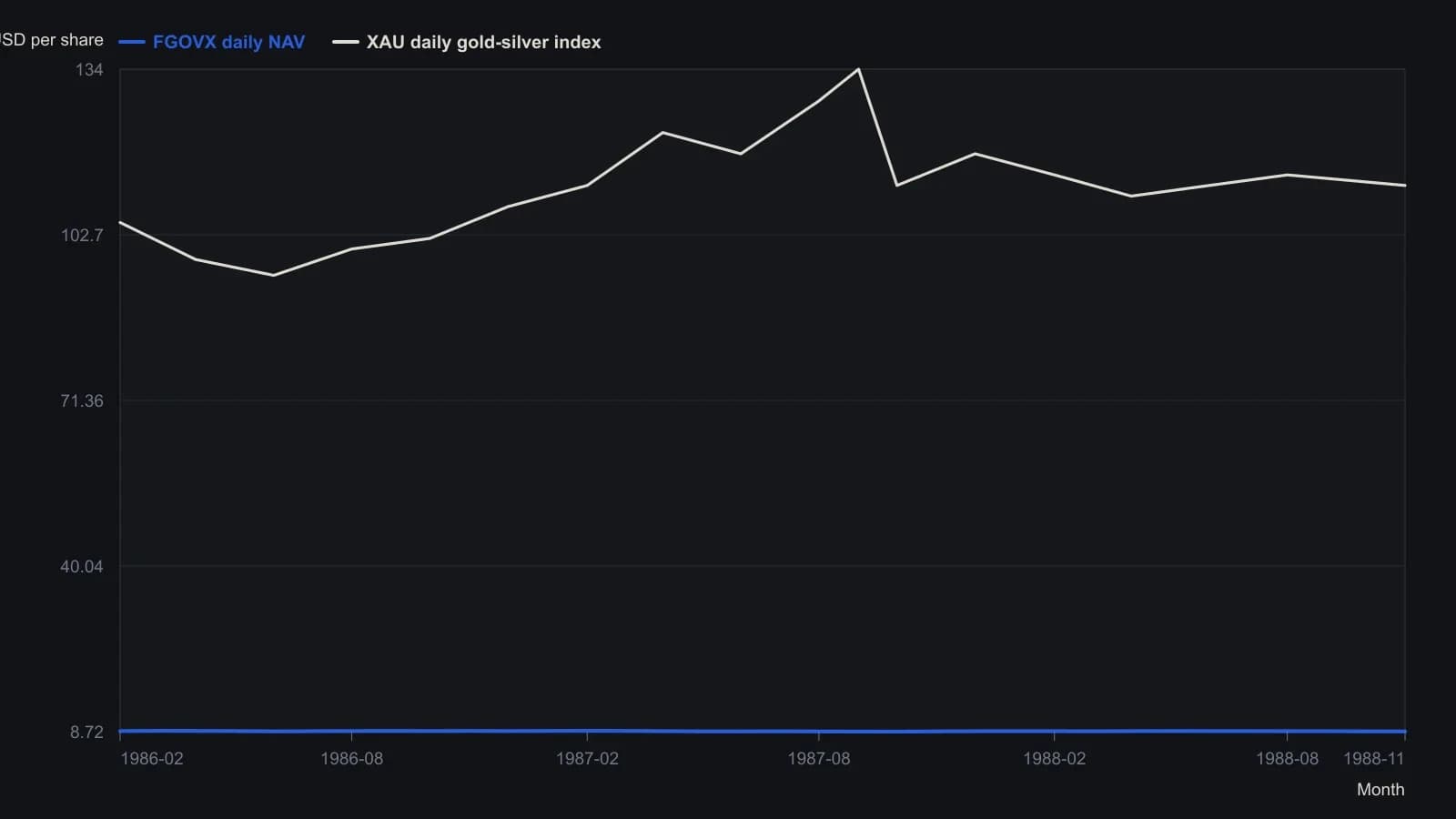
Approximate curve reading from a scanned raster. Y-scale ticks on the fund pane run from about 8.70 to 8.90; XAU from about 80 to 136; XAUjmp% from about −5 to 20. No more than the visually recoverable turning points are reported. FGOVX prices in the source are adjusted for capital-gains distributions but not monthly interest.
How the walk-forward cycles were built
With only about 12 years of daily index history, a single estimation-versus-holdout split was rejected because the estimation half would be too short to cover many price-dynamic regimes. Walk-forward windows were used instead.
Each walk-forward cycle estimated the five parameters on a six-year window, applied those values to the next one-year holdout, then advanced the window by one year. The holdouts were merged into one out-of-sample-holdout evaluation segment. That is walk-forward-analysis: fit the rules on a moving in-sample window, apply those frozen values to the next unused stretch, advance the window, and judge the merged holdouts rather than one curve-fit.
To limit computation, the search ran in two passes. First came the index-jump thresholds and lookback without confirmation. Then the bond-fund confirmation percentages were estimated on a short list of first-pass survivors.
Unstable coefficients and a later break
Chosen parameter sets changed from one six-year window to the next. That change was treated as evidence that six years did not yield coefficients that stayed stable or captured all observed dynamics. It is a parameter-stability finding: a shift to the next estimation window did not leave the chosen values settled.
A later stretch in which the index and bond prices moved opposite to the assumed linkage was treated as an unavoidable rule failure. That stretch is market-decoupling: the assumed gold-stock and bond-price linkage fails, so a rule that is internally consistent can still produce a large, unavoidable loss. A three-to-four-percent protective stop was proposed as a later design addition.
All readings on this track · 50 readings
- 1990Three-window walk-forward system evaluation
- 1990Building the construction layer of a mechanical trading system
- 1991Constructing walk-forward neural trading rules
- 1991Constructing neural trading systems from facts to walk-forward
- 1992Walk-forward evaluation of stop overlays on average crossovers
- 1992Audit mechanical system tests for fills and regimes
- 1993Walk-forward evaluation of monthly yield and real-rate forecasts
- 1993Constructing walk-forward forecasts with linear and moving-average baselines
- 1993Walk-forward hybrid rules for intermarket forecast stacks
- 1994Neural-net construction as a mechanical trading-system problem
- 1995Constructing an intermarket neural net trading system
- 1996Weekly market breadth as one procedure on an unused window
- 1996Walk-forward evaluation of gold-index bond-fund rules
- 1996Evaluating weekday-in-month filters for index day trades
- 1996Require both a trend filter and a cycle oscillator before entry
- 1997Walk-forward windows as a diagnostic of parameter instability
- 1997Walk-forward validation of a market-breadth timing rule
- 1997Sunspot spikes and walk-forward evaluation of an adaptive cycle rule
- 1997A walk-forward check for bond-breadth timing
- 1998Walk-forward audit of regression trend forecasts
- 1998Evaluating a cubic least-squares currency trend with walk-forward segments
- 1998Walk-forward evaluation of recursive yen trend signals
- 1999Personal system design under crowd psychology
- 1999Walk-forward evaluation of a polynomial price forecast
- 2000Walk-forward optimization of regression-slope-angle rules
- 2001Construct a winter seasonal window as one procedure
- 2001Inspectable rules when system write-ups dry up
- 2002Evaluating mechanical systems before position sizing
- 2003Walk-forward construction of rule-based market-position systems
- 2007Evaluating metal seasonal windows across regimes
- 2007Evaluating mechanical timing systems against hold baselines
- 2011Walk-forward reoptimization as a system design gate
- 2011Evaluate generated systems on holdouts, then add stops
- 2012Walk-forward analysis and out-of-sample tests for a mechanical trading system
- 2012Personality-first trading system design
- 2012Scorecard-first mechanical system construction
- 2012Constructing an advancer-decliner moving average for market breadth
- 2012Formula search as mechanical system construction
- 2013Identity-first system construction
- 2013Construct a swing system from bias rules to walk-forward
- 2014Evaluate mechanical stock systems with stops and walk-forward
- 2014Walk-forward velocity filters on noisy intraday trends
- 2015Event-predictability versus position-constrained rules
- 2015Constructing mechanical systems for walk-forward tests
- 2016When a tested system must be retired
- 2016Walk-forward metric filters and chance-level checks for selected inputs
- 2018Evaluate mechanical trading systems without catalog rankings
- 2019Phased stop construction from entry risk to trailing exit
- 2020Stockpiling simple ideas for mechanical system construction
- 2020A pretty first draft is not a walk-forward waiver