1998issue C051-10
Walk-forward audit of regression trend forecasts
A straight line is fitted to a finite run of daily closes and extended one sampling interval ahead. Five coefficients are then re-estimated on each successive five-year window and applied only to the following year, so later usefulness is judged on the merged one-year holdouts.
- A least-squares line through a finite run of daily closes is extended one sampling interval ahead to plot a next-close forecast.
- A long or short is taken only after that forecast curve has already moved by a stated percentage, with entries and exits at the next session open.
- Lookback length, two percentage trip levels, and two two-session jump levels are re-estimated on each successive five-year window and applied only to the following year.
- In-sample fitted values alone cannot establish later usefulness; the evaluation sample is the merged sequence of one-year holdouts.
Fitting a next-close forecast
Linear regression, in this workflow, is a least-squares line through ordered prices used as a next-interval forecast. A straight line is fitted through a finite run of daily closes by minimizing the sum of squared vertical distances from each close to the line. The same fit is extended one sampling interval ahead to produce a plotted next-close forecast.
Rules that wait for the curve to move
Trend following here means a long or short only after the forecast curve has already reversed by a stated threshold. A long is taken when that forecast curve has risen by a set percentage from its prior low while short, or when it has jumped by a set percentage versus two sessions earlier. The reverse pair of rules creates the short. Entries and exits are placed at the next session open, so the rules fire only after the forecast curve has already moved.
Scoring the later unseen year
Walk-forward analysis is a rolling in-sample fit followed by a later unseen interval used to score the same rules. Five coefficients are re-estimated on each successive five-year window and then applied only to the following year: lookback length, two percentage trip levels, and two two-session jump levels. In-sample fitted values alone cannot establish later usefulness. The evaluation sample is the merged sequence of one-year holdouts.
Continuous series and chart review
A back-adjusted continuous futures series lets quarterly contracts be treated as one price path, but omitted rollover costs and percentage-scale distortions mean that series is not identical to trading the live expiring contracts. Chart review of the same rules shows delayed signals after turns, weaker stretches in sideways ranges, and a stated need for more walk-forward work on choppy history before live use.
Linear-regression next-day forecast on continuous T-bond futures, 1988–89
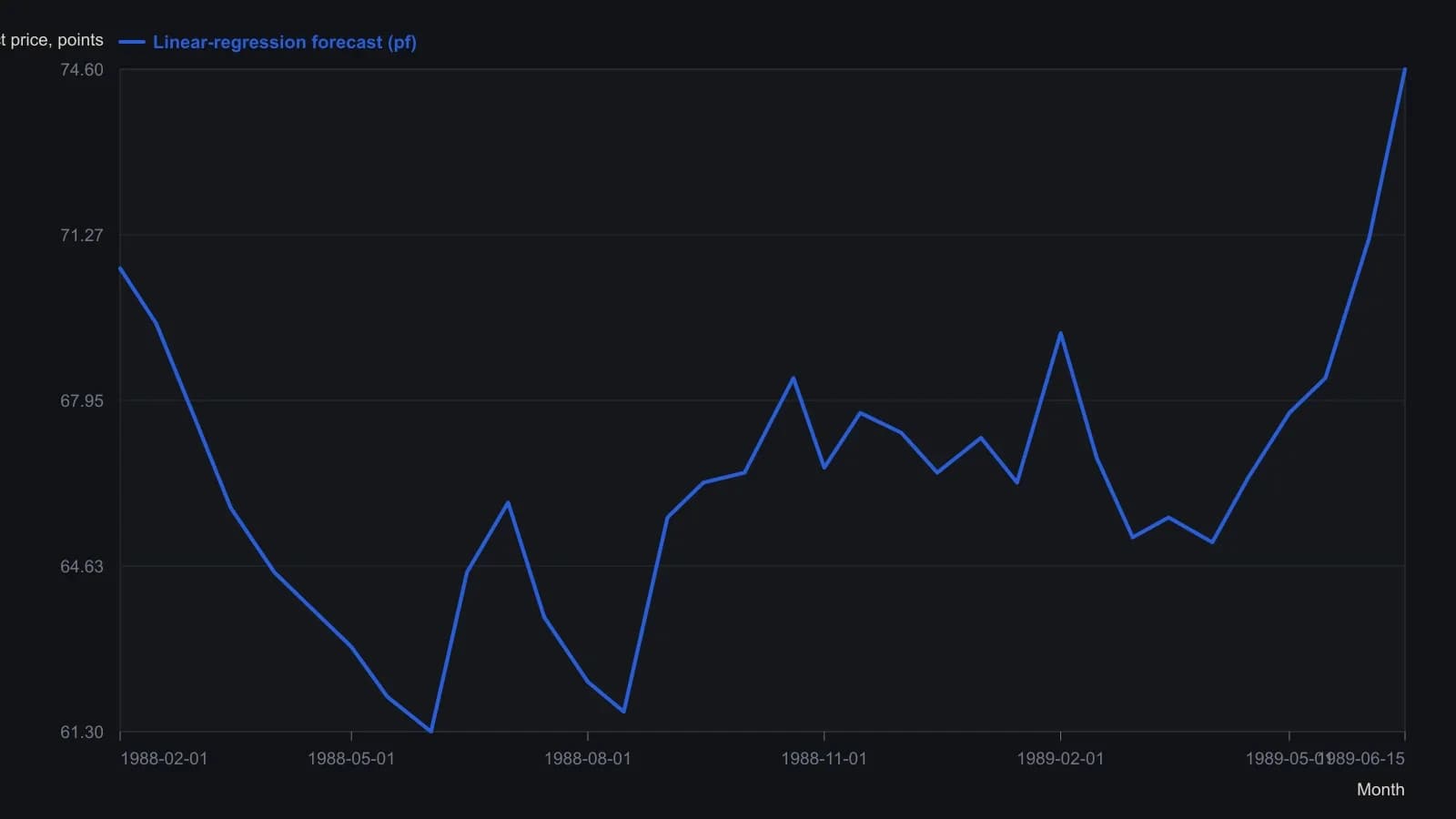
The overlay begins in February after the T-day fit warms up, not on 1 January 1988. Levels are roll-adjusted continuous-contract prices, not raw front-month prints. Points were sampled about every two weeks from the raster; allow roughly half a point of reading error.
All readings on this track · 50 readings
- 1990Three-window walk-forward system evaluation
- 1990Building the construction layer of a mechanical trading system
- 1991Constructing walk-forward neural trading rules
- 1991Constructing neural trading systems from facts to walk-forward
- 1992Walk-forward evaluation of stop overlays on average crossovers
- 1992Audit mechanical system tests for fills and regimes
- 1993Walk-forward evaluation of monthly yield and real-rate forecasts
- 1993Constructing walk-forward forecasts with linear and moving-average baselines
- 1993Walk-forward hybrid rules for intermarket forecast stacks
- 1994Neural-net construction as a mechanical trading-system problem
- 1995Constructing an intermarket neural net trading system
- 1996Weekly market breadth as one procedure on an unused window
- 1996Walk-forward evaluation of gold-index bond-fund rules
- 1996Evaluating weekday-in-month filters for index day trades
- 1996Require both a trend filter and a cycle oscillator before entry
- 1997Walk-forward windows as a diagnostic of parameter instability
- 1997Walk-forward validation of a market-breadth timing rule
- 1997Sunspot spikes and walk-forward evaluation of an adaptive cycle rule
- 1997A walk-forward check for bond-breadth timing
- 1998Walk-forward audit of regression trend forecasts
- 1998Evaluating a cubic least-squares currency trend with walk-forward segments
- 1998Walk-forward evaluation of recursive yen trend signals
- 1999Personal system design under crowd psychology
- 1999Walk-forward evaluation of a polynomial price forecast
- 2000Walk-forward optimization of regression-slope-angle rules
- 2001Construct a winter seasonal window as one procedure
- 2001Inspectable rules when system write-ups dry up
- 2002Evaluating mechanical systems before position sizing
- 2003Walk-forward construction of rule-based market-position systems
- 2007Evaluating metal seasonal windows across regimes
- 2007Evaluating mechanical timing systems against hold baselines
- 2011Walk-forward reoptimization as a system design gate
- 2011Evaluate generated systems on holdouts, then add stops
- 2012Walk-forward analysis and out-of-sample tests for a mechanical trading system
- 2012Personality-first trading system design
- 2012Scorecard-first mechanical system construction
- 2012Constructing an advancer-decliner moving average for market breadth
- 2012Formula search as mechanical system construction
- 2013Identity-first system construction
- 2013Construct a swing system from bias rules to walk-forward
- 2014Evaluate mechanical stock systems with stops and walk-forward
- 2014Walk-forward velocity filters on noisy intraday trends
- 2015Event-predictability versus position-constrained rules
- 2015Constructing mechanical systems for walk-forward tests
- 2016When a tested system must be retired
- 2016Walk-forward metric filters and chance-level checks for selected inputs
- 2018Evaluate mechanical trading systems without catalog rankings
- 2019Phased stop construction from entry risk to trailing exit
- 2020Stockpiling simple ideas for mechanical system construction
- 2020A pretty first draft is not a walk-forward waiver