1992issue C041-15
Constructing forecast models with regression, walk-forward, and robustness
Independent-variable series are prepared through preprocessing and mapped to a target-variable, then scored with squared-multiple-correlation on the training facts and on a later walk-forward-holdout, with a robustness-probe for capacity, sample size, and a changed market window.
- Construction begins by choosing independent-variable series, transforming them through preprocessing, and selecting a target-variable that is both usable in a later rule and realistically predictable from those inputs.
- Squared-multiple-correlation is the preferred training and accuracy statistic because it uses all observations and estimates how much target-variable variation the forecast accounts for.
- After a stable in-sample plateau, the same accuracy statistics are recomputed on a walk-forward-holdout. Failure on that later slice is treated as overfitting.
- A robustness-probe keeps hidden capacity small, requires at least twice as many training facts as interconnections, and asks whether a later market window has a different structure.
Inputs and the target-variable
Forecast construction begins by choosing independent-variable series, transforming them into numeric inputs, and selecting a target-variable that is both usable in a later rule and realistically predictable from those inputs.
Preprocessing for shape, scale, and redundancy
A 26-session close window is converted into 25 successive-difference observations so first-layer inputs emphasize recent shape rather than absolute price level and so adjacent-level collinearity is reduced.
Inputs are expected to occupy a 0-to-1 range with a useful spread. A series that sits near one value except for rare extremes is treated as a poor preprocessing design.
A derived average should be omitted when the raw window that already determines it is present, because the extra series adds no information the mapping cannot extract from the originals.
Training and the fit statistic
Training repeatedly adjusts each interconnection-weight to improve agreement with the target-variable and stops when further passes add little. The fitted mapping is then scored on both the training facts and later unseen observations.
Squared-multiple-correlation, carried over from linear regression, is used as the preferred training and accuracy statistic because it uses all observations and estimates how much target-variable variation the forecast accounts for.
Convergence is judged by an r-squared path that rises and then plateaus. A sharp rise followed by a collapse is treated as a failed training process rather than a usable fit.
Walk-forward-holdout and the robustness-probe
After a stable in-sample plateau, the same accuracy statistics are recomputed on a later walk-forward-holdout to test whether the mapping generalizes. Failure on that later slice is treated as overfitting.
Robustness design keeps hidden capacity small, requires at least twice as many training facts as interconnections, and treats an in-sample r-squared above 0.90 as a warning of leakage or memorization.
A later holdout can fail even when training converged if the later market structure differs from the training window, so a robustness-probe includes asking whether the regime itself has changed.
Squared multiple correlation across training runs
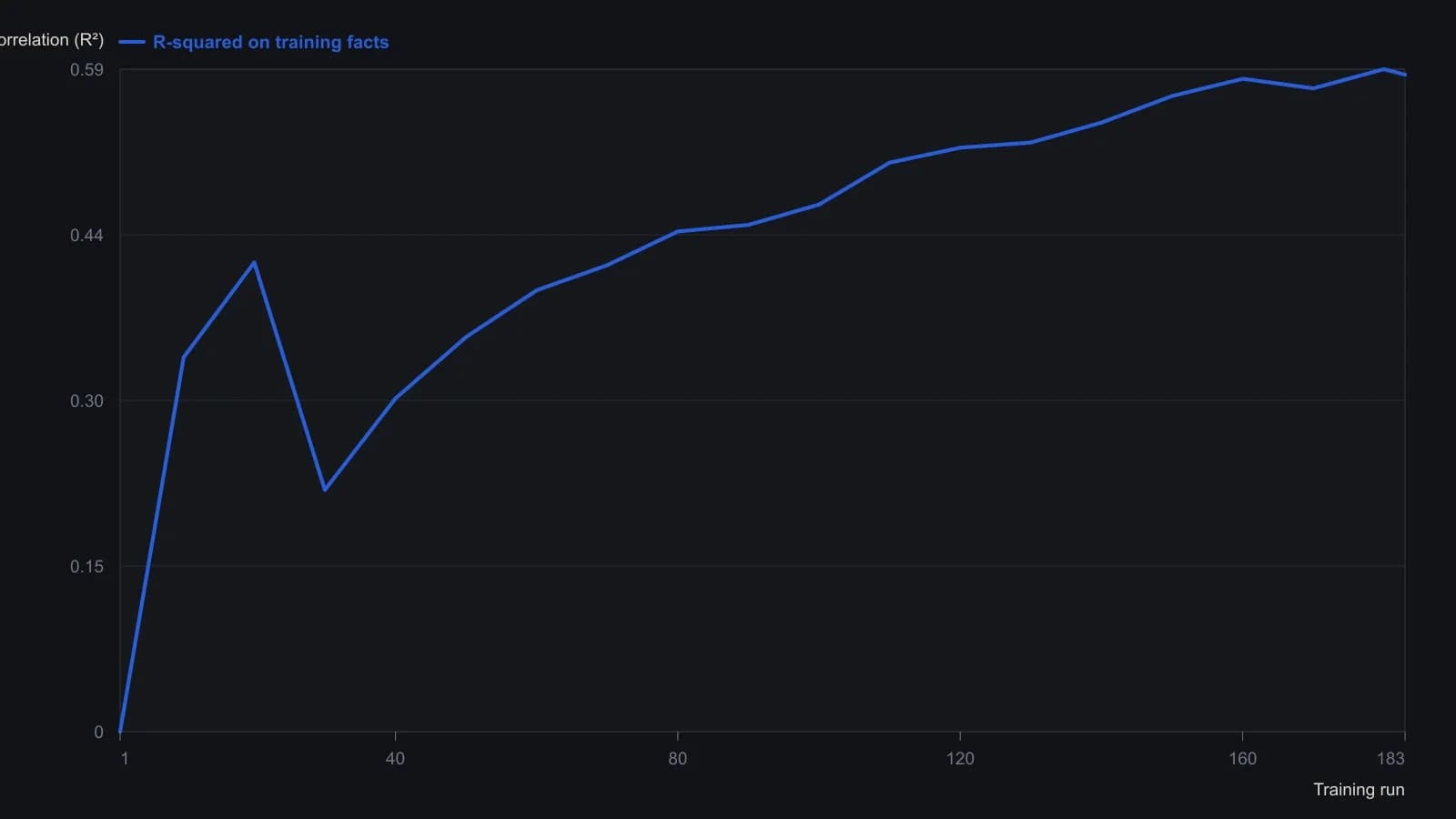
The printed log shows every tenth pass through 2,431 facts, plus the last run (183). Learning rate was held at 0.900 and the bad-forecast tolerance at 0.200. The drop at run 30 is in the source table and was not smoothed.
All readings on this track · 51 readings
- 1986Degrees of freedom in trading system optimization
- 1988Walk-forward and neighborhood tests after optimization
- 1988Undisclosed rules block system robustness tests
- 1988Testing re-optimization calendars against random parameter controls
- 1989Binary search limits on multi-peak average grids
- 1989Parameter neighborhoods that survive a shift
- 1990Use profit mapping to keep a cycle and stop plateau
- 1990Why popular indicator optimization fails robustness
- 1991Retesting weighted indicator balances across horizons
- 1992Constructing forecast models with regression, walk-forward, and robustness
- 1992Diagnose regimes before you lock parameters
- 1992When stops change system timing
- 1993Walk-forward halt rules for forecast models
- 1994Walk-forward evaluation of genetic index rules
- 1995Input pruning as walk-forward system evaluation
- 1995Critiquing neural nets as incomplete trading systems
- 1996Rebuild the equity-path ratio before it ranks a designed system
- 1996Parameter grids can fit random walks
- 1996Walk-forward analysis belongs in the design of a mechanical trading system
- 1997When a holdout fails, discard the rule set
- 1997Test rewarded rule breaks before replacing the system
- 1997Walk-forward rules keep system research from rewriting live trades
- 1999Keep a channel-breakout to two lookbacks and test neighbor stability
- 1999Constant investment size in stock system evaluation
- 2000Forcing optimization maps mechanical system failure boundaries
- 2000Robust parameter selection with surface charts
- 2001A two-gate classroom test for a two-window momentum trend filter
- 2002How a two-sided continuation factor becomes a testable trend rule
- 2002Evaluating two-window trend intensity as a reversal rule
- 2003Discounting speculative bubbles in system robustness tests
- 2003Walk-forward evaluation of locked stochastic oscillator rules
- 2003Critiquing mechanical system design after extreme price regimes
- 2004Evaluating a two-window trend trigger
- 2005Grade backtested signals with holdouts and optimization plateaus
- 2006Reserved-sample evaluation of trading system design
- 2006Walk-forward critique of hindsight crossover systems
- 2008Condition-matched walk-forward evaluation for mechanical systems
- 2011Session-split evaluation of regular and overnight systems
- 2012Walk-forward evaluation as operator rehearsal
- 2013Two-window evaluation of mechanical trading systems
- 2013Walk-forward filter selection for repeated-median velocity
- 2014Walk-forward evaluation for fading-memory velocity systems
- 2015Test oscillator events before tuning rules
- 2016Walk-forward evaluation of a five-parameter parabolic stop-and-reversal
- 2016Walk-forward optimization without curve fitting
- 2017Optimization without overfitting in trend-system evaluation
- 2017Parameter stability is a better guide than a larger crossover grid
- 2018Point-in-time universes for system evaluation
- 2018Walk-forward robustness evaluation for optimized systems
- 2018Critiquing breakout systems through robustness tests
- 2018A critique of parameter fitting in system design