2012issue C0951-56
Formula search as mechanical system construction
Archive construction loaded delimited numeric series, reserved a later unused row range for checking, and required inputs, an output, and an optimization method before formula search. Editorial interpretation: lock the data split, the objective, and the allowed operators first so exported mechanical rules are judged on reserved bars.
- Begin construction by loading delimited numeric series, inspecting them in a spreadsheet view, and assigning one row range to optimization and a later unused range to checking.
- Graph a dated price series with two background bands so the bars that create the formula stay distinct from the bars held back to test it.
- Choose inputs, an output, an optimization method, and formula-building parameters before the search runs, then score candidates with mathematical fit or trading criteria.
- Editorial interpretation: lock the data split, the objective, and the allowed operators first, then export the formula into a mechanical platform language so reserved bars can judge the rules.
Split the series before any search
The construction workflow begins by loading delimited numeric series, inspecting them in a spreadsheet view, and then assigning one row range to optimization and a later unused range to out-of-sample checking.
A dated price series can be graphed with two background bands so the builder can see which bars will create the formula and which bars are held back to test that formula.
One illustrated split used the first 762 rows to build the formula and the last 120 rows as the unused check set.
Harmony Gold daily open and close at the start of the search file
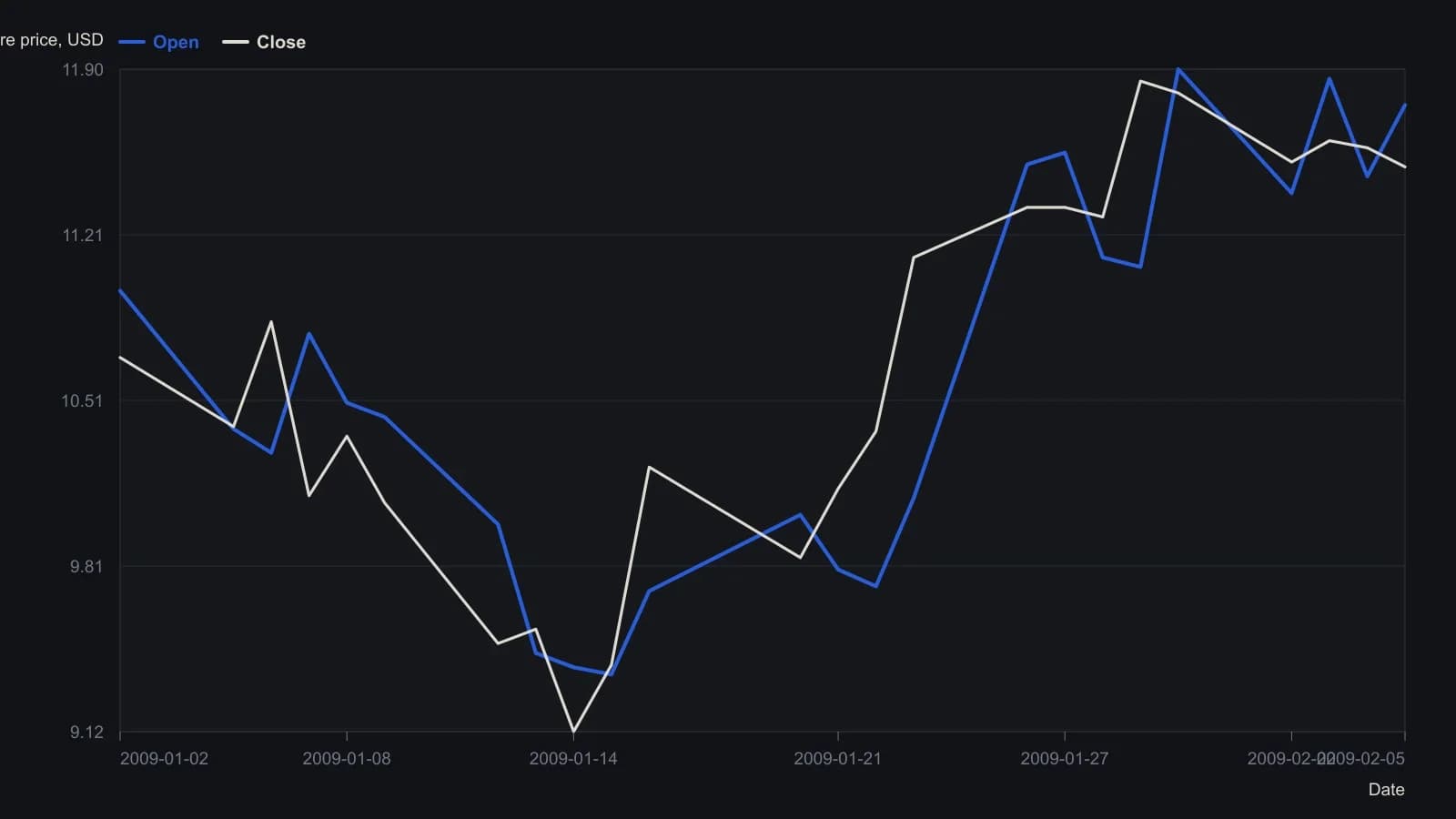
Only the first 24 of 882 rows are visible on the screenshot. The dialog shown with the grid sets 762 rows for optimization and 120 rows for out-of-sample checking.
Lock inputs, output, and scoring
Model construction requires choosing inputs, an output, an optimization method, and formula-building parameters before the search runs.
Independent-variable columns can be left unselected when technical indicators will later be generated from the same series, while a financial output such as the next session open can still be named.
Optional input scaling subtracts each column mean and divides by that column standard deviation before optimization.
The optimizer screen lets the builder choose a strategy type, cap how long the search may continue, and score candidates with either mathematical fit criteria or trading criteria.
Export the formula as executable rules
A finished formula can be exported through a conversion utility into a mechanical platform language so the same rules can be executed outside the search environment.
All readings on this track · 50 readings
- 1990Three-window walk-forward system evaluation
- 1990Building the construction layer of a mechanical trading system
- 1991Constructing walk-forward neural trading rules
- 1991Constructing neural trading systems from facts to walk-forward
- 1992Walk-forward evaluation of stop overlays on average crossovers
- 1992Audit mechanical system tests for fills and regimes
- 1993Walk-forward evaluation of monthly yield and real-rate forecasts
- 1993Constructing walk-forward forecasts with linear and moving-average baselines
- 1993Walk-forward hybrid rules for intermarket forecast stacks
- 1994Neural-net construction as a mechanical trading-system problem
- 1995Constructing an intermarket neural net trading system
- 1996Weekly market breadth as one procedure on an unused window
- 1996Walk-forward evaluation of gold-index bond-fund rules
- 1996Evaluating weekday-in-month filters for index day trades
- 1996Require both a trend filter and a cycle oscillator before entry
- 1997Walk-forward windows as a diagnostic of parameter instability
- 1997Walk-forward validation of a market-breadth timing rule
- 1997Sunspot spikes and walk-forward evaluation of an adaptive cycle rule
- 1997A walk-forward check for bond-breadth timing
- 1998Walk-forward audit of regression trend forecasts
- 1998Evaluating a cubic least-squares currency trend with walk-forward segments
- 1998Walk-forward evaluation of recursive yen trend signals
- 1999Personal system design under crowd psychology
- 1999Walk-forward evaluation of a polynomial price forecast
- 2000Walk-forward optimization of regression-slope-angle rules
- 2001Construct a winter seasonal window as one procedure
- 2001Inspectable rules when system write-ups dry up
- 2002Evaluating mechanical systems before position sizing
- 2003Walk-forward construction of rule-based market-position systems
- 2007Evaluating metal seasonal windows across regimes
- 2007Evaluating mechanical timing systems against hold baselines
- 2011Walk-forward reoptimization as a system design gate
- 2011Evaluate generated systems on holdouts, then add stops
- 2012Walk-forward analysis and out-of-sample tests for a mechanical trading system
- 2012Personality-first trading system design
- 2012Scorecard-first mechanical system construction
- 2012Constructing an advancer-decliner moving average for market breadth
- 2012Formula search as mechanical system construction
- 2013Identity-first system construction
- 2013Construct a swing system from bias rules to walk-forward
- 2014Evaluate mechanical stock systems with stops and walk-forward
- 2014Walk-forward velocity filters on noisy intraday trends
- 2015Event-predictability versus position-constrained rules
- 2015Constructing mechanical systems for walk-forward tests
- 2016When a tested system must be retired
- 2016Walk-forward metric filters and chance-level checks for selected inputs
- 2018Evaluate mechanical trading systems without catalog rankings
- 2019Phased stop construction from entry risk to trailing exit
- 2020Stockpiling simple ideas for mechanical system construction
- 2020A pretty first draft is not a walk-forward waiver