2013issue C0538-49
Construct a swing system from bias rules to walk-forward
A mechanical swing procedure can be built as one locked sequence. Freeze a long or short trading-bias from a major index, encode breakout and abstention rules from structure and a stochastic band, then walk those same coded rules onto later windows so entry, exit, and sitting out stay a single mechanical process.
- Start the mechanical-trading-system with a long or short trading-bias from a major index, then screen sectors and groups before any stock-level rule-based-entry.
- Specify new-trend construction as a prior trend, a basing-pattern, and a breakout, and keep trend state on successive peaks and troughs until the prior trough breaks.
- Let a continuation-pattern-entry supply entry, stop, and lean-in limits, then group the Boolean checks into condition-action-set blocks.
- After the rules are assembled, re-run the same procedure on later historical windows so walk-forward-analysis keeps entry, exit, and abstention as one checkable process.
Treat construction as one locked procedure
A mechanical-trading-system turns rule inputs, market state, and execution constraints into entry, exit, or abstention signals over the system's holding period. The construction job is to write those rules as one procedure before any later window is used to check them.
A written plan with simple rules, realistic expected return and risk, and a journal of winners and losers can keep entry, exit, and abstention as one procedure the trader can restudy.
Editorial interpretation: freeze the top-down stance first, encode the breakout and sit-out rules next, then walk that same coded process forward. The archive workflow is a historical construction sequence, not a claim about present markets.
Freeze the trading-bias and the sector list
A mechanical swing procedure can start by taking a long or short trading-bias from a major index, then move through sectors and industry groups before selecting individual stocks. That stance is taken from the major-index trend before sector, group, or stock selection begins.
Sector eligibility can be reduced to a relative-sector-screen: a short list of sector vehicles ranked on one-, three-, and six-month relative performance, without looking past a year.
Write trend, basing, and stochastic rules
New-trend construction can be specified as a prior trend, a basing-pattern where buying and selling pressure have equalized, and a breakout that shows one side has taken control.
A long-horizon stochastic rule can be written as an uptrend signal on a break above 60 after a 0-60 downtrend band, and a downtrend signal on a break below 40 after a 40-100 uptrend band.
Trend state for the system can be read from successive peaks and troughs on the price chart. An uptrend fails only when price breaks the prior trough.
Map continuation patterns to entry and abstention
Rule-based-entry fires only when specified price-structure or indicator conditions are met, not when a discretionary hunch arrives. After an uptrend is defined, a rule-based long can wait for a falling flag or falling wedge so the entry and exit levels come from the pattern. The inverse patterns apply after a downtrend.
That wait is a continuation-pattern-entry: a pullback taken in the direction of the already defined trend so the pattern itself supplies the entry, stop, and target.
Risk and reward can be calculated from the same continuation pattern before entry. The stop can sit at the pattern low, and the position can be leaned into before the breakout when that ratio is acceptable. Those limits are an execution-constraint on when a signal may fire.
Editorial interpretation: if the flag, wedge, or stochastic band is not in place, the same rules return abstention. Sitting out belongs inside the mechanical-trading-system, not in a later discretionary overlay.
Code the action sets and walk them forward
A strategy builder can group Boolean conditions into separate entry and exit condition-action-set blocks, then attach order-management steps such as enter long or exit long only when those comparisons evaluate as true.
After the rules are assembled, the same strategy can be backtested on a chart and forward-tested against historical data so simulated fills and results are checked beyond a single specification window. Walk-forward-analysis is that re-run of the same coded procedure on successive unseen or later windows, so the rules remain one checkable process rather than a single-sample fit.
QQQ 60-minute price, 6–7 February 2013
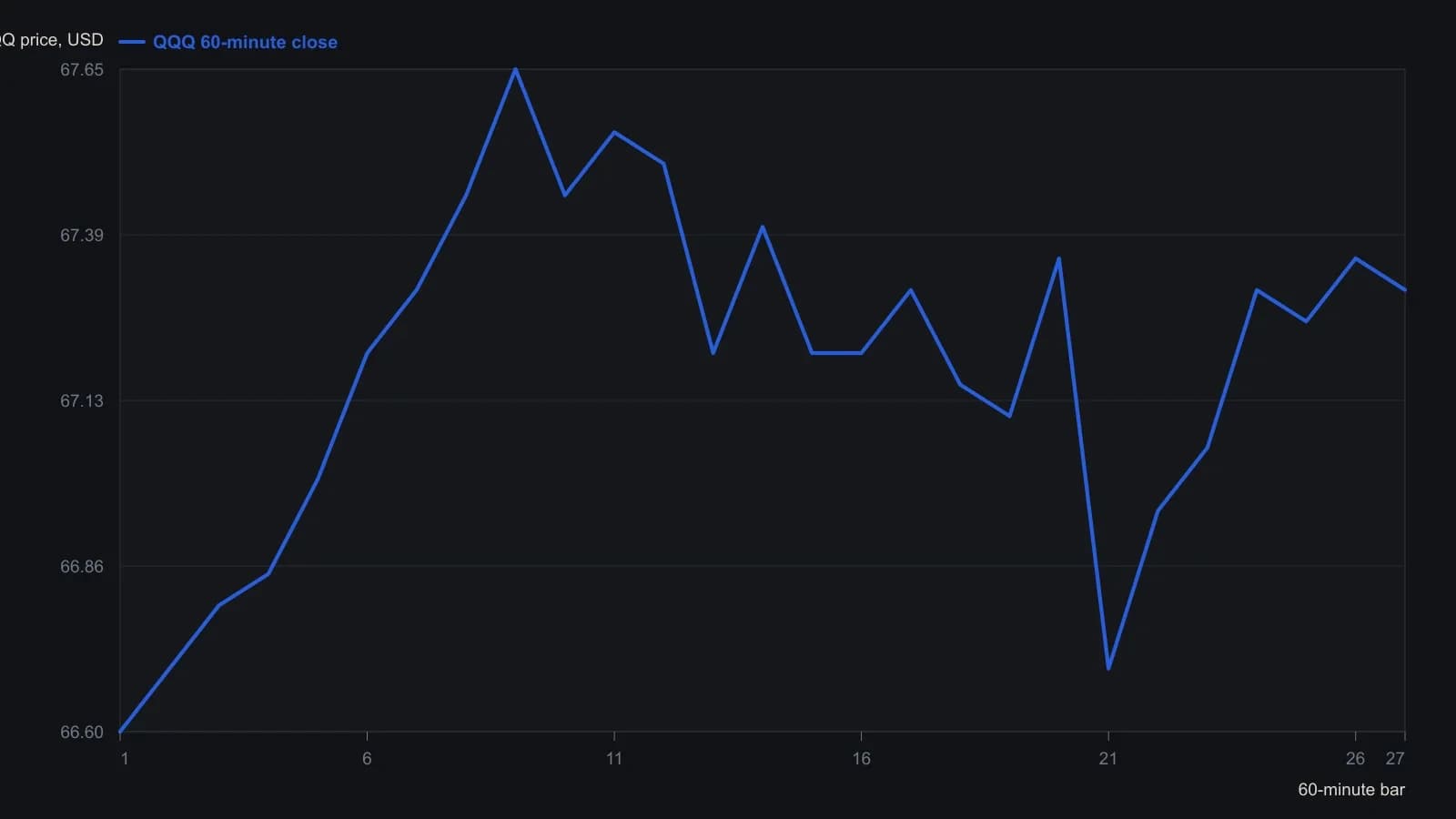
Printed Fibonacci percentages include unused extension projections above and below the bars and were not taken as traded prints. The review flags the first valley on the left as questionable. Closes are approximate to the nearest five cents except the labeled last print of 67.30.
All readings on this track · 50 readings
- 1990Three-window walk-forward system evaluation
- 1990Building the construction layer of a mechanical trading system
- 1991Constructing walk-forward neural trading rules
- 1991Constructing neural trading systems from facts to walk-forward
- 1992Walk-forward evaluation of stop overlays on average crossovers
- 1992Audit mechanical system tests for fills and regimes
- 1993Walk-forward evaluation of monthly yield and real-rate forecasts
- 1993Constructing walk-forward forecasts with linear and moving-average baselines
- 1993Walk-forward hybrid rules for intermarket forecast stacks
- 1994Neural-net construction as a mechanical trading-system problem
- 1995Constructing an intermarket neural net trading system
- 1996Weekly market breadth as one procedure on an unused window
- 1996Walk-forward evaluation of gold-index bond-fund rules
- 1996Evaluating weekday-in-month filters for index day trades
- 1996Require both a trend filter and a cycle oscillator before entry
- 1997Walk-forward windows as a diagnostic of parameter instability
- 1997Walk-forward validation of a market-breadth timing rule
- 1997Sunspot spikes and walk-forward evaluation of an adaptive cycle rule
- 1997A walk-forward check for bond-breadth timing
- 1998Walk-forward audit of regression trend forecasts
- 1998Evaluating a cubic least-squares currency trend with walk-forward segments
- 1998Walk-forward evaluation of recursive yen trend signals
- 1999Personal system design under crowd psychology
- 1999Walk-forward evaluation of a polynomial price forecast
- 2000Walk-forward optimization of regression-slope-angle rules
- 2001Construct a winter seasonal window as one procedure
- 2001Inspectable rules when system write-ups dry up
- 2002Evaluating mechanical systems before position sizing
- 2003Walk-forward construction of rule-based market-position systems
- 2007Evaluating metal seasonal windows across regimes
- 2007Evaluating mechanical timing systems against hold baselines
- 2011Walk-forward reoptimization as a system design gate
- 2011Evaluate generated systems on holdouts, then add stops
- 2012Walk-forward analysis and out-of-sample tests for a mechanical trading system
- 2012Personality-first trading system design
- 2012Scorecard-first mechanical system construction
- 2012Constructing an advancer-decliner moving average for market breadth
- 2012Formula search as mechanical system construction
- 2013Identity-first system construction
- 2013Construct a swing system from bias rules to walk-forward
- 2014Evaluate mechanical stock systems with stops and walk-forward
- 2014Walk-forward velocity filters on noisy intraday trends
- 2015Event-predictability versus position-constrained rules
- 2015Constructing mechanical systems for walk-forward tests
- 2016When a tested system must be retired
- 2016Walk-forward metric filters and chance-level checks for selected inputs
- 2018Evaluate mechanical trading systems without catalog rankings
- 2019Phased stop construction from entry risk to trailing exit
- 2020Stockpiling simple ideas for mechanical system construction
- 2020A pretty first draft is not a walk-forward waiver