2016issue C0513-16
Walk-forward metric filters and chance-level checks for selected inputs
A walk-forward search can apply an in-sample metric filter to choose one input row, then test the associated rules on the matching out-of-sample window. Chance-level mirrors that draw a random row in each weekly file give a reference distribution for the filter’s total out-of-sample net profit.
- Walk-forward analysis can search many input combinations on in-sample data, then apply a metric filter to pick one input row whose rules are evaluated on the matching out-of-sample window.
- Ranking candidate inputs by a single simple metric such as highest net profit or best profit factor is described as rarely producing good out-of-sample results.
- A composite filter first drops in-sample rows with more than five consecutive losers, then keeps the twenty remaining rows with the largest median-win-to-median-loss ratios so a few large trades do not distort the ranking the way an average would.
- Bootstrap resampling builds five thousand mirror filters that, in each weekly file, draw a random row’s out-of-sample net profit and sum those draws into a chance-level reference for total net profit.
Search many inputs, then test one selected row
A walk-forward procedure can search many input combinations on in-sample data, then apply a chosen metric filter to pick one input row whose associated rules are evaluated on the matching out-of-sample window.
System optimization is the in-sample search over those input combinations. Walk-forward analysis is the procedure that carries the selected row onto the matching out-of-sample window.
Simple ranking versus a composite metric filter
Ranking candidate inputs by a single simple metric such as highest net profit or best profit factor is described as rarely producing good out-of-sample results.
A more composite filter first drops in-sample rows with more than five consecutive losers, then keeps the twenty remaining rows with the largest median-win-to-median-loss ratios.
Median win and loss statistics are used in the filter so a few large, possibly nonrepeatable trades do not distort the ranking the way an average would.
The reported walk-forward explorer run
The reported walk-forward explorer run covers two hundred two weekly in-sample and out-of-sample windows of thirty-minute SPY bars for a parabolic SAR strategy, with first and last out-of-sample week-end dates of April 6, 2012 and February 12, 2016.
Out-of-sample evaluation in the reported run is framed on a one-hundred-share SPY size after subtracting a four-dollar round-trip cost and slippage from total net profit.
Walk-forward out-of-sample equity for the SPY SAR metric filter
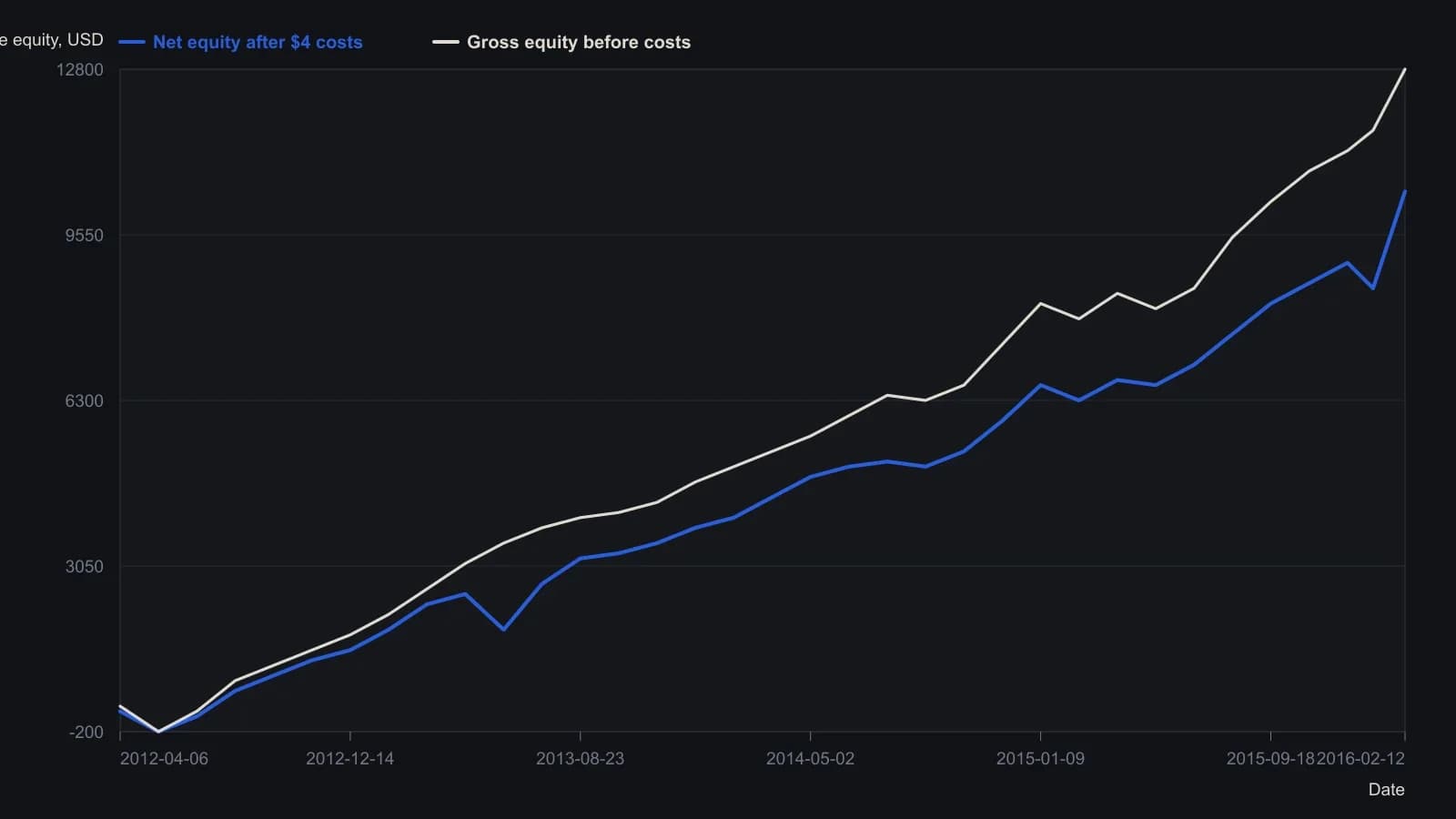
The in-sample screen kept rows with at most five consecutive losers, took the 20 highest median-win to median-loss ratios, then chose the smallest median losing trade. Second-order polynomial overlays on the source plot are omitted. Point values are approximate readings from the printed chart.
Chance-level mirrors and filter output columns
Chance-level comparison is constructed by building five thousand mirror filters that, in each weekly file, draw a random row’s out-of-sample net profit instead of the filter-selected row, then summing those draws to form a reference distribution of total net profit. That construction is the Bootstrap resampling step in the reported workflow.
Filter output columns include student-t on weekly out-of-sample profits, efficiency as average daily out-of-sample profit divided by average daily in-sample profit, and a probability that the filter’s total out-of-sample net profit arose by chance.
All readings on this track · 50 readings
- 1990Three-window walk-forward system evaluation
- 1990Building the construction layer of a mechanical trading system
- 1991Constructing walk-forward neural trading rules
- 1991Constructing neural trading systems from facts to walk-forward
- 1992Walk-forward evaluation of stop overlays on average crossovers
- 1992Audit mechanical system tests for fills and regimes
- 1993Walk-forward evaluation of monthly yield and real-rate forecasts
- 1993Constructing walk-forward forecasts with linear and moving-average baselines
- 1993Walk-forward hybrid rules for intermarket forecast stacks
- 1994Neural-net construction as a mechanical trading-system problem
- 1995Constructing an intermarket neural net trading system
- 1996Weekly market breadth as one procedure on an unused window
- 1996Walk-forward evaluation of gold-index bond-fund rules
- 1996Evaluating weekday-in-month filters for index day trades
- 1996Require both a trend filter and a cycle oscillator before entry
- 1997Walk-forward windows as a diagnostic of parameter instability
- 1997Walk-forward validation of a market-breadth timing rule
- 1997Sunspot spikes and walk-forward evaluation of an adaptive cycle rule
- 1997A walk-forward check for bond-breadth timing
- 1998Walk-forward audit of regression trend forecasts
- 1998Evaluating a cubic least-squares currency trend with walk-forward segments
- 1998Walk-forward evaluation of recursive yen trend signals
- 1999Personal system design under crowd psychology
- 1999Walk-forward evaluation of a polynomial price forecast
- 2000Walk-forward optimization of regression-slope-angle rules
- 2001Construct a winter seasonal window as one procedure
- 2001Inspectable rules when system write-ups dry up
- 2002Evaluating mechanical systems before position sizing
- 2003Walk-forward construction of rule-based market-position systems
- 2007Evaluating metal seasonal windows across regimes
- 2007Evaluating mechanical timing systems against hold baselines
- 2011Walk-forward reoptimization as a system design gate
- 2011Evaluate generated systems on holdouts, then add stops
- 2012Walk-forward analysis and out-of-sample tests for a mechanical trading system
- 2012Personality-first trading system design
- 2012Scorecard-first mechanical system construction
- 2012Constructing an advancer-decliner moving average for market breadth
- 2012Formula search as mechanical system construction
- 2013Identity-first system construction
- 2013Construct a swing system from bias rules to walk-forward
- 2014Evaluate mechanical stock systems with stops and walk-forward
- 2014Walk-forward velocity filters on noisy intraday trends
- 2015Event-predictability versus position-constrained rules
- 2015Constructing mechanical systems for walk-forward tests
- 2016When a tested system must be retired
- 2016Walk-forward metric filters and chance-level checks for selected inputs
- 2018Evaluate mechanical trading systems without catalog rankings
- 2019Phased stop construction from entry risk to trailing exit
- 2020Stockpiling simple ideas for mechanical system construction
- 2020A pretty first draft is not a walk-forward waiver