1992issue C091-6
Audit mechanical system tests for fills and regimes
A mechanical trading system is a complete rule procedure that issues specific buy and sell signals, with a moving-average crossover as the elementary case. Historical tests are described as informative only when transaction costs, fill prices, intraperiod path, and regime coverage resemble live trading conditions.
- A mechanical trading system is a complete rule procedure that issues specific buy and sell signals. A moving-average crossover is the elementary case, and the same historical testing is treated as applicable to composite stacks.
- A favorable historical score is described as failing to transfer when the test omits transaction costs, uses an illegal or same-bar fill price, or ignores intraperiod trades.
- A close-triggered signal cannot be filled at that close; the next open is the realistic price, and a close-to-close moving-average test can hide extra trades inside the bar.
- Trend-following mechanical systems need regime coverage across rising, falling, and sideways stretches. Editorial: grade the honesty of the simulator before grading the procedure.
Grade the test before the rule
Editorial: before asking whether a mechanical moving-average rule worked, ask which unstated gifts were doing the work. Zero friction, illegal or same-bar fills, ignored crossings inside the bar, and a one-way sample can carry a historical score. Grade the honesty of the simulator before grading the procedure.
A mechanical trading system is a complete rule procedure that issues specific buy and sell signals. A moving-average crossover is given as the elementary case. Composite mechanical systems may stack multiple moving averages with oscillators, stochastics, relative-strength, MACD, filters, and stop-loss rules. Historical testing is treated as applicable to both simple and composite stacks.
Historical price databases can score a mechanical strategy in minutes. A favorable historical result is described as failing to transfer when the test used incorrect assumptions.
Transaction costs can reverse the score
Omitting commissions and slippage, or setting them unrealistically low, is named a primary testing error. Transaction costs are commissions plus slippage charged against each completed trade inside a historical test.
In a 30-trade illustration, a 6,000 pre-cost total becomes 3,000, zero, or a 3,000 loss at per-trade costs of 100, 200, and 300.
Fill price must be later and increment-legal
The fill price is the price at which a test assumes a signal could actually have been executed after the rule fired. A crossover fill at 411.03 is rejected because the contract traded in 0.05 increments and because the buy decision is known only after the average has already been crossed. A later increment-legal price is required.
A close-triggered signal cannot be filled at that close. The next open is the realistic price. In a 63-session March to May 1992 index-futures sample, the open matched the prior close once, differed by 0.73 on average, and gapped 2.55 and nearly 3 points on two cited days.
Close-to-close tests can hide intraperiod trades
A daily close-to-close moving-average test can log one buy on a day whose intra-day path produced three buys and two sells. An intraperiod trade is an extra entry or exit created by the path inside a sampling bar and invisible to a close-to-close comparison. Ignored intraperiod trades overstate the procedure.
Regime coverage is part of the sample
Trend-following mechanical systems can look strong in a one-direction rise or decline and generate large losses in a sideways stretch. A sufficient sample must include rising, falling, and sideways movement. Regime coverage is the inclusion of those three stretches in the historical window used to judge a trend-following rule.
Next-open gaps versus prior close, June 1992 S&P 500 futures
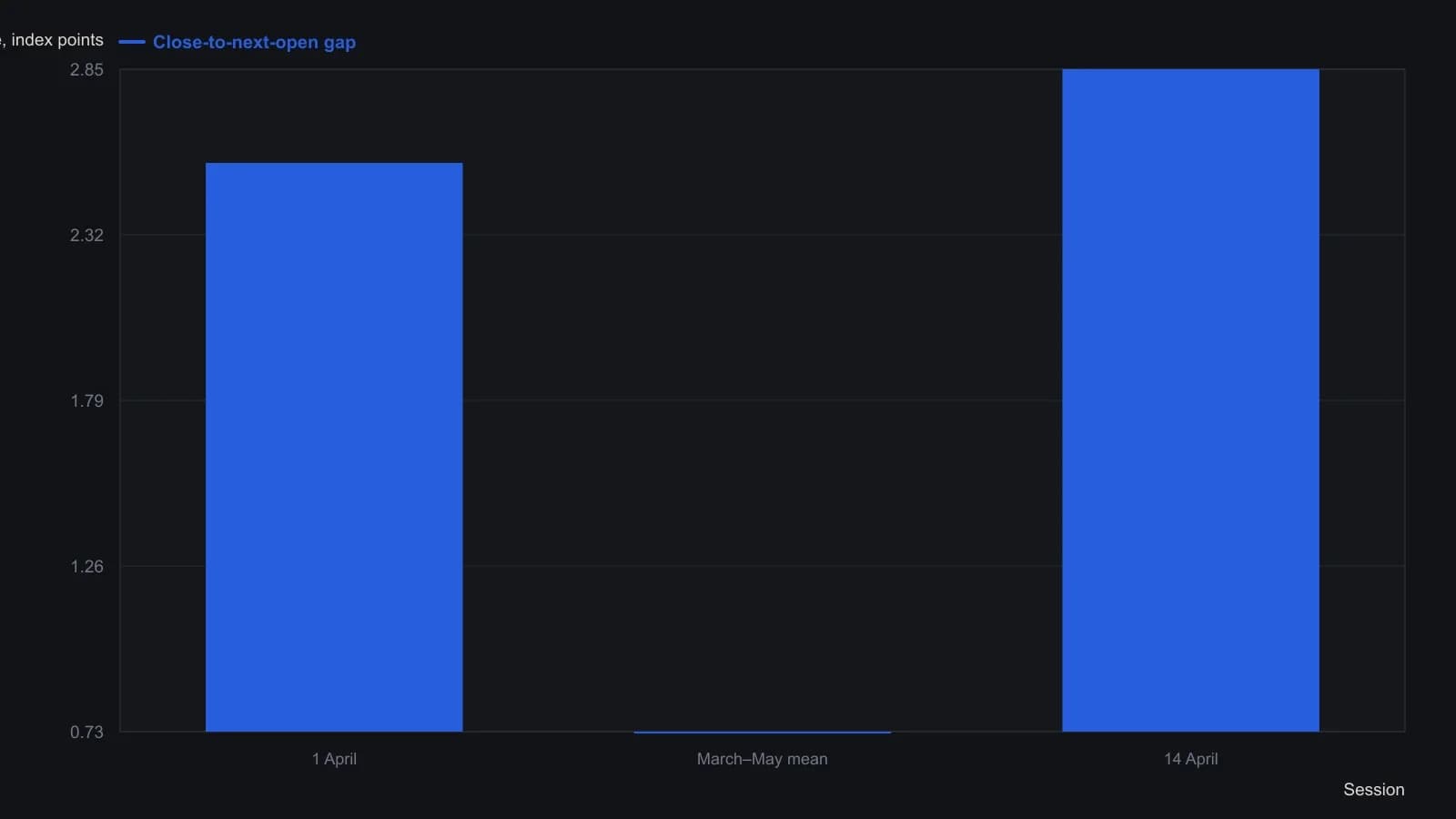
Gaps are absolute. The 14 April value is 407.95 minus the stated 13 April close of 405.10; Meyers rounds that opening jump to almost three points. S&P 500 futures then traded in 0.05 increments, so a moving-average print such as 411.03 was not a legal fill even before the next-open delay.
When a historical test is described as informative
Historical tests are described as informative only when cost, fill, path, and sample-period assumptions resemble live trading conditions.
Editorial: do not ask whether the moving-average crossover worked until the historical test has been audited for transaction costs, fill price, intraperiod trades, and regime coverage.
All readings on this track · 50 readings
- 1990Three-window walk-forward system evaluation
- 1990Building the construction layer of a mechanical trading system
- 1991Constructing walk-forward neural trading rules
- 1991Constructing neural trading systems from facts to walk-forward
- 1992Walk-forward evaluation of stop overlays on average crossovers
- 1992Audit mechanical system tests for fills and regimes
- 1993Walk-forward evaluation of monthly yield and real-rate forecasts
- 1993Constructing walk-forward forecasts with linear and moving-average baselines
- 1993Walk-forward hybrid rules for intermarket forecast stacks
- 1994Neural-net construction as a mechanical trading-system problem
- 1995Constructing an intermarket neural net trading system
- 1996Weekly market breadth as one procedure on an unused window
- 1996Walk-forward evaluation of gold-index bond-fund rules
- 1996Evaluating weekday-in-month filters for index day trades
- 1996Require both a trend filter and a cycle oscillator before entry
- 1997Walk-forward windows as a diagnostic of parameter instability
- 1997Walk-forward validation of a market-breadth timing rule
- 1997Sunspot spikes and walk-forward evaluation of an adaptive cycle rule
- 1997A walk-forward check for bond-breadth timing
- 1998Walk-forward audit of regression trend forecasts
- 1998Evaluating a cubic least-squares currency trend with walk-forward segments
- 1998Walk-forward evaluation of recursive yen trend signals
- 1999Personal system design under crowd psychology
- 1999Walk-forward evaluation of a polynomial price forecast
- 2000Walk-forward optimization of regression-slope-angle rules
- 2001Construct a winter seasonal window as one procedure
- 2001Inspectable rules when system write-ups dry up
- 2002Evaluating mechanical systems before position sizing
- 2003Walk-forward construction of rule-based market-position systems
- 2007Evaluating metal seasonal windows across regimes
- 2007Evaluating mechanical timing systems against hold baselines
- 2011Walk-forward reoptimization as a system design gate
- 2011Evaluate generated systems on holdouts, then add stops
- 2012Walk-forward analysis and out-of-sample tests for a mechanical trading system
- 2012Personality-first trading system design
- 2012Scorecard-first mechanical system construction
- 2012Constructing an advancer-decliner moving average for market breadth
- 2012Formula search as mechanical system construction
- 2013Identity-first system construction
- 2013Construct a swing system from bias rules to walk-forward
- 2014Evaluate mechanical stock systems with stops and walk-forward
- 2014Walk-forward velocity filters on noisy intraday trends
- 2015Event-predictability versus position-constrained rules
- 2015Constructing mechanical systems for walk-forward tests
- 2016When a tested system must be retired
- 2016Walk-forward metric filters and chance-level checks for selected inputs
- 2018Evaluate mechanical trading systems without catalog rankings
- 2019Phased stop construction from entry risk to trailing exit
- 2020Stockpiling simple ideas for mechanical system construction
- 2020A pretty first draft is not a walk-forward waiver