1996issue C081-5
Evaluating weekday-in-month filters for index day trades
This archive evaluation keys permission to trade off weekday-in-month codes instead of pairing many dates inside a year. Simple same-session entries are kept only when their calendar-position filter stays comparable on a later hold-out split.
- Weekday position inside a month is a permission gate for same-session entries, not a map of fixed days of the year.
- A simple open-relative pattern is kept only when its calendar-position filter stays comparable across the hold-out split.
- Matching quality on both windows is a check against an after-the-fact target; unseen live data is named as the stronger check, and the construction may still be an elaborate fit.
- After two short patterns and one long pattern were removed, the retained book is long-heavy, and a closer fixed-dollar stop reduced combined net and raised drawdown versus the same-session close exit.
A monthly slot rather than a yearly map
Older seasonal tests pair many entry and exit dates inside a year. This evaluation instead keys permission to trade off weekday position inside the month, because scheduled reports and similar events land on those monthly slots rather than on a fixed day of the year.
The weekday-in-month code is a two-digit label for the nth weekday inside a calendar month. It is used to permit or block a trade rather than to pick a day of the year.
How each session is coded
Each session is coded as a two-digit weekday-in-month code, with the first digit the occurrence in the month and the second a weekday from 1 to 5, running as high as a fifth-week 55. Fifth-week codes are pooled into one greater-than-50 gate because those sessions are scarce.
Eight simple open-relative, same-session entry patterns were each screened against those codes instead of being left to fire on every date. The calendar-position filter allows an otherwise simple open-relative entry only on selected weekday-in-month codes.
The hold-out split as a keep-or-drop test
The continuous index-futures series was split so April 1982 through December 1989 is the fitting window and January 1990 through March 1996 is the hold-out split. That reserved later window is used to keep a rule only when win rate and average trade stay comparable to the fitting window.
A pattern-and-filter pairing was dropped when win rate or average trade diverged across that split. Three of the eight patterns were removed for large average-trade gaps even when the hold-out window improved.
What the kept rules share
Kept rules use a same-session close exit, leaving the position at that session close so entry, calendar gate, and exit stay one day-trade procedure. They issue the signal the day before so the weekday-in-month code names the prior session, allow only one position in a given direction at a time, and carry no protective stop in the base procedure.
Stability checks and leftover tilt
Matching quality on both sides of the hold-out split is treated as a check against an after-the-fact target, the error of circling the densest historical hits and then treating that circle as a planned method. Unseen live data is named as the stronger check, and the whole construction is still allowed to be an elaborate fit.
After two short patterns and one long pattern were removed, the retained evaluation book is long-heavy. A closer fixed-dollar stop reduced combined net and raised drawdown versus the same-session close exit, while larger stops scored better in the optimizer run. Editorial reading: that long-side tilt and the stop-size contrast are leftovers of the evaluation book, not a claim that the screen is a finished edge.
Average S&P day trade by pattern on the hold-out split
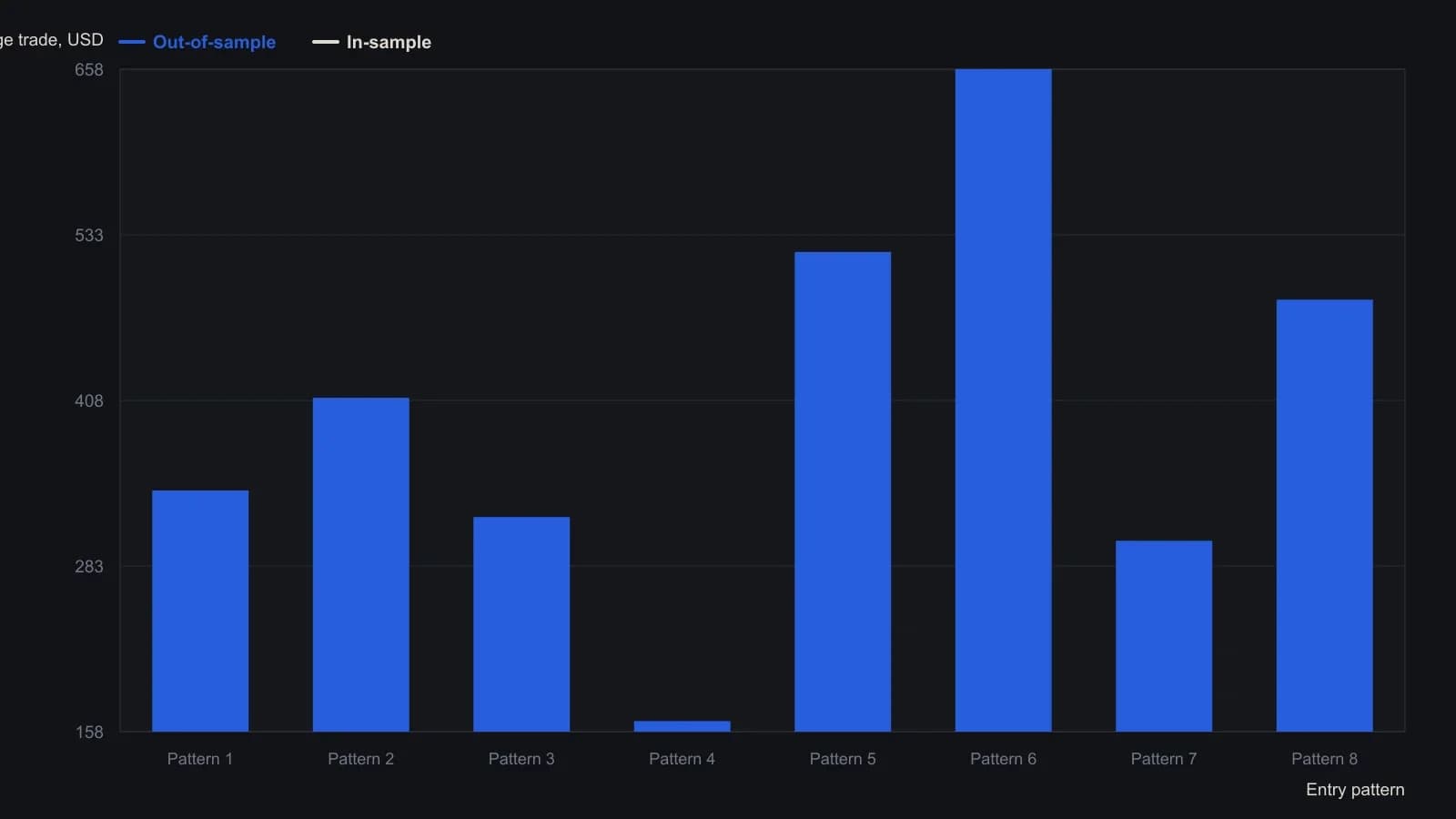
Continuous back-adjusted S&P 500 futures, April 1982–March 1996, $100 slippage and commission, market-on-close exit and no stops. Weekday codes 51–55 were pooled as one >50 filter.
All readings on this track · 50 readings
- 1990Three-window walk-forward system evaluation
- 1990Building the construction layer of a mechanical trading system
- 1991Constructing walk-forward neural trading rules
- 1991Constructing neural trading systems from facts to walk-forward
- 1992Walk-forward evaluation of stop overlays on average crossovers
- 1992Audit mechanical system tests for fills and regimes
- 1993Walk-forward evaluation of monthly yield and real-rate forecasts
- 1993Constructing walk-forward forecasts with linear and moving-average baselines
- 1993Walk-forward hybrid rules for intermarket forecast stacks
- 1994Neural-net construction as a mechanical trading-system problem
- 1995Constructing an intermarket neural net trading system
- 1996Weekly market breadth as one procedure on an unused window
- 1996Walk-forward evaluation of gold-index bond-fund rules
- 1996Evaluating weekday-in-month filters for index day trades
- 1996Require both a trend filter and a cycle oscillator before entry
- 1997Walk-forward windows as a diagnostic of parameter instability
- 1997Walk-forward validation of a market-breadth timing rule
- 1997Sunspot spikes and walk-forward evaluation of an adaptive cycle rule
- 1997A walk-forward check for bond-breadth timing
- 1998Walk-forward audit of regression trend forecasts
- 1998Evaluating a cubic least-squares currency trend with walk-forward segments
- 1998Walk-forward evaluation of recursive yen trend signals
- 1999Personal system design under crowd psychology
- 1999Walk-forward evaluation of a polynomial price forecast
- 2000Walk-forward optimization of regression-slope-angle rules
- 2001Construct a winter seasonal window as one procedure
- 2001Inspectable rules when system write-ups dry up
- 2002Evaluating mechanical systems before position sizing
- 2003Walk-forward construction of rule-based market-position systems
- 2007Evaluating metal seasonal windows across regimes
- 2007Evaluating mechanical timing systems against hold baselines
- 2011Walk-forward reoptimization as a system design gate
- 2011Evaluate generated systems on holdouts, then add stops
- 2012Walk-forward analysis and out-of-sample tests for a mechanical trading system
- 2012Personality-first trading system design
- 2012Scorecard-first mechanical system construction
- 2012Constructing an advancer-decliner moving average for market breadth
- 2012Formula search as mechanical system construction
- 2013Identity-first system construction
- 2013Construct a swing system from bias rules to walk-forward
- 2014Evaluate mechanical stock systems with stops and walk-forward
- 2014Walk-forward velocity filters on noisy intraday trends
- 2015Event-predictability versus position-constrained rules
- 2015Constructing mechanical systems for walk-forward tests
- 2016When a tested system must be retired
- 2016Walk-forward metric filters and chance-level checks for selected inputs
- 2018Evaluate mechanical trading systems without catalog rankings
- 2019Phased stop construction from entry risk to trailing exit
- 2020Stockpiling simple ideas for mechanical system construction
- 2020A pretty first draft is not a walk-forward waiver