2014issue C0551-54
Evaluate mechanical stock systems with stops and walk-forward
A 2014 hands-on review described a subscription ranking-and-timing platform that could encode name selection, market-state filters, and stop rules as one mechanical procedure, then paper-trade that same plan before brokerage execution.
- Encode ranking, confirmed market timing, stop rules, and money management as one mechanical trading system so entry, exit, and abstention can be tested as a single procedure.
- Choose the stop-loss method, including any ratchet-stop, before a name is held so loss or exposure stays bounded after entry.
- Walk-forward analysis rechecks that same procedure on later windows, sliding recent lookbacks, and paper-trade mode before brokerage execution.
- Sliding-window ranking can identify a currently stronger search rule, but it does not replace paper-trading the full plan first.
What the ranking platform put on one desk
A 2014 hands-on review described a subscription stock-ranking and portfolio platform covering more than 8,000 names and more than 16 years of history. It was offered in end-of-day, 15-minute delayed, and real-time editions.
A technical-search module supplied more than 35 prebuilt long and short screens, including bands, MACD, moving averages, stochastics, ADX, and support or resistance events. A user could combine those screens with fundamental filters and sort the list so preferred setups ranked first.
One illustrated screen combined an MACD and stochastic crossover search with a composite rank above 1.0 and a growth-rate threshold of at least 14. It surfaced Sirona Dental on February 28, 2014 with a 12/26/9 MACD cross and a 14/3 stochastic cross.
Charts could overlay price history from 1995, a 30-period weighted average, a master rank series, automatic support and resistance, volume, and fundamentals, so technical state and whether fundamentals were improving or deteriorating could be read together.
Selection, timing, and stops as one procedure
The historical-testing module let a user encode market timing, name selection, stop rules, and money management as one mechanical trading system. In the sense used here, that is a complete, repeatable procedure that turns ranking inputs, market state, and execution constraints into entry, exit, or abstention signals that can be tested as one unit.
A documented example bought the top five names by a rank-to-price score after a confirmed timing signal in an advancing market on December 19, 2012. A confirmed timing signal is a market-level buy or sell condition that must be in force before names may be held and that forces an exit when it reverses.
The same example sold a name when it fell through a ratchet-stop or when a confirmed sell appeared on December 11, 2013. A ratchet-stop is a trailing exit that only tightens as price moves in the position's favor and fires when price later falls through that raised threshold. Stop method, position weights, margin, and commissions were left as user settings.
A stop-loss in this workflow is a pre-specified exit that bounds loss or exposure once a position is open, including fixed, trailing, or ratchet variants chosen before the trade is placed.
WOW Winners backtest: net gain, annualized return, and max drawdown
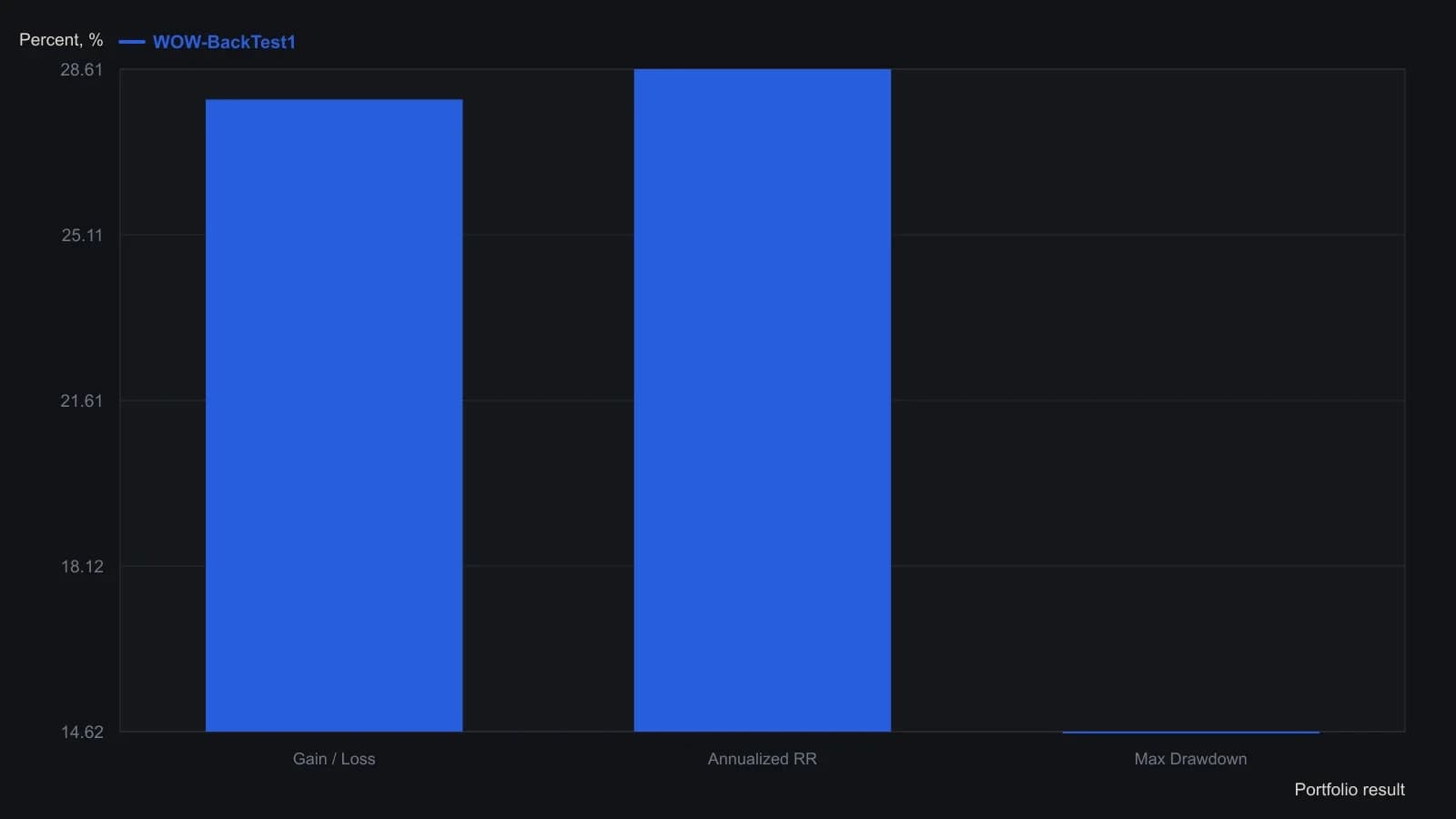
The book started at $100,000. It bought the top five VST/price-rated names after a confirmed buy on 19 December 2012 and ran until the confirmed sell on 11 December 2013. Commission was $726.35; no short trades and no margin were used.
Recheck the same plan on later windows
Editorial reading: first measure the encoded procedure on chosen past intervals, then recheck it on sliding recent windows and in paper-trade mode before live use. That staged check is walk-forward analysis rather than a new set of rules.
An enhanced comparison module ranked built-in searches each day by recent gain or loss, share of winners, maximum drawdown, and efficiency. It added buy-and-hold, vary-by-start-date, and sliding-window views over spans from one to 90 days.
Sliding-window ranking compares candidate search rules by results over successive recent lookbacks so a currently stronger rule set can be identified without relying on one fixed sample.
The tester fed a portfolio manager that could paper-trade the same plan before brokerage execution. An alerting module could watch the full market, watchlists, or saved scans and deliver buy, sell, or support-and-resistance-break notices by text or email without the desktop program remaining open. Comparison-plus-alert plugins could notify when names from recently stronger 90-day searches issued buy or sell conditions.
All readings on this track · 50 readings
- 1990Three-window walk-forward system evaluation
- 1990Building the construction layer of a mechanical trading system
- 1991Constructing walk-forward neural trading rules
- 1991Constructing neural trading systems from facts to walk-forward
- 1992Walk-forward evaluation of stop overlays on average crossovers
- 1992Audit mechanical system tests for fills and regimes
- 1993Walk-forward evaluation of monthly yield and real-rate forecasts
- 1993Constructing walk-forward forecasts with linear and moving-average baselines
- 1993Walk-forward hybrid rules for intermarket forecast stacks
- 1994Neural-net construction as a mechanical trading-system problem
- 1995Constructing an intermarket neural net trading system
- 1996Weekly market breadth as one procedure on an unused window
- 1996Walk-forward evaluation of gold-index bond-fund rules
- 1996Evaluating weekday-in-month filters for index day trades
- 1996Require both a trend filter and a cycle oscillator before entry
- 1997Walk-forward windows as a diagnostic of parameter instability
- 1997Walk-forward validation of a market-breadth timing rule
- 1997Sunspot spikes and walk-forward evaluation of an adaptive cycle rule
- 1997A walk-forward check for bond-breadth timing
- 1998Walk-forward audit of regression trend forecasts
- 1998Evaluating a cubic least-squares currency trend with walk-forward segments
- 1998Walk-forward evaluation of recursive yen trend signals
- 1999Personal system design under crowd psychology
- 1999Walk-forward evaluation of a polynomial price forecast
- 2000Walk-forward optimization of regression-slope-angle rules
- 2001Construct a winter seasonal window as one procedure
- 2001Inspectable rules when system write-ups dry up
- 2002Evaluating mechanical systems before position sizing
- 2003Walk-forward construction of rule-based market-position systems
- 2007Evaluating metal seasonal windows across regimes
- 2007Evaluating mechanical timing systems against hold baselines
- 2011Walk-forward reoptimization as a system design gate
- 2011Evaluate generated systems on holdouts, then add stops
- 2012Walk-forward analysis and out-of-sample tests for a mechanical trading system
- 2012Personality-first trading system design
- 2012Scorecard-first mechanical system construction
- 2012Constructing an advancer-decliner moving average for market breadth
- 2012Formula search as mechanical system construction
- 2013Identity-first system construction
- 2013Construct a swing system from bias rules to walk-forward
- 2014Evaluate mechanical stock systems with stops and walk-forward
- 2014Walk-forward velocity filters on noisy intraday trends
- 2015Event-predictability versus position-constrained rules
- 2015Constructing mechanical systems for walk-forward tests
- 2016When a tested system must be retired
- 2016Walk-forward metric filters and chance-level checks for selected inputs
- 2018Evaluate mechanical trading systems without catalog rankings
- 2019Phased stop construction from entry risk to trailing exit
- 2020Stockpiling simple ideas for mechanical system construction
- 2020A pretty first draft is not a walk-forward waiver