2000issue C121-3
Walk-forward optimization of regression-slope-angle rules
A linear fit can summarize a chosen price segment as a regression-slope-angle. A genetic search then jointly sets segment-length, start-lag, angle gates, and rule-quorum as one reversal-procedure, and the frozen rules are scored on a later unused-window against a buy-and-hold baseline.
- A linear fit can summarize a chosen price segment as a regression-slope-angle that later long and short rules can read.
- A genetic search can jointly set segment count, segment-length, start-lag, angle gates, and rule-quorum against a single objective-score.
- Overlapping-segments are an intended design choice so nearby geometries can vote together inside one reversal-procedure.
- Rules chosen on the in-sample-window stay frozen on the unused-window, which is the designated test of whether the procedure generalizes.
Slope angles from selected price segments
A linear fit can be laid through selected parts of a price series so that each segment is summarized as a regression-slope-angle that later rules can read.
Each fit is defined by a segment-length, which is how many bars the line covers, and a start-lag, which is how many bars before the current bar the fitted segment begins.
Joint search of length, lag, gates, and quorum
A genetic search can jointly choose how many such segments to place, each segment-length, each start-lag, and the angle gates used as conditions. The search maximizes an objective-score, such as profit or another stated function, while it assembles the procedure.
A long condition can require that a fitted segment of chosen segment-length, starting at a chosen start-lag, has a regression-slope-angle steeper than a chosen angle. The same search also chooses the rule-quorum, which is how many of those slope-versus-angle conditions must hold before a long order is allowed.
The search may place overlapping-segments that share bars. That overlap is treated as an intended design choice, so nearby geometries can vote together.
Long and short as one reversal-procedure
Short conditions use the complementary test of a regression-slope-angle falling below an angle. Long and short conditions can be fitted together as one reversal-procedure for a single instrument and period, so the book is always considering a flip rather than two independent one-way systems.
The unused-window as the designated test
Parameter search is confined to an in-sample-window, the earlier stretch used only to choose segment counts, segment-length values, start-lag values, angles, and rule-quorum. The frozen rules are then evaluated on a later unused-window.
That later walk-forward check is the designated test of whether the procedure generalizes. Both the in-sample-window and the unused-window were scored against a buy-and-hold baseline.
A slope-only demonstration and later variants
The worked example used only slope-versus-threshold rules and did not insert a neural network. The same optimized slopes can later become inputs to a predictive network. The demonstration applied the slope-rule procedure to a 30-minute price series.
Design variants include adding opposite-side threshold tests, requiring a regression-slope-angle to lie between two angles, and allowing the search to relax other variables when some search ranges are set too tightly.
Unused-window Dell returns by trade side
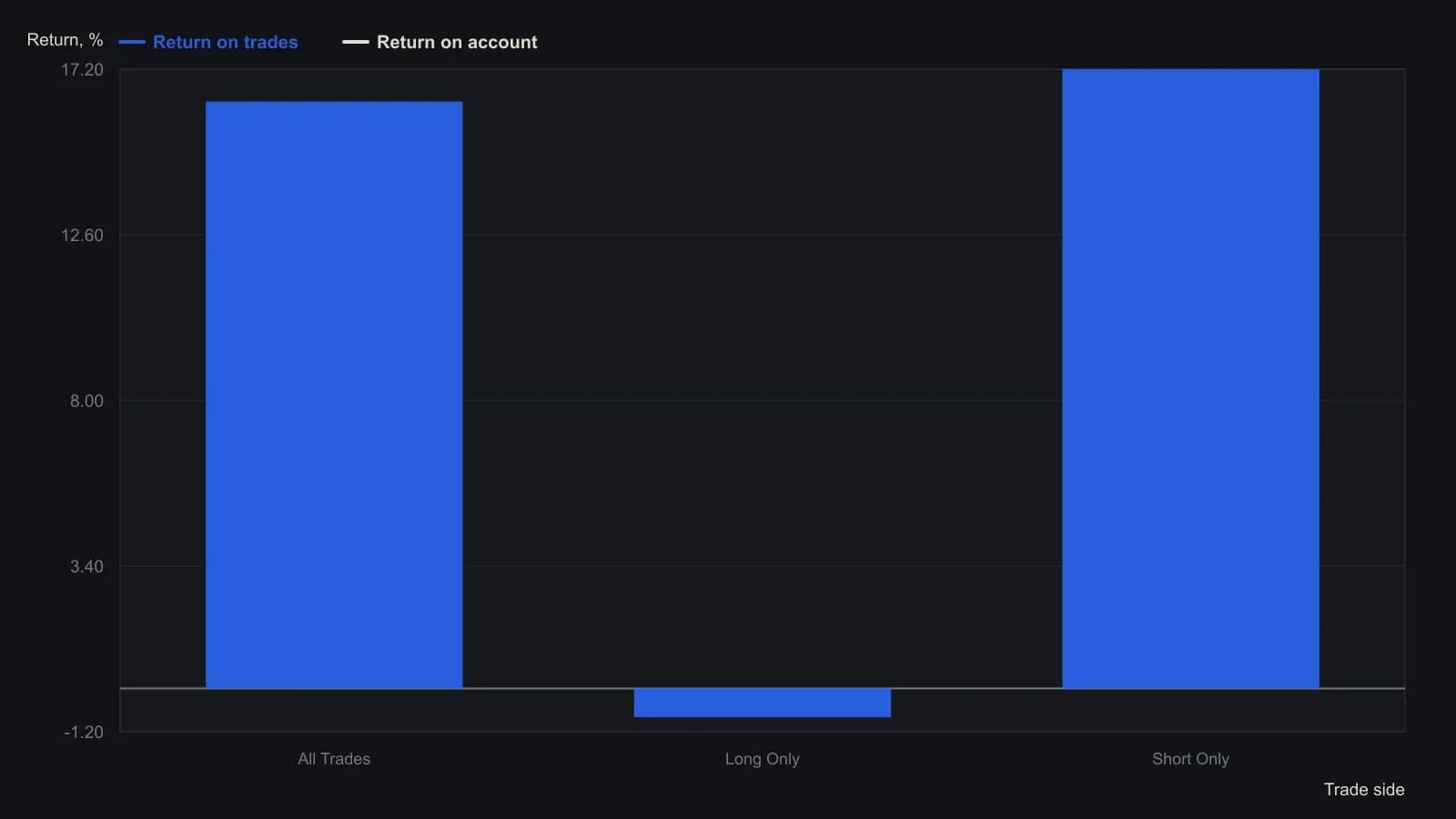
The same dialog annualizes those two-week results to 747.1 percent on trades and 658.7 percent on account; those rows are left out because the short unused window inflates them. The demonstration used only lagged linear-regression slope thresholds, not a neural net.
All readings on this track · 50 readings
- 1990Three-window walk-forward system evaluation
- 1990Building the construction layer of a mechanical trading system
- 1991Constructing walk-forward neural trading rules
- 1991Constructing neural trading systems from facts to walk-forward
- 1992Walk-forward evaluation of stop overlays on average crossovers
- 1992Audit mechanical system tests for fills and regimes
- 1993Walk-forward evaluation of monthly yield and real-rate forecasts
- 1993Constructing walk-forward forecasts with linear and moving-average baselines
- 1993Walk-forward hybrid rules for intermarket forecast stacks
- 1994Neural-net construction as a mechanical trading-system problem
- 1995Constructing an intermarket neural net trading system
- 1996Weekly market breadth as one procedure on an unused window
- 1996Walk-forward evaluation of gold-index bond-fund rules
- 1996Evaluating weekday-in-month filters for index day trades
- 1996Require both a trend filter and a cycle oscillator before entry
- 1997Walk-forward windows as a diagnostic of parameter instability
- 1997Walk-forward validation of a market-breadth timing rule
- 1997Sunspot spikes and walk-forward evaluation of an adaptive cycle rule
- 1997A walk-forward check for bond-breadth timing
- 1998Walk-forward audit of regression trend forecasts
- 1998Evaluating a cubic least-squares currency trend with walk-forward segments
- 1998Walk-forward evaluation of recursive yen trend signals
- 1999Personal system design under crowd psychology
- 1999Walk-forward evaluation of a polynomial price forecast
- 2000Walk-forward optimization of regression-slope-angle rules
- 2001Construct a winter seasonal window as one procedure
- 2001Inspectable rules when system write-ups dry up
- 2002Evaluating mechanical systems before position sizing
- 2003Walk-forward construction of rule-based market-position systems
- 2007Evaluating metal seasonal windows across regimes
- 2007Evaluating mechanical timing systems against hold baselines
- 2011Walk-forward reoptimization as a system design gate
- 2011Evaluate generated systems on holdouts, then add stops
- 2012Walk-forward analysis and out-of-sample tests for a mechanical trading system
- 2012Personality-first trading system design
- 2012Scorecard-first mechanical system construction
- 2012Constructing an advancer-decliner moving average for market breadth
- 2012Formula search as mechanical system construction
- 2013Identity-first system construction
- 2013Construct a swing system from bias rules to walk-forward
- 2014Evaluate mechanical stock systems with stops and walk-forward
- 2014Walk-forward velocity filters on noisy intraday trends
- 2015Event-predictability versus position-constrained rules
- 2015Constructing mechanical systems for walk-forward tests
- 2016When a tested system must be retired
- 2016Walk-forward metric filters and chance-level checks for selected inputs
- 2018Evaluate mechanical trading systems without catalog rankings
- 2019Phased stop construction from entry risk to trailing exit
- 2020Stockpiling simple ideas for mechanical system construction
- 2020A pretty first draft is not a walk-forward waiver