2018issue C0944-47
Seasonal windows as testable entry and abstention rules
A seasonality window can be a planned observation period with the same context rules as the window is approached, not a forced entry on the first calendar day. The historical test is whether holding only inside a defined window left the rest of the year adding nothing that compensated for remaining invested.
- Treat a seasonality window as a planned observation period with shared context rules, not as a forced entry on the first calendar day.
- If holding only for a defined window such as 60 days produced the same historic returns as the full year, the rest of the year did not compensate for the risk of remaining invested on the other days.
- A hypothesized reason can raise confidence, but a complete causal explanation is not required, because the forces behind biases can be hard to identify and can change.
- The operational edge is having scenarios prepared so entry can wait for a discount, even on a later day in a last-seven or first-five day window.
Treat the window as an observation period
A seasonality window can be used as a planned observation period in which the same context rules apply as the window is approached, rather than as a forced entry on the first calendar day.
The window marks when those rules are active. It does not require a position to be open on the first calendar day.
AAPL 20-day relative change into earnings
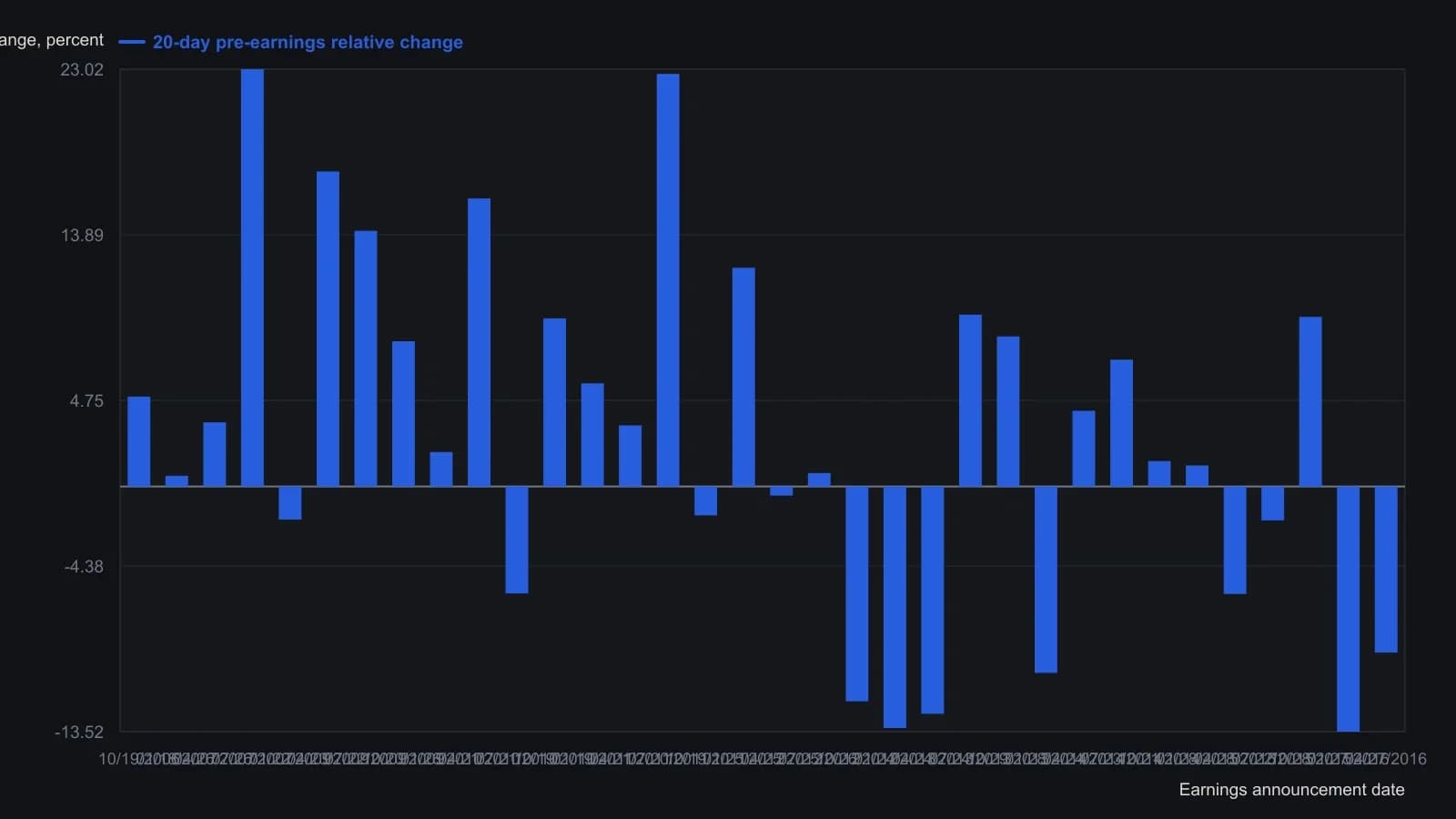
The printed legend lists 34 events from 10/19/2006 through 04/27/2016 and omits late 2007 and calendar 2008. Every path on the source figure is rebased to zero 20 days before the announcement; these bars are those terminal labeled percentages, not a tracing of the overlapping curves.
Judge the window by the rest of the year
When holding only for a defined window such as 60 days produced the same historic returns as holding the full year, the rest of the year did not compensate for the risk of remaining invested on the other days.
The holding period under test is then the window itself. Days outside that window are a separate question: did they compensate for the risk of staying invested?
A cause can help and can also narrow attention
Knowing a hypothesized reason for a seasonal pattern can raise confidence. It can also produce overconfidence, complacency, or a myopic focus that misses nearby market detail.
A seasonal pattern can still be treated as usable without a complete causal explanation. The forces that create biases can be hard to identify and can change over time.
Plan for variance, discount, and a watchlist
A walk-forward plan for a long-sample seasonal case includes handling variance and strategy change, waiting for a discount before or inside the window, and exiting into premium rather than extracting exact tops and bottoms.
Relative strength versus a benchmark such as SPY can generate a watchlist of outperformers and underperformers to monitor for entry signals just before or during a seasonality window.
Prepare scenarios before the window opens
The operational edge of a seasonal setup is having scenarios prepared in advance so entry can occur whenever conditions align, including on a later day in the window if that day offers a discount instead of premium.
A trader prepared for a last-seven or first-five day window may still enter only on the last day of the month if that is when the market offers a beneficial discount.
All readings on this track · 21 readings
- 1986Two gates for setup and operator readiness
- 1990Time-only cycle dates in a Treasury bond case study
- 1990Constant-dollar regimes, the value line, and nested cycles
- 1992The four-year election cycle as an equity regime map
- 1992A semiconductor seasonal-index before the relative-strength overlay
- 1992Lock the holiday window as a regime, then veto resistance
- 1995Regime-aware stock screening with intermarket context
- 1996Standard-error bands, width gates, and weekday counts
- 1999Constructing seasonal factors from centered moving averages
- 2000Seasonal window, then weekly breadth
- 2004Copper as a regime map for cycles and recessions
- 2008Election-cycle windows as a mechanical seasonal system
- 2012A 2012 case study in Kondratieff-wave and presidential-cycle overlays
- 2012The October to May window as a mechanical portfolio procedure
- 2013Half-year seasonality as an equity regime overlay
- 2014Seasonal cycles as a regime overlay
- 2015Seasonal oil window as a defined-risk spread case
- 2017Calendar regimes, RSI events, and sector rotation rules
- 2018Seasonal windows as testable entry and abstention rules
- 2019Calendar rotation of seasonal and regime questions
- 2020Constructing calendar interval votes for cycle workbooks