1988issue C071-7
Testing re-optimization calendars against random parameter controls
A historical evaluation compared history-based re-optimization calendars with a random-parameter-control on a channel breakout and a directional-movement index crossover. History-based search did not produce a statistically greater result than chance assignment. Editorial: treat the calendar as an extra trading rule, and treat walk-forward search as useful system-design work only when robustness-testing can show it beats a random draw from the same parameter-grid.
- A re-optimization calendar jointly sets how much past data ranks the next parameter and how long that choice is held before the search may run again.
- Walk-forward analysis selects a parameter on an earlier window and applies that choice only on a later interval that was not used to rank the candidates.
- On both tested systems, history-based calendars did not differ statistically from a random-parameter-control, and they did not statistically impair mean results.
- The in-sample-champion is not a valid stand-in for later results; the center of the full tested parameter-grid is the more defensible historical benchmark.
The calendar sits inside the procedure
System-optimization chooses a system's lookback or threshold from ranked historical results instead of committing to a setting before the test begins. The re-optimization calendar is the joint choice of how much past data ranks the next parameter and how long that choice is held before the search is allowed to run again.
That calendar decides when a new lookback may be selected and which already observed results are allowed to rank the candidates. It is part of the trading procedure, not a setting that can be left outside the test.
What the historical evaluation compared
A historical evaluation compared several history-based re-optimization calendars with a random-parameter-control across a one-parameter channel breakout and a directional-movement index crossover. The random-parameter-control assigns each evaluation period's setting by chance so the search procedure itself can be tested.
Practitioners at the time did not share a standard for how much history to use, how often to refresh parameters, or whether to search at all. Lookbacks ranged from a few years to all available data, and refresh intervals ranged from twice a year to once every several years.
Each system was searched over a parameter-grid spanning short to multi-month lookbacks in even steps. Both systems were simulated on a multi-market futures portfolio, with equal margin allocations, a fixed commission per trade, and positions taken only in the nearby contract.
Walk-forward choice and hold periods
Walk-forward analysis selects a parameter on an earlier window and applies that choice only on a later interval that was not used to rank the candidates. Every history-based calendar chose the next parameter only from already observed results, so the evaluation interval never reused the observations that ranked the candidates.
Annual-refresh calendars used several prior years of profit ranking, or all history from market inception or a fixed early start. Fixed calendars held a multi-year choice for a matching multi-year block.
Channel-breakout mean portfolio returns by re-optimization calendar, 1965–1985
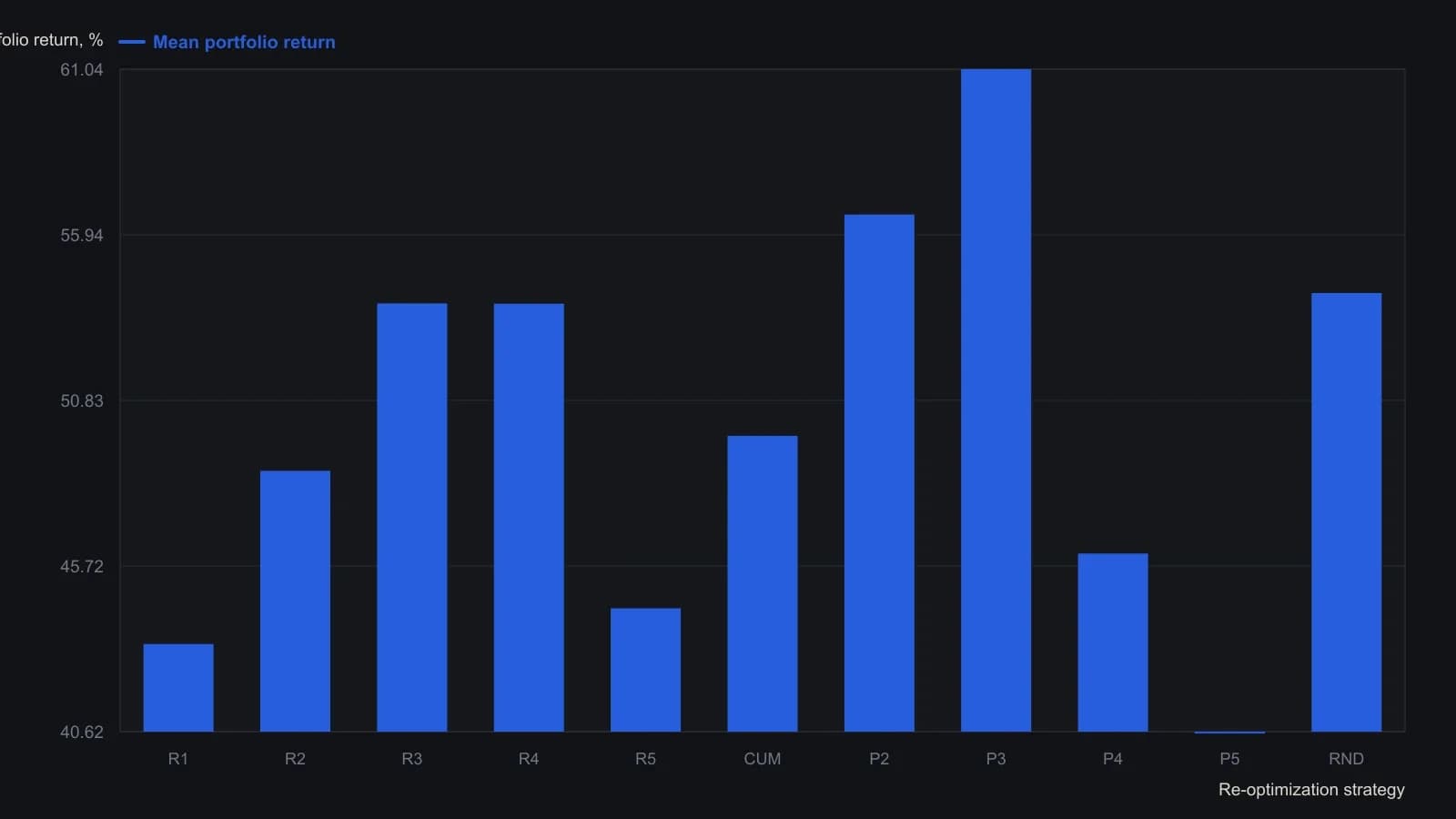
Means assume 30 percent of capital is posted to initial margins. The search grid was 5–60 days in steps of five; commission $100 per trade; every calendar is evaluated out of sample on a 15-market portfolio.
Paired tests including the random control
Robustness-testing checks whether alternative search calendars, including a chance-assignment control, produce statistically distinguishable later results. Statistical comparison used tests of mean portfolio results against zero and paired-difference tests among calendars, including the random-parameter-control.
On the breakout system, paired-difference tests found no statistically significant gap among mean monthly results of the calendars, including the gap versus random assignment.
On the directional-movement system, only a few pairwise contrasts reached significance, no calendar formed a consistent ranking, and none differed statistically from random assignment.
Within the tested systems, parameter-grids, and calendars, history-based re-optimization did not produce a statistically greater result than chance assignment and did not statistically impair mean results.
What the in-sample champion cannot replace
The in-sample-champion is the single historically best setting on a window. Its own window result is not a valid estimate of later results, so that champion is not a valid stand-in for what follows. The center of the full tested parameter-grid is the more defensible historical benchmark.
All readings on this track · 51 readings
- 1986Degrees of freedom in trading system optimization
- 1988Walk-forward and neighborhood tests after optimization
- 1988Undisclosed rules block system robustness tests
- 1988Testing re-optimization calendars against random parameter controls
- 1989Binary search limits on multi-peak average grids
- 1989Parameter neighborhoods that survive a shift
- 1990Use profit mapping to keep a cycle and stop plateau
- 1990Why popular indicator optimization fails robustness
- 1991Retesting weighted indicator balances across horizons
- 1992Constructing forecast models with regression, walk-forward, and robustness
- 1992Diagnose regimes before you lock parameters
- 1992When stops change system timing
- 1993Walk-forward halt rules for forecast models
- 1994Walk-forward evaluation of genetic index rules
- 1995Input pruning as walk-forward system evaluation
- 1995Critiquing neural nets as incomplete trading systems
- 1996Rebuild the equity-path ratio before it ranks a designed system
- 1996Parameter grids can fit random walks
- 1996Walk-forward analysis belongs in the design of a mechanical trading system
- 1997When a holdout fails, discard the rule set
- 1997Test rewarded rule breaks before replacing the system
- 1997Walk-forward rules keep system research from rewriting live trades
- 1999Keep a channel-breakout to two lookbacks and test neighbor stability
- 1999Constant investment size in stock system evaluation
- 2000Forcing optimization maps mechanical system failure boundaries
- 2000Robust parameter selection with surface charts
- 2001A two-gate classroom test for a two-window momentum trend filter
- 2002How a two-sided continuation factor becomes a testable trend rule
- 2002Evaluating two-window trend intensity as a reversal rule
- 2003Discounting speculative bubbles in system robustness tests
- 2003Walk-forward evaluation of locked stochastic oscillator rules
- 2003Critiquing mechanical system design after extreme price regimes
- 2004Evaluating a two-window trend trigger
- 2005Grade backtested signals with holdouts and optimization plateaus
- 2006Reserved-sample evaluation of trading system design
- 2006Walk-forward critique of hindsight crossover systems
- 2008Condition-matched walk-forward evaluation for mechanical systems
- 2011Session-split evaluation of regular and overnight systems
- 2012Walk-forward evaluation as operator rehearsal
- 2013Two-window evaluation of mechanical trading systems
- 2013Walk-forward filter selection for repeated-median velocity
- 2014Walk-forward evaluation for fading-memory velocity systems
- 2015Test oscillator events before tuning rules
- 2016Walk-forward evaluation of a five-parameter parabolic stop-and-reversal
- 2016Walk-forward optimization without curve fitting
- 2017Optimization without overfitting in trend-system evaluation
- 2017Parameter stability is a better guide than a larger crossover grid
- 2018Point-in-time universes for system evaluation
- 2018Walk-forward robustness evaluation for optimized systems
- 2018Critiquing breakout systems through robustness tests
- 2018A critique of parameter fitting in system design