1996issue C031-7
A volume-gated moving-average trend combination
A moving-average-crossover supplies the trend-state switch, and volume-confirmation is added so new positions are not taken from the price average alone. The same 20-session close-through-average rule is written as an always-in-market trend-following system and as an abstention version that waits for session volume above the prior 10-session average.
- The combination uses a moving-average-crossover as the trend-state switch and volume-confirmation as an entry filter, so signals are not taken from price averages alone.
- The always-in-market baseline stays long or short after every close through a 20-session average. The volume-gated version opens a new position only when that crossover occurs with session volume above the average of the prior 10 sessions.
- Exits remain a close back through the price average alone. A crossover without volume-confirmation produces abstention rather than an immediate reverse.
- A trend-following engine can be paired with a volume, momentum, or open-interest filter, and simple older tools can still be written as one complete procedure.
A state engine and a permission gate
The procedure is specified as a combination: a price moving average supplies the trend-state switch, and a volume condition is added so signals are not taken from price averages alone.
A moving-average-crossover is a close through a moving average of price used as the switch that declares or reverses trend state. Volume-confirmation is an entry filter that permits a new position only when session volume exceeds a recent average, treating elevated activity as participation rather than as a price target.
The trend-following premise
Trend-following is a directional procedure that assumes an established price trend is likely to persist and that stays aligned with that state until a later rule says the state has ended.
The premise treats a close above a moving average as a long state and a close below it as a short state, on the assumption that the force behind an established move tends to persist. Two assumptions are made explicit: underlying market forces tend to trend, and a moving average both marks when a trend is established and recognizes when that trend has ended.
The always-in-market baseline
Always-in-market is a ruleset in which a close through the average both exits the current side and immediately opens the opposite side, so the system never stands aside.
The baseline implementation entered long after a cross and close above a 20-session average, reversed short after a close below that average, and therefore remained continuously long or short.
Why a volume gate was added
Used in isolation, the 20-session close-through-average rule was judged unable to separate a minor fluctuation from the start of a new trend.
Volume above its recent average was treated as evidence that new information had reached participants and that the associated price move was more likely the beginning of a trend.
The abstention version
The combined entry required a close through the 20-session price average and that session’s volume above the average volume of the prior 10 sessions. Exits remained a close back through the price average alone.
After the volume filter was added, the system was no longer always in the market: a new position opened only when the crossover and the volume threshold occurred together. Abstention is the idle state created when the price average is crossed without volume confirmation, so no new position is opened.
Two design lessons
The write-up framed two design lessons: a trend-following engine can be paired with a volume, momentum, or open-interest filter, and simple older tools can still be written as one complete procedure.
Cumulative equity of the volume-gated T-bond strategy
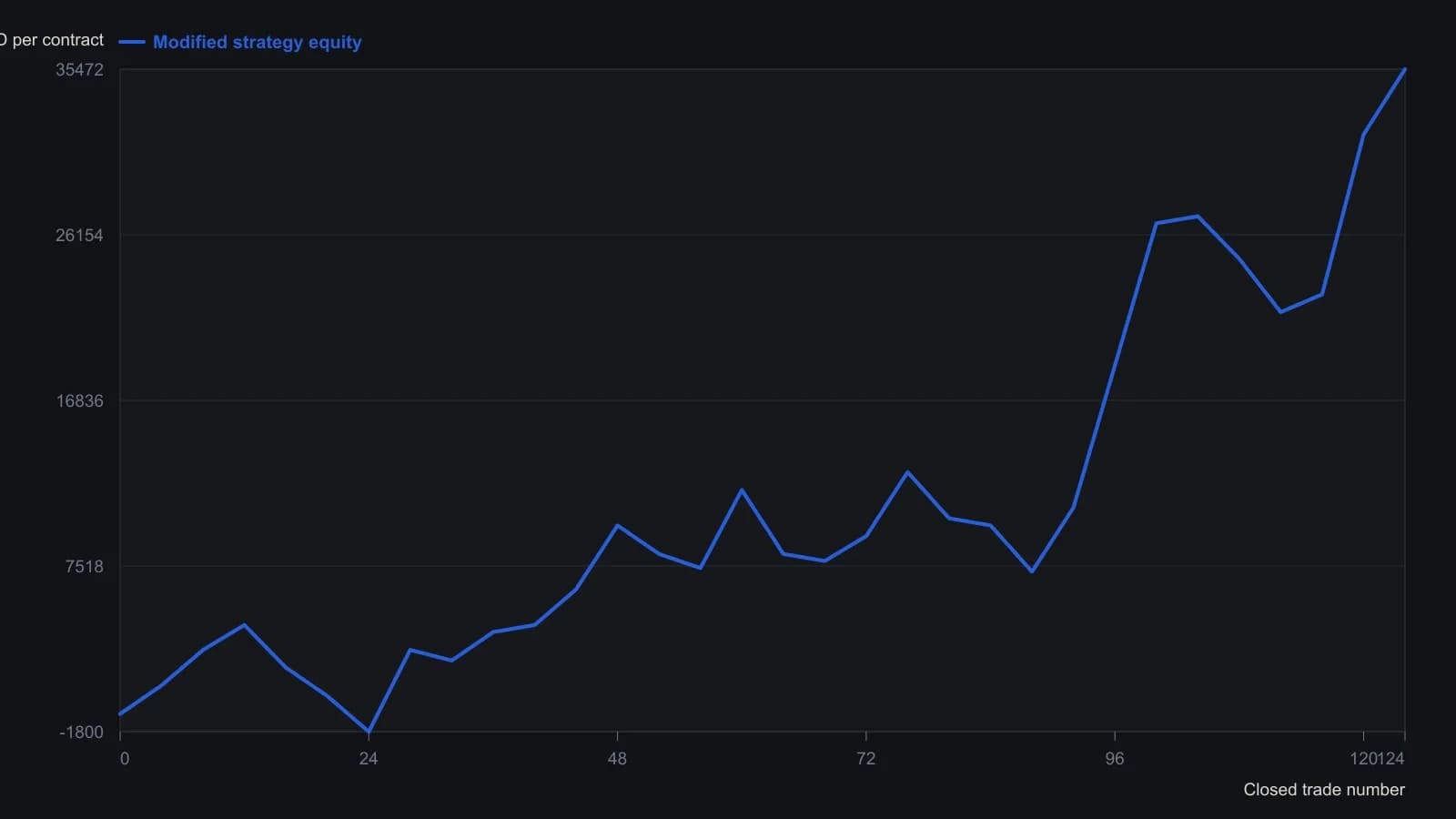
One continuous T-bond contract, no commission or slippage; x is sequential closed trades on the modified (not always-in) rules. Digitized from the printed equity mountain, so intermediate levels are approximate.
All readings on this track · 40 readings
- 1988Constructing volume-confirmation overlays on OHLC spreadsheet charts
- 1989Commodity advance-decline from delivery months
- 1989The most-active list as a three-layer breadth lab
- 1989Constructing a yield-curve volume-breadth composite
- 1989A bond-futures case study in support, volume, and confirmation
- 1989Volume-scaled price boxes and volume cycles
- 1990Futures-signed on-balance volume construction
- 1990Self-relative volume boxes for news-free breakouts
- 1990Broadening swings, demand tests, and volume filters
- 1991A same-session pressure test of breadth and volume share
- 1991Tick extremes that confirm double tops and bottoms
- 1991Constructing auction fuel from volume and open interest
- 1994Constructing On-balance volume with smoothing and timeframe confirmation
- 1996A volume-gated moving-average trend combination
- 1996Constructing four-state range-volume bars
- 1997Failed trade review of a descending-triangle breakdown
- 1997Construct a head-and-shoulders before the neckline break
- 2004Volume confirmation is not optional for a head-and-shoulders reversal
- 2007Constructing a three-factor volume-price confirmation filter
- 2007Constructing a three-condition moving-average entry with a volume filter
- 2008Breakout rules that wait for volume and liquidity
- 2011Screen futures liquidity with open interest and volume
- 2011Filter executable futures with liquidity and open interest
- 2012Rank listed futures by liquidity before a forecast chooses the name
- 2012Filter futures liquidity using open interest and volume
- 2013Pre-trade futures liquidity as an execution filter
- 2014A futures liquidity screen from range, open interest and volume
- 2014Evaluating futures contract liquidity before execution
- 2014Constructing defended price lines from volume clusters
- 2014Filter futures by equal-dollar size, open interest, and volume
- 2015Filter futures ideas by ranked contract liquidity
- 2017Screen listed futures for execution liquidity first
- 2017Filter futures orders by liquidity, open interest, and volume
- 2018Using open interest and volume to rank futures liquidity
- 2018Score listed futures as an execution menu before the setup
- 2019Filtering futures orders with liquidity, open interest and volume
- 2019Futures liquidity as an execution filter
- 2020A futures liquidity board as a pre-trade execution filter
- 2020Sequenced volume and golden-cross breakout rules
- 2020Use a listed-futures liquidity filter before execution