1989issue C121-2
A bond-futures case study in support, volume, and confirmation
A December bond-futures sequence from September and early October 1989 is used as a classroom drill. Each prior high and low is restated as a live supply or demand test, and volume must confirm before the next few sessions are treated as a channel shift.
- Support is treated as demand and resistance as supply, so a retracement after a multi-month advance is expected to meet prior selling prices and later find buying that absorbs that supply.
- Buyer-seller contests lasting three to five sessions are presented as short-horizon setups distinct from the larger trend.
- Light volume and narrow daily ranges mark demand as only modestly stronger than supply, while expanding volume is required before a print through a prior high is treated as a durable advance.
- Closing prices together with volume are presented as identifying two short-term opportunities in September and October 1989 after a change in supply or demand.
A classroom drill in one bond-futures swing
The archive uses a December bond-futures sequence in September and early October 1989 to illustrate two short-term opportunities after a change in supply or demand. Closing prices together with volume are presented as the readings that identify those opportunities.
Editorial framing treats that sequence as a classroom drill. Convert each prior high and low into a live supply or demand test. Then require volume confirmation before treating the next few sessions as a real channel shift rather than an unconfirmed drift.
Support as demand, resistance as supply
Support is treated as demand and resistance as supply. A retracement after a multi-month advance is therefore expected to meet prior selling prices and later find buying that absorbs that supply.
Support and resistance, in this workflow, are prior prices where buying or selling once halted a move. Restating them as demand and supply makes a retest a checkable hypothesis: will buying absorb the selling at that band, or will selling cap the next advance?
A three-to-five session contest
Buyer-seller contests lasting three to five sessions are presented as short-horizon setups distinct from the larger trend. They are short-term contests, a few-session battle between buyers and sellers that can set up a trade inside a larger trend or channel.
A rally from three-week lows that later advanced on light volume and narrow daily ranges is interpreted as demand only modestly stronger than supply. That is volume-price analysis: the quality of the swing is judged from the pairing of range, close location, and volume, not from direction alone.
Several sessions of active trading that failed to better the 11 September close, while volume increased inside the range, are read as supply appearing at that price band. Editorial reading: that is supply in the archive sense, selling pressure strong enough to cap an advance at prices already being contested.
December 1989 T-bond futures, September–October swing
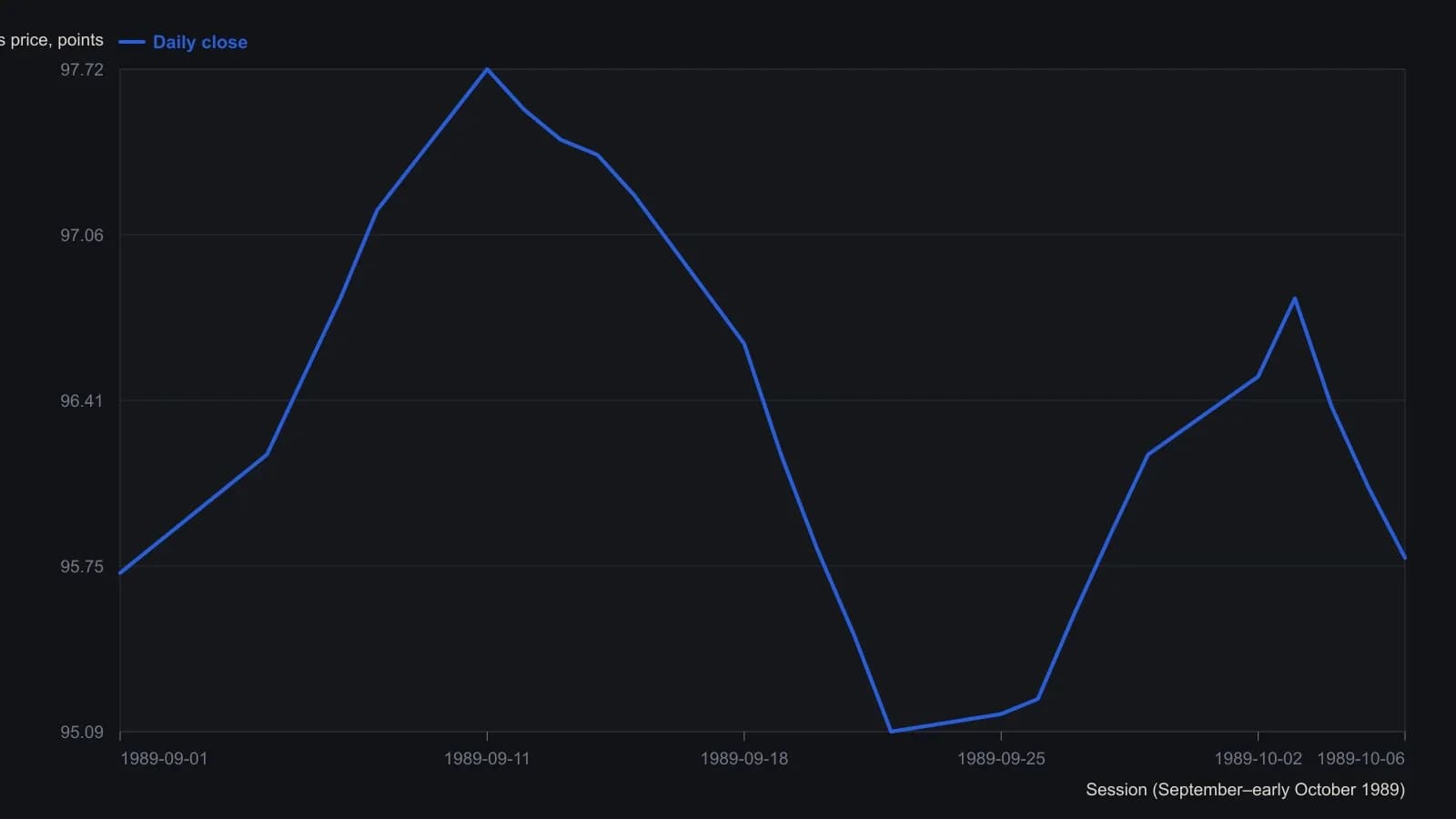
Bond quotes converted from points-and-32nds to decimal points (97-23 = 97 + 23/32). Bar closes estimated from the raster except where the article states an exact print. Volume is described in the text but not recovered as a numeric series.
When a break fails to expand selling
A break through August lows is treated as a cue that selling should expand. Holding the 26 September lows with four closes at the session high is instead read as demand absorbing that selling. Buying is treated as strong enough to halt or reverse the decline even after those August lows had given way.
A print above the 29 September high is the stated condition that buying has overtaken supply. Expanding volume is required to confirm a durable advance. Weak volume marks the same print as likely temporary.
That last step is volume confirmation. Expanding or quiet volume is used as a filter that accepts or rejects a support-resistance hold, failure, or bounce.
What the two opportunities were meant to show
Closing prices together with volume are presented as identifying two short-term opportunities in September and October 1989. Editorial pairing of the archive readings puts the first opportunity at the stalled advance into the 11 September close, where volume rose inside the range, and the second at the hold of the 26 September lows and the later print through the 29 September high.
Editorial takeaway: the larger trend can remain in place while a three-to-five session contest still produces a falsifiable setup. Volume is what decides whether the next few sessions are a channel shift or only an unconfirmed drift.
All readings on this track · 40 readings
- 1988Constructing volume-confirmation overlays on OHLC spreadsheet charts
- 1989Commodity advance-decline from delivery months
- 1989The most-active list as a three-layer breadth lab
- 1989Constructing a yield-curve volume-breadth composite
- 1989A bond-futures case study in support, volume, and confirmation
- 1989Volume-scaled price boxes and volume cycles
- 1990Futures-signed on-balance volume construction
- 1990Self-relative volume boxes for news-free breakouts
- 1990Broadening swings, demand tests, and volume filters
- 1991A same-session pressure test of breadth and volume share
- 1991Tick extremes that confirm double tops and bottoms
- 1991Constructing auction fuel from volume and open interest
- 1994Constructing On-balance volume with smoothing and timeframe confirmation
- 1996A volume-gated moving-average trend combination
- 1996Constructing four-state range-volume bars
- 1997Failed trade review of a descending-triangle breakdown
- 1997Construct a head-and-shoulders before the neckline break
- 2004Volume confirmation is not optional for a head-and-shoulders reversal
- 2007Constructing a three-factor volume-price confirmation filter
- 2007Constructing a three-condition moving-average entry with a volume filter
- 2008Breakout rules that wait for volume and liquidity
- 2011Screen futures liquidity with open interest and volume
- 2011Filter executable futures with liquidity and open interest
- 2012Rank listed futures by liquidity before a forecast chooses the name
- 2012Filter futures liquidity using open interest and volume
- 2013Pre-trade futures liquidity as an execution filter
- 2014A futures liquidity screen from range, open interest and volume
- 2014Evaluating futures contract liquidity before execution
- 2014Constructing defended price lines from volume clusters
- 2014Filter futures by equal-dollar size, open interest, and volume
- 2015Filter futures ideas by ranked contract liquidity
- 2017Screen listed futures for execution liquidity first
- 2017Filter futures orders by liquidity, open interest, and volume
- 2018Using open interest and volume to rank futures liquidity
- 2018Score listed futures as an execution menu before the setup
- 2019Filtering futures orders with liquidity, open interest and volume
- 2019Futures liquidity as an execution filter
- 2020A futures liquidity board as a pre-trade execution filter
- 2020Sequenced volume and golden-cross breakout rules
- 2020Use a listed-futures liquidity filter before execution