1990issue C011-6
Futures-signed on-balance volume construction
On-balance volume is a running total that adds or subtracts a session's entire volume according to the direction of a chosen price series. This archive note treats that sign as a construction choice: cash-session volume can stay as the increment while a cash close, a range position, or a stock-index futures direction decides whether the volume is added or subtracted.
- On-balance volume adds a session's full volume when the tracked price series finishes higher and subtracts that volume when it finishes lower.
- Volume confirmation asks a new price high or low to be matched by a corresponding extreme in the cumulative volume line; a mismatch is read as a volume divergence.
- Futures-signed volume keeps cash-market session volume as the increment and lets the daily direction of a stock-index futures contract decide the sign.
- A close-signed line can show an upside bias, and many periods produce no usable signal under either the cash-index or the futures signing rule.
A running total of signed session volume
On-balance volume is built as a running total of session volume. When the tracked price series finishes higher, the construction adds that session's entire volume. When the series finishes lower, it subtracts the same session volume.
The line is then compared with the price series. Volume confirmation uses the sign assigned to volume as a filter on a price move rather than as a standalone forecast.
Confirmation versus volume divergence
The intended confirmation rule is that a new high or new low in the price series should be matched by a corresponding extreme in the cumulative volume line. A price high or low is treated as more credible when the volume construct makes a matching extreme.
A mismatch is a volume divergence: price prints a new high or new low while the cumulative volume line does not. That reading is a warning that buying or selling pressure is not confirming the print.
Simple volume-price analysis also treats advances on expanding volume and declines on contracting volume as constructive, and the reverse as cautionary. Those heuristics are described with many exceptions and imprecise timing.
Close-signed volume and upside bias
A close-signed cumulative volume line is described as having an upside bias because session volume often expands on advancing days and contracts on declining days. New highs in the line can therefore appear before later price weakness.
Assigning a full session's volume to the close direction also ignores day structure. A tiny net gain still books all volume as buying even if the close sits near the session low.
Range-weighted and futures-signed increments
Range-weighted volume is an alternative volume-price construction. It multiplies total session volume by the close-minus-open distance divided by the high-minus-low range, so the increment reflects where the session settled inside its range. A weak close inside a wide range does not receive a full up-day credit.
Futures-signed volume keeps cash-market session volume as the increment but uses the stock-index futures contract's daily direction, not the cash index close, to decide whether that volume is added or subtracted. That rule is motivated by treating the contract as a leading price series whose larger participants are assumed to be more informed than cash-index prints.
Limits of the confirmation read
The same confirmation logic is described as clearer near market lows than near highs. Many periods are said to produce no usable signal under either the cash-index or the futures signing rule.
Futures-signed OBV through the 1987 crash and recovery
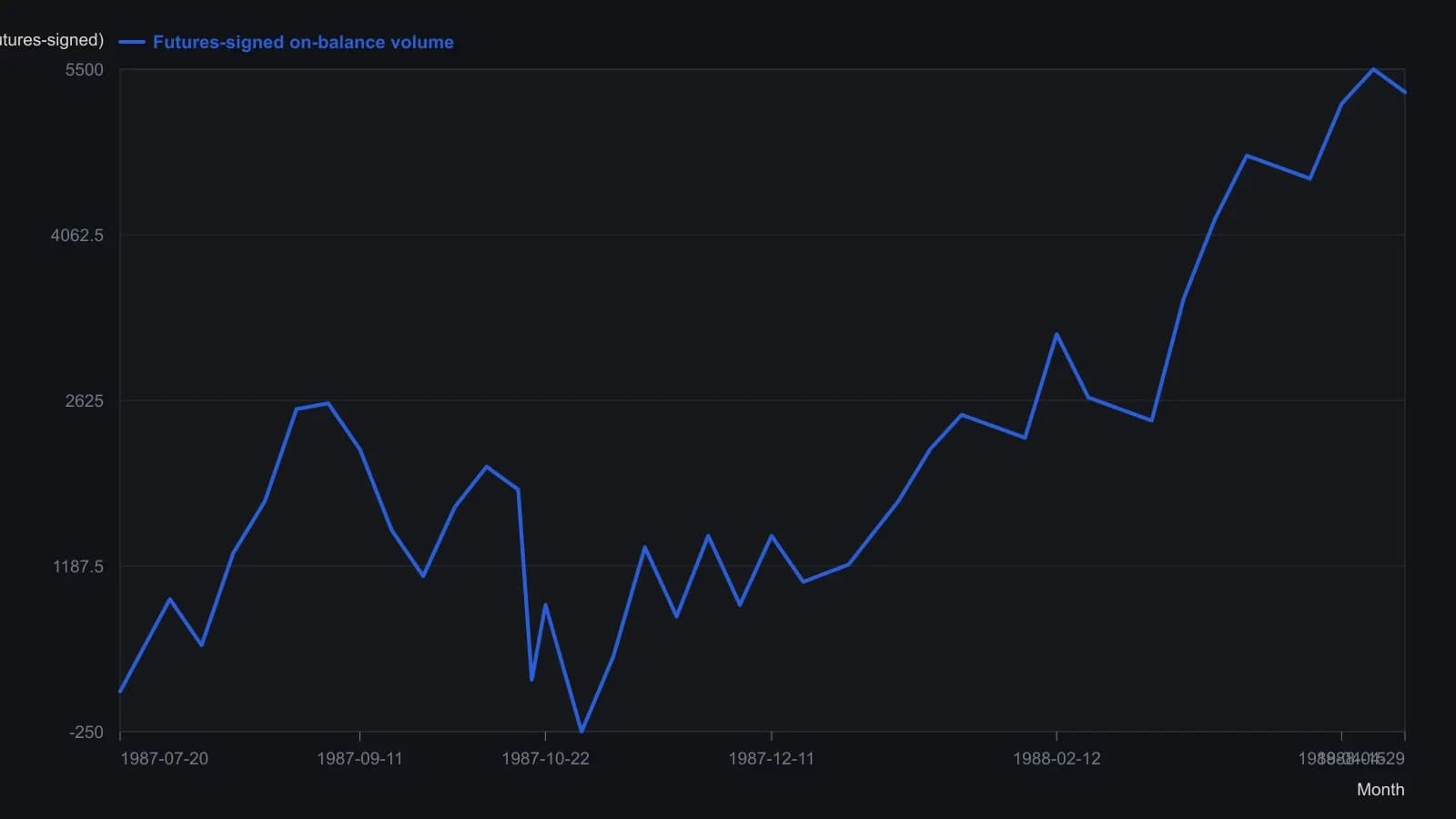
Digitized from the magazine scan. The printed grid is 500 OBV units; readings are approximate to about ±100 units and skip intra-week wiggles the raster does not resolve. The increment is cash NYSE volume; the sign is the futures contract’s daily direction.
All readings on this track · 40 readings
- 1988Constructing volume-confirmation overlays on OHLC spreadsheet charts
- 1989Commodity advance-decline from delivery months
- 1989The most-active list as a three-layer breadth lab
- 1989Constructing a yield-curve volume-breadth composite
- 1989A bond-futures case study in support, volume, and confirmation
- 1989Volume-scaled price boxes and volume cycles
- 1990Futures-signed on-balance volume construction
- 1990Self-relative volume boxes for news-free breakouts
- 1990Broadening swings, demand tests, and volume filters
- 1991A same-session pressure test of breadth and volume share
- 1991Tick extremes that confirm double tops and bottoms
- 1991Constructing auction fuel from volume and open interest
- 1994Constructing On-balance volume with smoothing and timeframe confirmation
- 1996A volume-gated moving-average trend combination
- 1996Constructing four-state range-volume bars
- 1997Failed trade review of a descending-triangle breakdown
- 1997Construct a head-and-shoulders before the neckline break
- 2004Volume confirmation is not optional for a head-and-shoulders reversal
- 2007Constructing a three-factor volume-price confirmation filter
- 2007Constructing a three-condition moving-average entry with a volume filter
- 2008Breakout rules that wait for volume and liquidity
- 2011Screen futures liquidity with open interest and volume
- 2011Filter executable futures with liquidity and open interest
- 2012Rank listed futures by liquidity before a forecast chooses the name
- 2012Filter futures liquidity using open interest and volume
- 2013Pre-trade futures liquidity as an execution filter
- 2014A futures liquidity screen from range, open interest and volume
- 2014Evaluating futures contract liquidity before execution
- 2014Constructing defended price lines from volume clusters
- 2014Filter futures by equal-dollar size, open interest, and volume
- 2015Filter futures ideas by ranked contract liquidity
- 2017Screen listed futures for execution liquidity first
- 2017Filter futures orders by liquidity, open interest, and volume
- 2018Using open interest and volume to rank futures liquidity
- 2018Score listed futures as an execution menu before the setup
- 2019Filtering futures orders with liquidity, open interest and volume
- 2019Futures liquidity as an execution filter
- 2020A futures liquidity board as a pre-trade execution filter
- 2020Sequenced volume and golden-cross breakout rules
- 2020Use a listed-futures liquidity filter before execution