1989issue C081-7
Constructing a yield-curve volume-breadth composite
This note shows how to convert each maturity’s volume into signed waves, apply unequal curve weights, and tally a daily plus-one, zero, or minus-one scoreboard for volume-confirmation of rate-market price breaks.
- On-balance volume adds full session volume after a higher close, subtracts it after a lower close, and ignores an unchanged close, even if the running total turns negative.
- The close-weighted volume-accumulator is assigned to short-horizon volume-price-analysis; on-balance volume with staircase-labeling is assigned to the long-horizon major-wave.
- Each of eight unequally weighted cash-index and interest-rate-futures entities receives a signal-score of plus one, zero, or minus one, then those scores are summed into a daily financial-volume-index.
- Weak short-maturity volume signals against strong long-maturity signals are treated as a flattening setup under yield-curve-segmentation.
Compare a running volume series with price
The archive workflow treats volume-trend turns as preceding price-trend turns. A running volume series is therefore compared with price for confirmation or non-confirmation of new highs and lows.
Volume-price-analysis reads those price extremes against the volume-derived series. A new high or a new low is accepted only when the volume series agrees.
Build the signed volume series
On-balance volume is a cumulative total that adds session volume after a higher close, subtracts it after a lower close, and ignores volume when the close is unchanged. The running total may be negative.
A volume-accumulator assigns a signed fraction of session volume from where the close sits in that session’s high-low range. One documented implementation starts that series at 10000. The close-weighted accumulator is assigned to short-horizon volume-price work. On-balance volume with staircase-labeling is assigned to longer-horizon work.
Label peaks, troughs, and a major-wave
Direction changes on the volume series are labeled as peaks and troughs. Staircase-labeling marks those successive peaks and troughs so a higher or lower sequence becomes the trend assignment. Four consecutive labels trending the same way assign a major trend. Mixed waves produce no signal.
A long-horizon volume signal is specified as a two-step sequence in each direction. It remains in force until an opposite major-wave appears.
Granville vs Chakin volume rules on T-bond futures
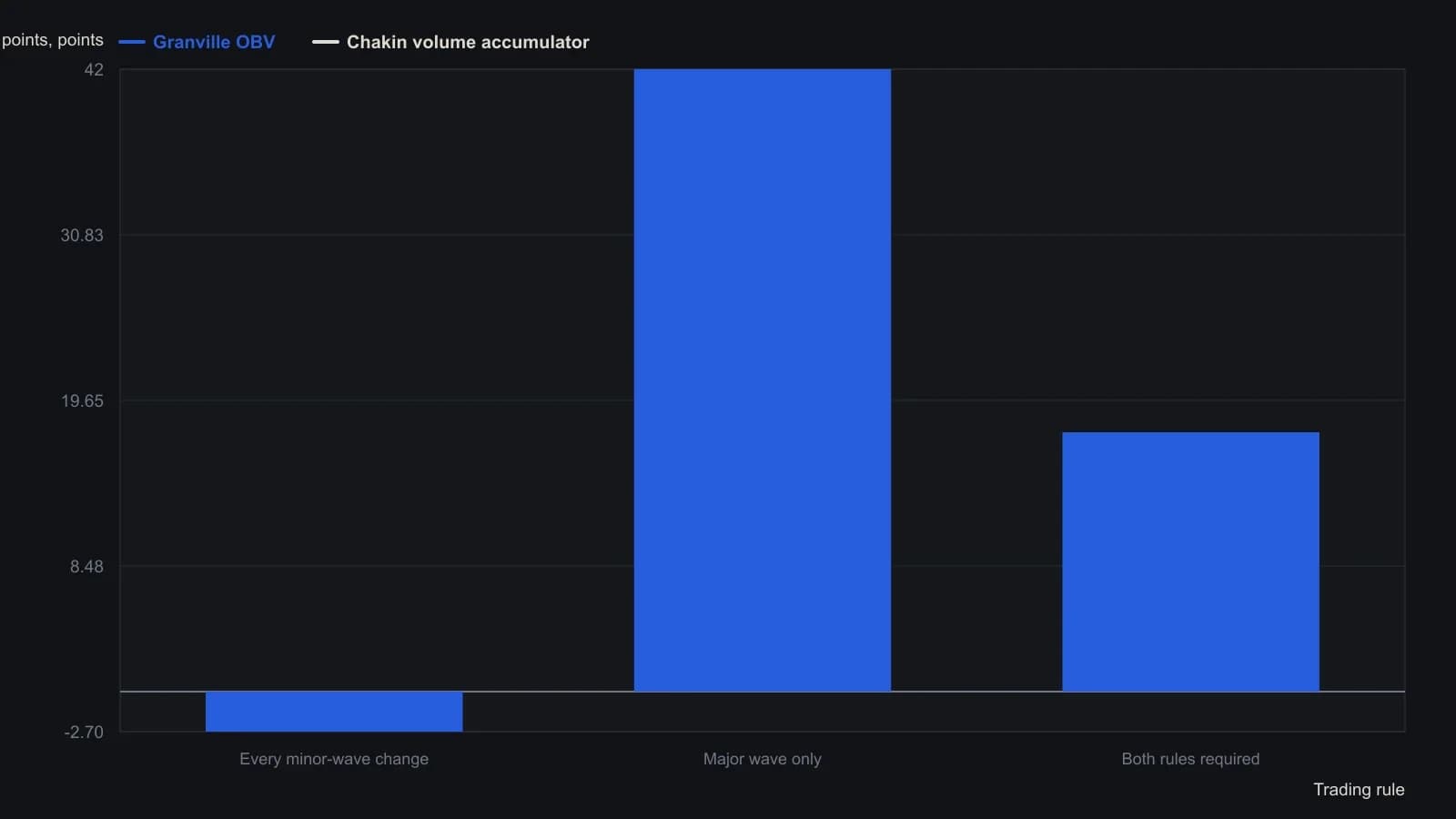
The sample spans both a bear and a bull market in bonds. A buy-and-hold stance lost more than 26 points over the same window.
Weight eight entities into a financial-volume-index
The breadth composite records on-balance volume on eight cash-index and interest-rate-futures entities. It averages the front two futures contracts and then applies unequal weights along the curve.
Stated weights are one-half on a utility cash index, full weight on a twenty-bond cash index, double weight on long-bond and ten-year note futures, and full weight on bill, eurodollar, municipal, and five-year note futures.
Tally a daily signal-score and read the curve
Each entity is scored plus one for a bullish short-horizon or long-horizon volume signal, minus one for a bearish signal, and zero when it sits between signals. Those signal-score values are tallied daily into a chartable composite.
Divergent volume signals across maturities are read as yield-curve information. Weak short-maturity signals against strong long-maturity signals are treated as a flattening setup. Yield-curve-segmentation keeps short-maturity, intermediate-maturity, and long-maturity volume signals separate so that split can be read as curve shape.
All readings on this track · 40 readings
- 1988Constructing volume-confirmation overlays on OHLC spreadsheet charts
- 1989Commodity advance-decline from delivery months
- 1989The most-active list as a three-layer breadth lab
- 1989Constructing a yield-curve volume-breadth composite
- 1989A bond-futures case study in support, volume, and confirmation
- 1989Volume-scaled price boxes and volume cycles
- 1990Futures-signed on-balance volume construction
- 1990Self-relative volume boxes for news-free breakouts
- 1990Broadening swings, demand tests, and volume filters
- 1991A same-session pressure test of breadth and volume share
- 1991Tick extremes that confirm double tops and bottoms
- 1991Constructing auction fuel from volume and open interest
- 1994Constructing On-balance volume with smoothing and timeframe confirmation
- 1996A volume-gated moving-average trend combination
- 1996Constructing four-state range-volume bars
- 1997Failed trade review of a descending-triangle breakdown
- 1997Construct a head-and-shoulders before the neckline break
- 2004Volume confirmation is not optional for a head-and-shoulders reversal
- 2007Constructing a three-factor volume-price confirmation filter
- 2007Constructing a three-condition moving-average entry with a volume filter
- 2008Breakout rules that wait for volume and liquidity
- 2011Screen futures liquidity with open interest and volume
- 2011Filter executable futures with liquidity and open interest
- 2012Rank listed futures by liquidity before a forecast chooses the name
- 2012Filter futures liquidity using open interest and volume
- 2013Pre-trade futures liquidity as an execution filter
- 2014A futures liquidity screen from range, open interest and volume
- 2014Evaluating futures contract liquidity before execution
- 2014Constructing defended price lines from volume clusters
- 2014Filter futures by equal-dollar size, open interest, and volume
- 2015Filter futures ideas by ranked contract liquidity
- 2017Screen listed futures for execution liquidity first
- 2017Filter futures orders by liquidity, open interest, and volume
- 2018Using open interest and volume to rank futures liquidity
- 2018Score listed futures as an execution menu before the setup
- 2019Filtering futures orders with liquidity, open interest and volume
- 2019Futures liquidity as an execution filter
- 2020A futures liquidity board as a pre-trade execution filter
- 2020Sequenced volume and golden-cross breakout rules
- 2020Use a listed-futures liquidity filter before execution