2018issue C1260
Score listed futures as an execution menu before the setup
Treat every listed futures market as an execution menu first. Use open interest, tape volume, and equal-dollar contract counts to score whether an order can be placed and flattened before a price setup is treated as a live trade.
- A liquidity filter keeps only contracts with enough participation, range-adjusted size, and margin context to be entered and exited over the life of an order.
- Relative contract liquidity multiplies the equal-dollar contract count by total open interest and by a volume factor.
- Volume confirmation lifts an active tape and floors a quiet tape at 1, so a large open book is not treated as executable without current activity.
- Each ranking column is a proportional measure and is only comparable to other values in that same column.
Score the book before the setup
Editorially, TradersWeek treats every listed futures market as an execution menu first. A price setup becomes a live trade only after the contract can be placed and flattened over the life of an order.
The archive workflow applies a liquidity filter. That pre-trade screen keeps only contracts with enough participation, range-adjusted size, and margin context to be entered and exited over the life of an order.
How the archive builds a liquidity rank
A futures liquidity rank can be built by multiplying contract point value, a three-year maximum price range, open interest, and a volume factor usually set between 1 and 4.
Relative contract liquidity is the equal-dollar contract count multiplied by total open interest and by a volume factor. Editorially, that rank is read as an execution score, not as a forecast of direction.
Put open interest on one dollar unit
Open interest analysis scales outstanding contracts by point value and a multi-year price range so outstanding interest can be compared across products.
Contracts to trade for equal dollar profit equals tick dollar value times the three-year maximum price excursion, putting each listed product on the same dollar-range unit. That count is how many contracts of one product match another product's three-year dollar range, so listed markets can be compared on a common economic unit.
Confirm the tape, not only the open book
Volume confirmation raises or floors a liquidity rank from recent volume so a large open book is not treated as executable without current activity.
The volume factor is the greater of 1 and an exponential of log volume over log 5000, minus 2, which lifts active tape and floors quiet tape at 1.
A liquidity display with one activity marker or none corresponds to little current activity and a weaker score on an execution screen.
Compare capital intensity, not headline margin
Effective percent margin is posted margin divided by the three-year dollar range of the contract, then multiplied by 100, so capital intensity can be compared across products. The archive uses that figure rather than headline margin rates.
For listed shares, period volume as a percentage of shares outstanding is treated as turnover and used as a liquidity proxy.
Read each column only against itself
Each ranking column is a proportional measure and is only comparable to other values in that same column.
Editorially, the columns are a menu of execution measures. They do not forecast price. They score whether an order in that listed product can be treated as executable.
Contracts to trade for equal dollar profit
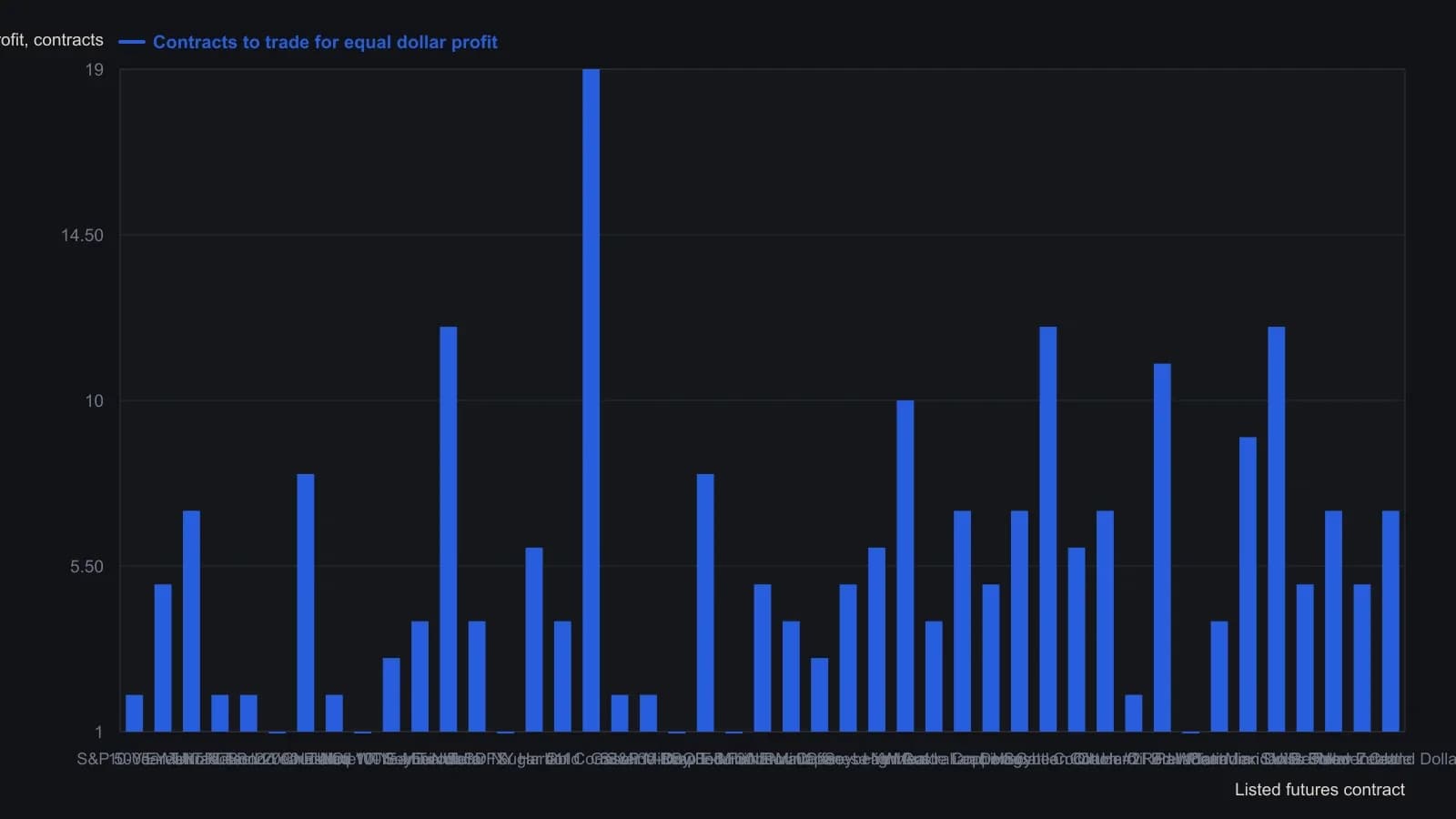
The source sets Contracts to Trade = (tick dollar value) × (3-year maximum price excursion), so every bar is on one dollar unit. Rows stay in the printed descending relative-liquidity order. The dot scale for relative contract liquidity is a graphic rank, not a numeric series, and is omitted.
All readings on this track · 40 readings
- 1988Constructing volume-confirmation overlays on OHLC spreadsheet charts
- 1989Commodity advance-decline from delivery months
- 1989The most-active list as a three-layer breadth lab
- 1989Constructing a yield-curve volume-breadth composite
- 1989A bond-futures case study in support, volume, and confirmation
- 1989Volume-scaled price boxes and volume cycles
- 1990Futures-signed on-balance volume construction
- 1990Self-relative volume boxes for news-free breakouts
- 1990Broadening swings, demand tests, and volume filters
- 1991A same-session pressure test of breadth and volume share
- 1991Tick extremes that confirm double tops and bottoms
- 1991Constructing auction fuel from volume and open interest
- 1994Constructing On-balance volume with smoothing and timeframe confirmation
- 1996A volume-gated moving-average trend combination
- 1996Constructing four-state range-volume bars
- 1997Failed trade review of a descending-triangle breakdown
- 1997Construct a head-and-shoulders before the neckline break
- 2004Volume confirmation is not optional for a head-and-shoulders reversal
- 2007Constructing a three-factor volume-price confirmation filter
- 2007Constructing a three-condition moving-average entry with a volume filter
- 2008Breakout rules that wait for volume and liquidity
- 2011Screen futures liquidity with open interest and volume
- 2011Filter executable futures with liquidity and open interest
- 2012Rank listed futures by liquidity before a forecast chooses the name
- 2012Filter futures liquidity using open interest and volume
- 2013Pre-trade futures liquidity as an execution filter
- 2014A futures liquidity screen from range, open interest and volume
- 2014Evaluating futures contract liquidity before execution
- 2014Constructing defended price lines from volume clusters
- 2014Filter futures by equal-dollar size, open interest, and volume
- 2015Filter futures ideas by ranked contract liquidity
- 2017Screen listed futures for execution liquidity first
- 2017Filter futures orders by liquidity, open interest, and volume
- 2018Using open interest and volume to rank futures liquidity
- 2018Score listed futures as an execution menu before the setup
- 2019Filtering futures orders with liquidity, open interest and volume
- 2019Futures liquidity as an execution filter
- 2020A futures liquidity board as a pre-trade execution filter
- 2020Sequenced volume and golden-cross breakout rules
- 2020Use a listed-futures liquidity filter before execution