2014issue C0459-61
Constructing defended price lines from volume clusters
A relative-volume histogram isolates unusually large-volume sessions. After a volume-cluster, a defended-price-line can be parked at the close, then shifted to a local best fit when nearby support and resistance prints stack, or hidden when a proximity-filter or visible-origin-filter finds it redundant.
- A relative-volume histogram marks unusually large-volume sessions as a distinct state, and a two-bar volume-cluster can trigger a defended-price-line at the closing price.
- Freedom-of-movement compares a price move with the accompanying volume change over a lookback and flags when travel suddenly becomes restricted.
- Tight stacks of repeated support and resistance readings can confirm a local level, and the defended-price-line can then be moved to a single best fit of that zone.
- A proximity-filter hides a new line that sits too close to an older one, and a visible-origin-filter drops many older lines that start off the left edge of the visible window.
Isolate a volume-cluster
A relative-volume histogram can mark unusually large-volume sessions as a distinct state against ordinary volume bars. After a cluster of those large-volume sessions, a defended-price-line can be placed at the closing price. A two-bar large-volume cluster can be used as the construction trigger for that close-based line.
Flag restricted travel
A second construction compares a price move with the accompanying volume change over a lookback and flags when movement suddenly becomes restricted. That freedom-of-movement reading marks when travel becomes constrained relative to the volume change that arrived with the move.
Confirm and shift the line
Repeated support and resistance readings tend to stack near the same prices, and those tight stacks can be read as confirmation of a local level. When new confirming prints appear, the defended-price-line can be moved up or down to a single best-fit of the apparent local support or resistance zone.
Hide redundant neighbors
A proximity-filter can hide a new defended-price-line if its price sits inside a user-set tolerance of an older line that is already shown. A visible-origin-filter keeps only lines whose first print falls inside the current chart window. Restricting the plot that way removes many older lines that start off the left edge and still leaves congestion as more recent levels accumulate.
S&P 500 daily path and the parked defended price line
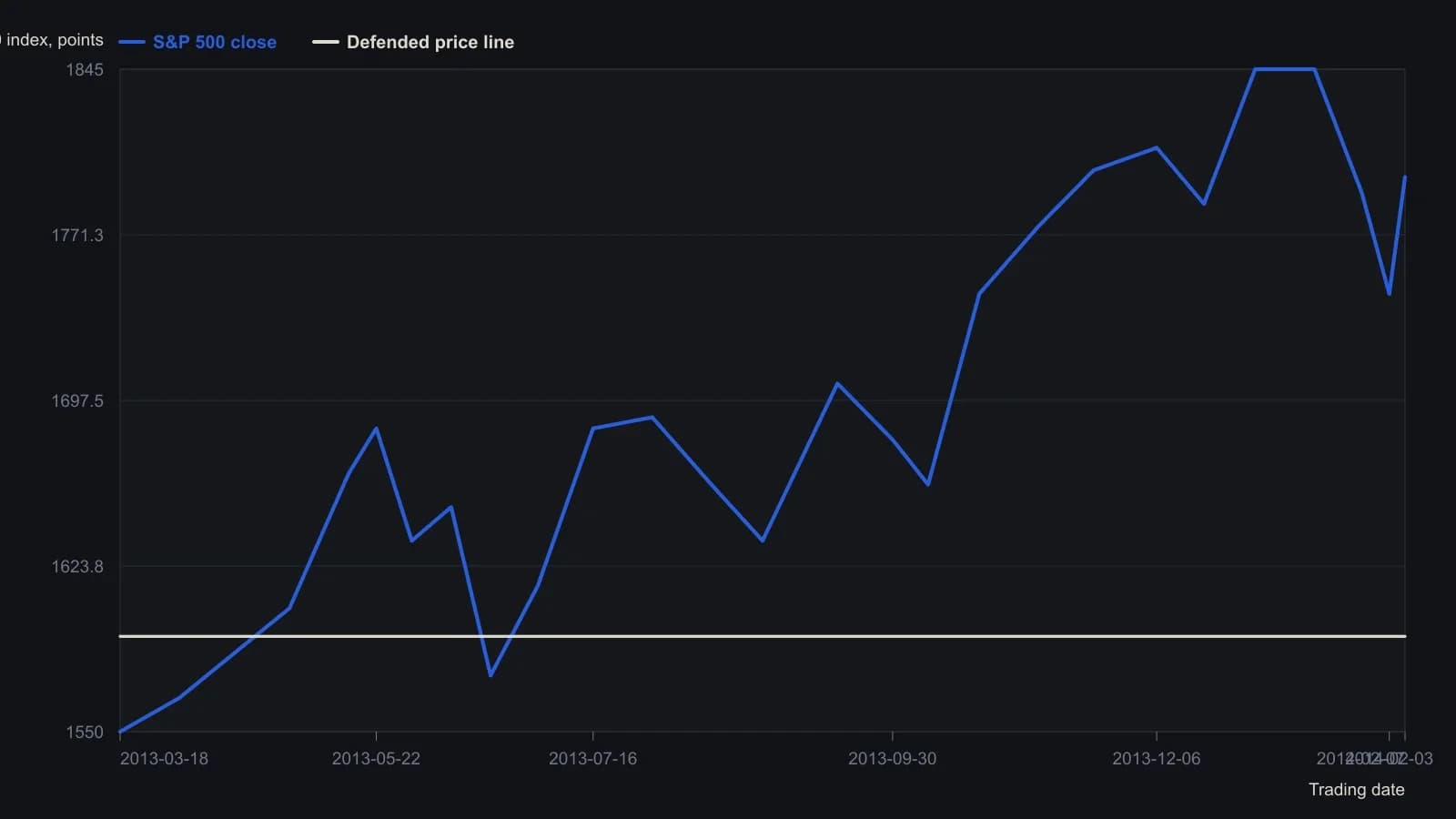
Relative Volume and Freedom of Movement both use a 60-session lookback and a 2-sigma flag; Updata parks each defended price line at the close after a size-2 relative-volume cluster. Closes other than the labeled 7 February print are read off the figure, so they are approximate to about five index points.
All readings on this track · 40 readings
- 1988Constructing volume-confirmation overlays on OHLC spreadsheet charts
- 1989Commodity advance-decline from delivery months
- 1989The most-active list as a three-layer breadth lab
- 1989Constructing a yield-curve volume-breadth composite
- 1989A bond-futures case study in support, volume, and confirmation
- 1989Volume-scaled price boxes and volume cycles
- 1990Futures-signed on-balance volume construction
- 1990Self-relative volume boxes for news-free breakouts
- 1990Broadening swings, demand tests, and volume filters
- 1991A same-session pressure test of breadth and volume share
- 1991Tick extremes that confirm double tops and bottoms
- 1991Constructing auction fuel from volume and open interest
- 1994Constructing On-balance volume with smoothing and timeframe confirmation
- 1996A volume-gated moving-average trend combination
- 1996Constructing four-state range-volume bars
- 1997Failed trade review of a descending-triangle breakdown
- 1997Construct a head-and-shoulders before the neckline break
- 2004Volume confirmation is not optional for a head-and-shoulders reversal
- 2007Constructing a three-factor volume-price confirmation filter
- 2007Constructing a three-condition moving-average entry with a volume filter
- 2008Breakout rules that wait for volume and liquidity
- 2011Screen futures liquidity with open interest and volume
- 2011Filter executable futures with liquidity and open interest
- 2012Rank listed futures by liquidity before a forecast chooses the name
- 2012Filter futures liquidity using open interest and volume
- 2013Pre-trade futures liquidity as an execution filter
- 2014A futures liquidity screen from range, open interest and volume
- 2014Evaluating futures contract liquidity before execution
- 2014Constructing defended price lines from volume clusters
- 2014Filter futures by equal-dollar size, open interest, and volume
- 2015Filter futures ideas by ranked contract liquidity
- 2017Screen listed futures for execution liquidity first
- 2017Filter futures orders by liquidity, open interest, and volume
- 2018Using open interest and volume to rank futures liquidity
- 2018Score listed futures as an execution menu before the setup
- 2019Filtering futures orders with liquidity, open interest and volume
- 2019Futures liquidity as an execution filter
- 2020A futures liquidity board as a pre-trade execution filter
- 2020Sequenced volume and golden-cross breakout rules
- 2020Use a listed-futures liquidity filter before execution