2004issue C031-3
Volume confirmation is not optional for a head-and-shoulders reversal
A three-peak outline on price or momentum can be read as reversal or continuation. The historical workflow keeps a reversal reading live only when later peaks print on lighter volume than the left shoulder.
- A head-and-shoulders outline can appear on price or on momentum, and the same three-peak shape can be read as reversal or continuation.
- A reversal reading after an advance expects the head and the right shoulder to print on lighter volume than the left shoulder.
- Similar volume on the head and the right shoulder is treated as a warning that the advance may continue.
- A leading volume-price downturn while price is still rising is not by itself a short-sale confirmation.
The same outline can reverse or continue
A head-and-shoulders outline can form on a price series and on a momentum series. The same three-peak outline can be read as a reversal structure or as a continuation structure.
That is the reversal-versus-continuation split. The same silhouette can argue for trend change or trend persistence. The volume sequence, not the outline, decides which reading remains live.
The left shoulder is the first peak in the three-peak outline and is the volume benchmark for later peaks. The right shoulder is the third peak. Its volume relative to the left shoulder is the main confirmation check.
Later-peak volume decides the reading
A reversal reading after an advance expects volume on the head and on the right shoulder to be lighter than volume on the left shoulder. Similar volume on the head and the right shoulder is treated as a warning that the advance may continue rather than reverse.
An advance that prints later peaks on declining volume is described as more likely to reverse or move sideways. If later peaks lack that declining-volume sequence, the volume series itself will not display a matching head-and-shoulders profile.
Volume confirmation is the filter that accepts a reversal reading only when the head and right shoulder print on lighter volume than the left shoulder, and treats similar later-peak volume as a continuation warning. Volume-price analysis infers participation and directional pressure from how volume expands or contracts as successive highs and lows print, rather than from the price outline alone.
Price peaks and volume at a late-cycle three-peak outline
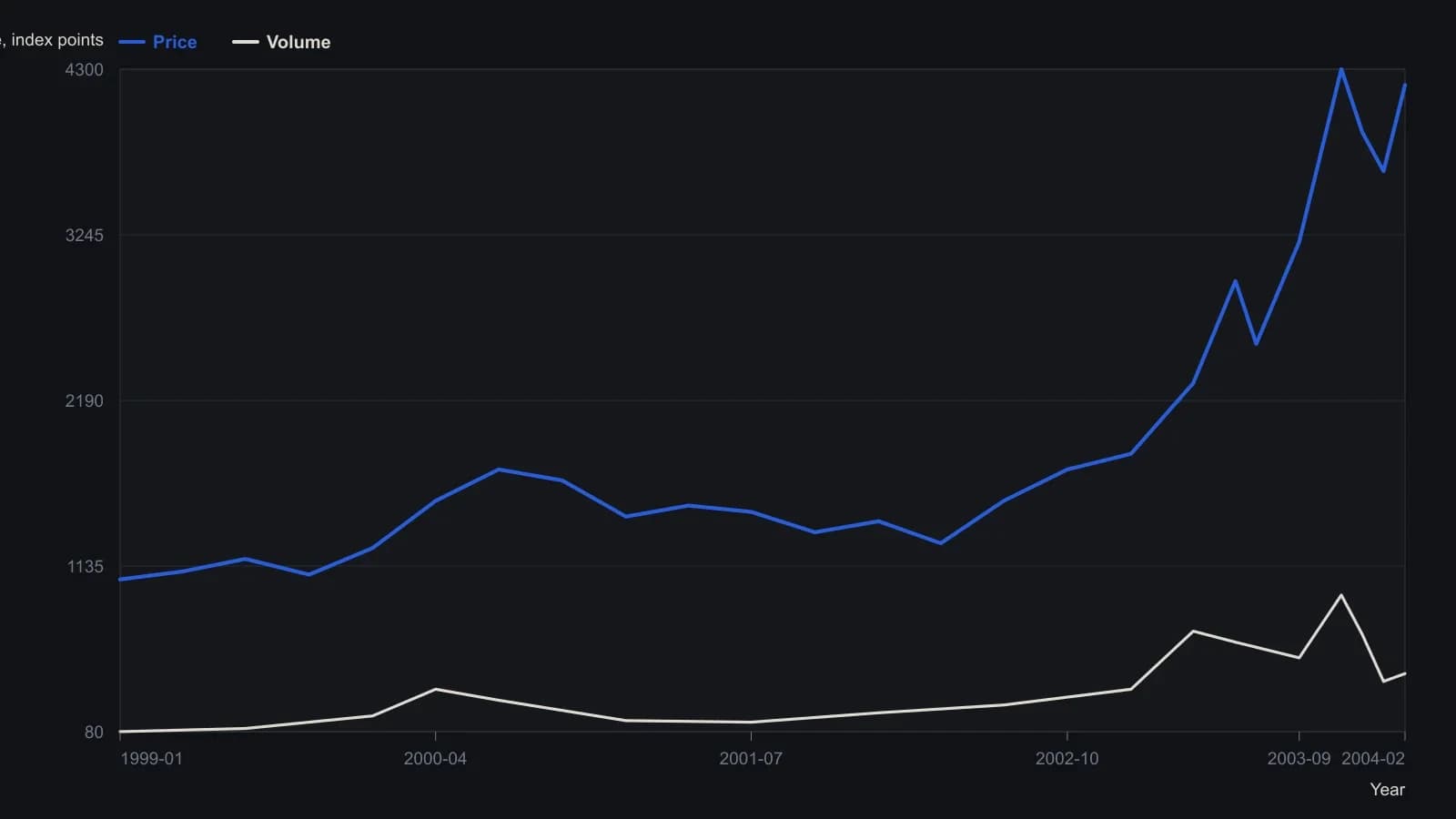
Values are approximate readings off the published raster: yearly ticks on the time axis and printed price/volume scales only. No table was given, so peaks are sampled coarsely and no extra precision is claimed.
Direction is not read from every volume cue
A volatility squeeze is treated as useful for anticipating higher volatility but as offering little directional information on its own. Direction is left to volume-price measures or other price patterns.
A leading volume-price reading can turn down while price is still rising once participation thins. That downturn is not by itself a short-sale confirmation.
All readings on this track · 40 readings
- 1988Constructing volume-confirmation overlays on OHLC spreadsheet charts
- 1989Commodity advance-decline from delivery months
- 1989The most-active list as a three-layer breadth lab
- 1989Constructing a yield-curve volume-breadth composite
- 1989A bond-futures case study in support, volume, and confirmation
- 1989Volume-scaled price boxes and volume cycles
- 1990Futures-signed on-balance volume construction
- 1990Self-relative volume boxes for news-free breakouts
- 1990Broadening swings, demand tests, and volume filters
- 1991A same-session pressure test of breadth and volume share
- 1991Tick extremes that confirm double tops and bottoms
- 1991Constructing auction fuel from volume and open interest
- 1994Constructing On-balance volume with smoothing and timeframe confirmation
- 1996A volume-gated moving-average trend combination
- 1996Constructing four-state range-volume bars
- 1997Failed trade review of a descending-triangle breakdown
- 1997Construct a head-and-shoulders before the neckline break
- 2004Volume confirmation is not optional for a head-and-shoulders reversal
- 2007Constructing a three-factor volume-price confirmation filter
- 2007Constructing a three-condition moving-average entry with a volume filter
- 2008Breakout rules that wait for volume and liquidity
- 2011Screen futures liquidity with open interest and volume
- 2011Filter executable futures with liquidity and open interest
- 2012Rank listed futures by liquidity before a forecast chooses the name
- 2012Filter futures liquidity using open interest and volume
- 2013Pre-trade futures liquidity as an execution filter
- 2014A futures liquidity screen from range, open interest and volume
- 2014Evaluating futures contract liquidity before execution
- 2014Constructing defended price lines from volume clusters
- 2014Filter futures by equal-dollar size, open interest, and volume
- 2015Filter futures ideas by ranked contract liquidity
- 2017Screen listed futures for execution liquidity first
- 2017Filter futures orders by liquidity, open interest, and volume
- 2018Using open interest and volume to rank futures liquidity
- 2018Score listed futures as an execution menu before the setup
- 2019Filtering futures orders with liquidity, open interest and volume
- 2019Futures liquidity as an execution filter
- 2020A futures liquidity board as a pre-trade execution filter
- 2020Sequenced volume and golden-cross breakout rules
- 2020Use a listed-futures liquidity filter before execution