2007issue C091-9
Constructing a three-condition moving-average entry with a volume filter
The archive constructs a jointly testable long or short entry from three simultaneous checks: moving-average location, prior-bar volume confirmation, and an open-to-prior-close gap. Moving-average inputs and a market-bias setting stay separate from the entry logic.
- A long entry requires three conditions at once: the open above the moving average, prior-bar volume above a volume filter, and a negative open-to-prior-close change.
- A short entry uses the complementary location and gap checks with the same volume filter.
- Default construction uses a 34-period simple moving average of close and a volume filter of 500, while price series, lookback, and average type stay separate inputs.
- A market-bias enumeration keeps the same rule set and limits it to long-only, short-only, or both long and short trades.
A jointly testable entry from three checks
The archive constructs a rule-based entry: a fixed, jointly testable set of entry conditions that must all be true before a long or short signal is issued. The moving average is a defined lookback average of ordered price used as a location baseline for long versus short eligibility. Volume confirmation is a prior-bar volume threshold used as a filter so entries fire only after a minimum activity level.
The remaining check is a same-bar gap on the open relative to the prior close. The location check, the volume filter, and the gap condition must all hold together before a long or short signal is issued.
Long and short conditions
The constructed long entry requires three simultaneous conditions: the open above the moving average, prior-bar volume above a volume filter, and a negative open-to-prior-close change.
The constructed short entry is the complementary three-condition set: the open below the moving average, prior-bar volume above the same volume filter, and a positive open-to-prior-close change.
Inputs that rebuild the baseline
Default construction parameters are a 34-period simple moving average of close and a volume filter of 500.
The moving-average price series, lookback length, and average type are exposed as separate inputs so the baseline can be rebuilt without rewriting the entry logic.
A market-bias setting on the same rules
A market-bias enumeration restricts the same rule set to long-only, short-only, or both long and short trades.
Annualized IRR of timed long trendline-break trades versus indexes
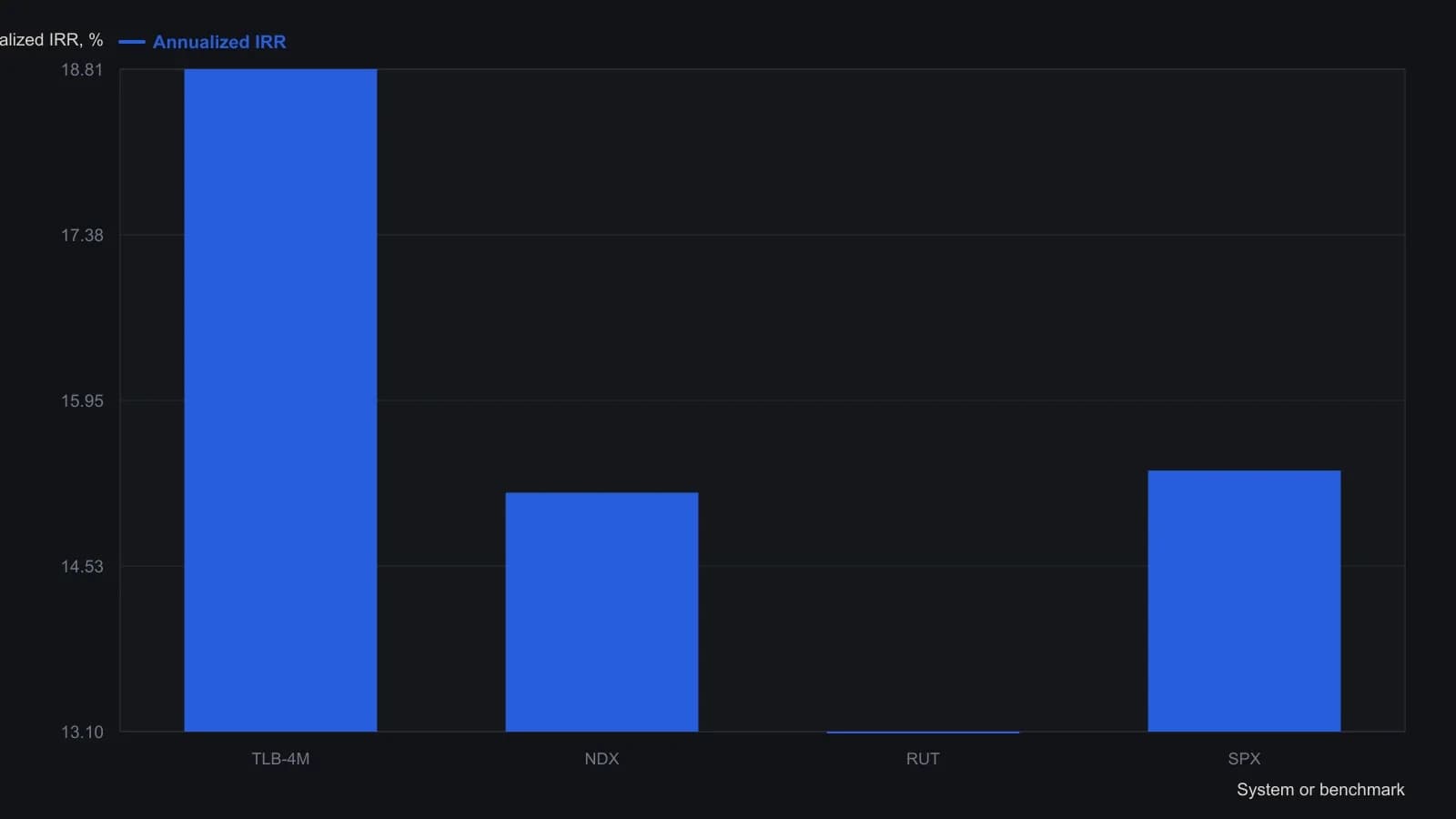
Completed chart-pattern breakouts on the NASDAQ 100, next-day open entries, three-day hold, at most three names, three cents per share round-trip. The text rounds this row to a 19 percent annualized return and separately cites an 8 percent maximum drawdown that is not in the table.
All readings on this track · 40 readings
- 1988Constructing volume-confirmation overlays on OHLC spreadsheet charts
- 1989Commodity advance-decline from delivery months
- 1989The most-active list as a three-layer breadth lab
- 1989Constructing a yield-curve volume-breadth composite
- 1989A bond-futures case study in support, volume, and confirmation
- 1989Volume-scaled price boxes and volume cycles
- 1990Futures-signed on-balance volume construction
- 1990Self-relative volume boxes for news-free breakouts
- 1990Broadening swings, demand tests, and volume filters
- 1991A same-session pressure test of breadth and volume share
- 1991Tick extremes that confirm double tops and bottoms
- 1991Constructing auction fuel from volume and open interest
- 1994Constructing On-balance volume with smoothing and timeframe confirmation
- 1996A volume-gated moving-average trend combination
- 1996Constructing four-state range-volume bars
- 1997Failed trade review of a descending-triangle breakdown
- 1997Construct a head-and-shoulders before the neckline break
- 2004Volume confirmation is not optional for a head-and-shoulders reversal
- 2007Constructing a three-factor volume-price confirmation filter
- 2007Constructing a three-condition moving-average entry with a volume filter
- 2008Breakout rules that wait for volume and liquidity
- 2011Screen futures liquidity with open interest and volume
- 2011Filter executable futures with liquidity and open interest
- 2012Rank listed futures by liquidity before a forecast chooses the name
- 2012Filter futures liquidity using open interest and volume
- 2013Pre-trade futures liquidity as an execution filter
- 2014A futures liquidity screen from range, open interest and volume
- 2014Evaluating futures contract liquidity before execution
- 2014Constructing defended price lines from volume clusters
- 2014Filter futures by equal-dollar size, open interest, and volume
- 2015Filter futures ideas by ranked contract liquidity
- 2017Screen listed futures for execution liquidity first
- 2017Filter futures orders by liquidity, open interest, and volume
- 2018Using open interest and volume to rank futures liquidity
- 2018Score listed futures as an execution menu before the setup
- 2019Filtering futures orders with liquidity, open interest and volume
- 2019Futures liquidity as an execution filter
- 2020A futures liquidity board as a pre-trade execution filter
- 2020Sequenced volume and golden-cross breakout rules
- 2020Use a listed-futures liquidity filter before execution