2013issue C0726-32
Step candle construction at price turning points
A two-candle step is marked at a high-low zigzag turning point when the second body opens inside the prior body and closes beyond it. A gap between the bodies is treated as a stronger form of the same construction, not as a separate pattern class.
- The step construction is checked at high-low zigzag turning points, not anywhere on the chart or only with moving averages.
- An upstep or downstep requires the second body to open inside or equal to the prior body and close beyond it; a body gap is a stronger form of the same rule.
- Preferring the step definition at turning points often completely or partly masks other named candlestick constructions on the same bars.
- Candlestick recognition at a turning point is one rule inside the irsts swing framework, not a complete standalone system.
Locate the turning point first
The step construction is checked at high-low zigzag turning points rather than anywhere on the chart or only in combination with moving averages. On a daily chart, the high-low zigzag used to locate those turning points requires at least a 10 percent move between successive highs and lows.
Build an upstep after a pivot low
An upstep is a white or green candle at or after a pivot low. It opens inside or equal to the low side of the previous body and closes above the upper side of that previous body. The first candle may be either color.
The upstep has four enumerated bar-color sequences. All four keep the same inside-open and beyond-close relationship to the prior body.
Build a downstep after a pivot high
A downstep is a black or red candle at or after a pivot high. It opens inside or equal to the high side of the previous body and closes below the lower side of that previous body. The first candle may be either color.
The downstep likewise has four enumerated sequences. They preserve the same inside-open and beyond-close relationship on the opposite side of the prior body.
Treat a body gap as the same construction
A gap between the two consecutive bodies is a valid and stronger form of the same upstep or downstep construction, not a separate pattern class. The open-inside and close-beyond logic still applies when the two bodies do not overlap.
Pattern masking at the same bars
Preferring the step definition at turning points often completely or partly masks other named candlestick constructions that occupy the same bars. On one five-year example chart, 45 harami markings, 85 step markings, and 127 combined step, engulfing, and harami markings were counted.
One rule inside the irsts framework
Candlestick recognition at turning points is presented as one rule inside the irsts swing framework, not as a complete standalone system.
Pattern counts at Ford zigzag turns
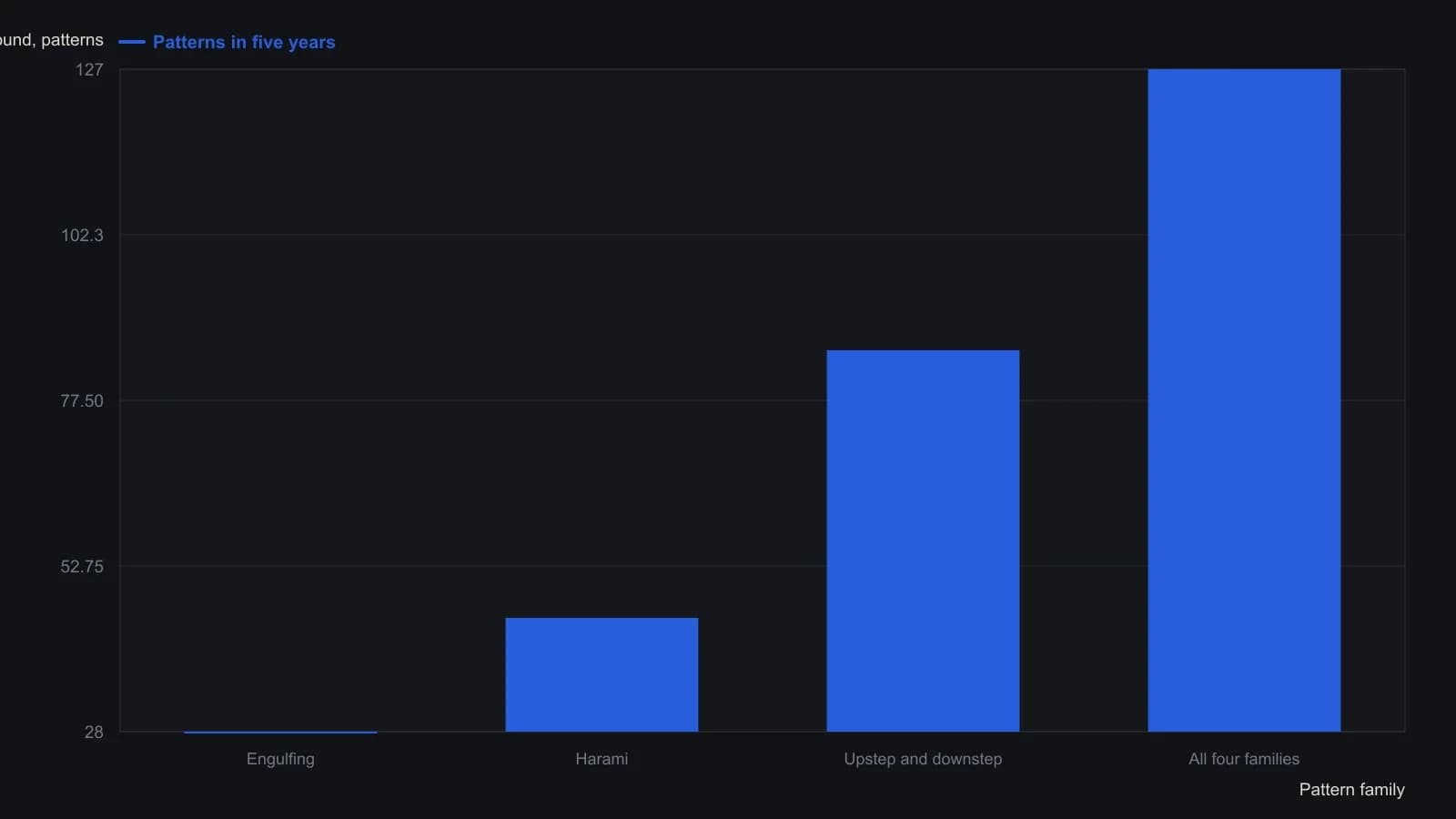
Daily Ford Motor (F) bars and a 10% high-low zigzag. The four bars are CandlePattern settings 2, 3, 1, and 9. The combined count is smaller than the sum because a step at a pivot often occupies the same bars as an engulfing or harami.
All readings on this track · 54 readings
- 1990Constructing three-session rally and reaction volume signals
- 1991Constructing candlestick real bodies and multi-session patterns
- 1991Treat a candlestick reversal as incomplete until %D confirms it
- 1991Filtering candlestick signals with stochastic percent-D
- 1991Constructing compressed candlestick summaries
- 1993Intraday candlestick confirmation with oscillators
- 1993Candlestick hypotheses from a 1993 reading list
- 1994License candlestick signals with oscillators and weekly vetoes
- 1995Real-body support, resistance, and close-through breakouts
- 1997Weekly reversal as a three-part hypothesis
- 1998Turning fear levels into testable rules with a psychological matrix
- 2000Evaluating three-bar reversal reliability
- 2000Prior-day candles, open confirmation, and same-session stops
- 2000Intraday candlestick volume confirmation for daytrading
- 2001Count the key reversal up before coding a mechanical exit
- 2001Rising and falling three continuation candle construction
- 2002Treat a moving average as a contested fence
- 2003Candlestick signals need support and a risk-reward screen
- 2003Constructing one-day reversal tops and bottoms
- 2003Chart sentiment as a regime filter for hourly stochastic entries
- 2004Confirming index reversals with candlesticks, stochastics and averages
- 2004The harami inner close as a reversal barometer
- 2004Constructing a true-range volume power-shift filter
- 2005Weighing reversal clusters against moving-average support
- 2005Candlestick exits confirmed by overbought stochastics
- 2005Confirming piercing patterns with stochastics and moving averages
- 2006Candlestick cluster exits confirmed by overbought stochastics
- 2007Three black crows become a trade hypothesis only after regime, trend and nearby levels
- 2008Asymmetrical RSI lookbacks for divergence and candle confirmation
- 2008A permission checklist for the end of a trend
- 2010Mechanical entries still need confirmation gates
- 2010Crude oil as a case study in candlestick session reading
- 2010Gold weekly candles and the thousand resistance breakout
- 2010A three-layer gold chart drill from waves to candle confirmation
- 2011Why entry scans fail without trend filters
- 2011Price-zone oscillator trend-regime rules
- 2011A candlestick checklist before commodity entries
- 2013Step candle construction at price turning points
- 2013Two-bar step-candle construction
- 2014Small-range bars as a timed volume-climax hypothesis
- 2014Constructing volume-scaled candlestick charts
- 2015Weekly range midpoints as support and resistance
- 2015Constructing weekly body-midpoint pattern codes
- 2015Evaluating encoded candlestick sequence hypotheses
- 2015Constructing a breakout relative-strength index from two-day range candles
- 2016A three-gate classroom on hourly sterling
- 2016Fibonacci retracement as a pre-commitment stop map
- 2017Nine-zone filter for decade-level breakouts
- 2017Constructing pin-bar and inside-bar setups
- 2017Two-bar soldier and crow rules become a system only after filters and exits
- 2017Confirm a one-white-soldier or one-black-crow before entry
- 2018Session control from marubozu and engulfing geometry
- 2019Volume, acceleration, and candle filters on a completed double bottom
- 2019Sector-filtered candlestick scans and predrawn stops