1989issue C111-6
Inside-day contraction as a same-session open-to-close rule
An inside day is a session whose high sits below the prior high and whose low sits above the prior low. The archive entered on the next open in that opening direction and exited on the same session close. Editorial reading: treat the bar as a candlestick congestion contract and keep a filter only if it changes that open-to-close procedure.
- An inside day is a candlestick session whose high is below the prior high and whose low is above the prior low.
- The baseline rule-based entry bought a higher next-session open or sold a lower next-session open after an inside day, then used a same-session exit at the close with no stop.
- Close-open alignment required the inside-day close and the next open to point the same way and, in the 1982-1987 window, produced 44 open-to-close trades with 74 percent finishing as winners, against 68 percent for the unfiltered baseline.
- Four-session context kept the same Day 4 open-to-close exit. The short sequence appeared 10 times from 1982 through 1987, and the inverse long rule did not require Day 4 to open above Day 3's midpoint.
What an inside day is
An inside day is defined as a session whose high is below the prior session high and whose low is above the prior session low. That bar is a candlestick-patterns condition: a full session contained by the prior range.
The historical evaluation treated the inside day as a narrowing congestion inside the prior range and treated the next open as the first cue used to expand. The argument was that a market which often trends through a single session can complete that expansion from the inside-day contraction alone.
Editorial reading: treat the inside day as a candlestick congestion contract. The working premise is contraction-then-expansion, in which a narrowing inside bar is a pause that can precede a directional widening, and the first print after the inside day is an opening-direction-breakout rather than a wait for a later range break.
The baseline open-to-close rule
The baseline tested rule bought a higher next-session open or sold a lower next-session open after an inside day. Entry was taken on that open. Exit was the same session close, with no stop. That pairing is the rule-based-entry to keep as one procedure: opening-direction-breakout plus same-session-exit.
A 1982-1987 S&P 500 futures test of that baseline open-to-close rule reported that 68 percent of the trades finished as winners.
Close-open alignment
Close-open alignment requires the inside-day close and the next open to point the same way before a trade is taken. When that filter was applied, the same 1982-1987 window produced 44 open-to-close trades, and 74 percent of that filtered sample finished as winners.
The entry and exit did not change. The filter only decided whether the next-open vote was allowed to stand. Editorial reading: that is the standard for keeping the add-on. It alters abstention, not the same-session-exit.
Four-session context
A four-session short rule required Day 2 to hold a higher low than Day 1 and Day 4 to open below Day 3's midpoint and close. The sale was taken on Day 4's open and exited on Day 4's close. The sequence appeared 10 times from 1982 through 1987.
The inverse four-session long rule required Day 2's high to sit below Day 1's high and Day 4's open to sit above Day 3's close, not necessarily above Day 3's midpoint. The long side was therefore not a mirror of the short side's midpoint condition.
Editorial reading: four-session context is a multi-bar sequence in which a short-term thrust loses momentum on the inside day and the fourth session opens against that thrust. It still lives or dies as a Day 4 opening-direction-breakout with a same-session-exit.
What the next open implied for Day 3
After an inside day with a lower close and a next open above that close, the 1982-1987 tests reported that Day 3 closed above the inside-day close in 62 percent of cases. A higher inside-day close followed by a higher open reported 79 percent.
After an inside day with a lower close and a lower next open, Day 3 closed below the inside-day close in 59 percent of tested cases. A higher inside-day close followed by a lower open reported 67 percent. Those counts describe the next session relative to the inside-day close. They do not replace the baseline same-session-exit.
Large moves away from the open
On S&P sessions from 1982 through 1988, a 200-point rise from the open was followed by a close above the open on 90 percent of those days. A 200-point fall from the open was followed by a close below the open on 88 percent of those days.
Editorial reading: those counts function as an intraday-extension-check. They mark a large same-session move away from the open as an initial trend inside the session the exit already uses. They support the archive claim that expansion can finish from the inside-day pause and the next open alone. They are not a second entry rule.
How to grade the add-ons
Editorial reading: keep the inside day, the opening-direction-breakout, and the same-session-exit as one testable procedure. Close-open alignment and four-session context matter only as changes to when that procedure is allowed to fire. If an add-on does not change the open-to-close rule, it does not earn a separate place in the same-session workflow.
Inside-day S&P open-to-close win rates
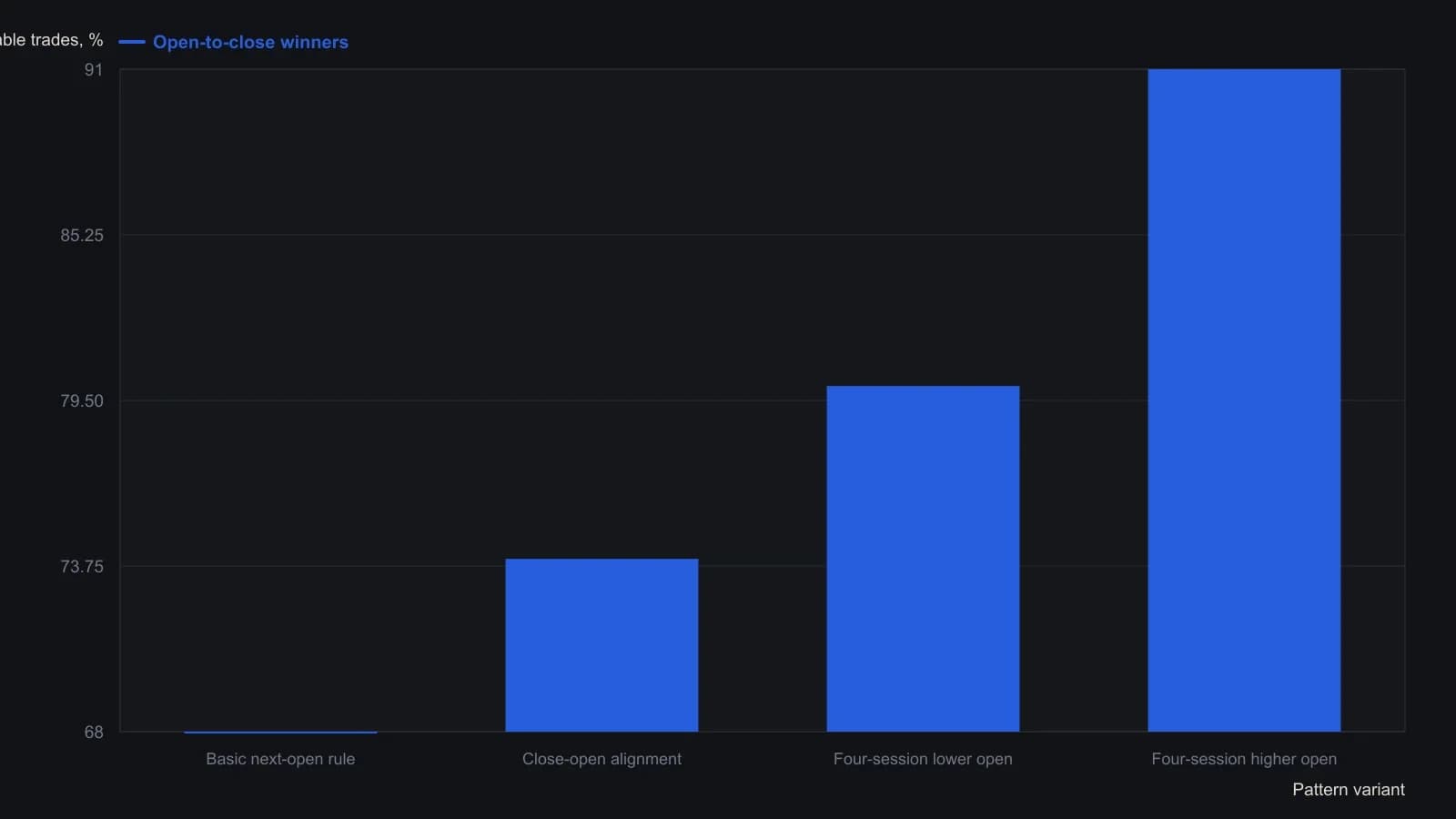
No protective stop. Baseline net profit is after an $18 commission. The close-open alignment sample is 44 trades; the four-session lower-open pattern appeared only 10 times. Crabel notes the 1980s bull market likely lifted long-side results. A later 56 percent remark is omitted because it conflicts with the 68 percent baseline and is not tied to a separate sample.
All readings on this track · 25 readings
- 1988Early entry as the session switch for an opening-range breakout
- 1989Evaluating inside-day filters on opening-range breakouts
- 1989Opening-range breakout after a narrow-range-four session
- 1989A joint contraction setup as the arming switch for an opening-range breakout
- 1989Next-session opening-range rules after a bear hook
- 1989Same-session exits from multi-day open-close codes
- 1989A close-to-close sequence is a bias label, not a trigger
- 1989Inside-day contraction as a same-session open-to-close rule
- 1990Evaluating five-day soybean open-to-close rules
- 1990Hourly breakouts gated by absolute tick volume
- 1993Premarket setup selection and opening-range rules
- 1994First-hour opening-range construction as a refusal problem
- 1995Why historically tested rules fail without a decision process
- 2001The opening range as a measuring stick for a ladder breakout
- 2001Evaluating an opening reaction as one timed stop procedure
- 2003Swing trading, opening-range checks, and the decision to stand aside
- 2006Monitor each opening-range setup as its own regime
- 2006Midday breakout rules from the opening range
- 2007Opening-range breakout as one session procedure
- 2007Evaluating same-day opening range entry rules
- 2008Overnight auction regimes and the intraday hold-or-exit choice
- 2010Construct a market-state-first range-breakout system as one procedure
- 2013Opening-hour stop as a session filter
- 2017Overnight volume as a construction step for the opening-range breakout
- 2017Night-volume gate for opening range breakouts