1989issue C101-4
Packaging two-bar reversals into testable entry and exit rules
A two-session reversal is only a research object after it is locked to an n-day extreme filter, a next-open rule-based entry, a hard initial stop, and a high/low trailing stop that does not wait for a mirror-image candle. This editorial article treats that closed procedure as the evaluation object, not the candle print alone.
- Three related two-session reversals share a higher high than the prior bar and a close below the prior close, and they differ only on whether the prior low is pierced and whether the close finishes below that low.
- A reversal counted as a signal only when it was also the highest high or lowest low of a recent n-day window; the rule-based entry was the next session's open, with an initial stop one point beyond that reversal day's high or low.
- Because an opposite reversal was not assumed to appear, open trades were liquidated with a simple high/low trailing stop rather than by waiting for a mirror pattern.
- Several reversal days can print during a multi-month trend before a final extreme, so the procedure can take losses on the way and can miss a major move if no pattern appears at the actual turn.
A pattern is not yet a procedure
Candlestick patterns in this write-up are two-session OHLC structures that share a higher high and a lower close, then split on whether the prior low is pierced and whether the close finishes below that low.
Editorial: a two-bar reversal is only a research object after it is locked to an n-day extreme filter, a next-open rule-based entry, a hard initial stop, and a high/low trailing stop that does not wait for a mirror-image candle.
Three reversal definitions and the extreme filter
Three related two-session reversal definitions share a higher high than the prior bar and a close below the prior close, and they differ only on whether the prior low is pierced and whether the close finishes below that low.
The n-day extreme filter is a gate that counts a reversal only when that bar is also the highest high or lowest low of the most recent n sessions. A reversal counted as a signal only when it passed that gate. Other prints were ignored.
Rule-based entry and the first stop
Rule-based entry is a next-session open after a reversal that also marks an n-day extreme, with non-extreme prints ignored and an inverse rule for longs. After a qualifying reversal, the entry was the next session's open, and an initial stop was placed one point beyond that reversal day's high or low.
The trailing stop is a high/low lookback used first as a one-point protective stop beyond the reversal extreme and later as the liquidation level when no opposite reversal is assumed.
Liquidation without a mirror candle
Because an opposite reversal was not assumed to appear, open trades were liquidated with a simple high/low trailing stop rather than by waiting for a mirror pattern.
One fully specified short used a 30-day new high plus a reversal, sold the following open, placed a protective stop one point above the high of the day before entry, and liquidated at the most recent 10-day high. Longs inverted those rules.
Nested models and a position reverse
Nested pattern models are three entry gates that accept any of the three reversal variants, only the two stricter variants, or only a close below the prior low. Those three nested entry models were compared: one fired on any of the three pattern variants, one on the two stricter variants, and one only when the close finished below the prior low.
A position reverse is flipping an open short to a long when a bullish reversal prints, instead of leaving the short untouched until the trailing stop is hit. A bullish reversal printed while a short was open reversed the position instead of leaving it untouched.
What a closed procedure can still miss
The tests scanned setup lookbacks from 5 to 40 days and trailing-stop lookbacks from 5 to 30 days, applied a $100 per-trade cost assumption, and used five years of perpetual series.
Several reversal days can print during a multi-month trend before a final extreme, so the procedure can take losses on the way and can miss a major move if no pattern appears at the actual turn.
Editorial: those failure modes are the classroom point. Tightening the candlestick definition changes which prints pass the nested gates, but it does not remove the need for the extreme filter, the next-open entry, or the trailing stop.
Key-reversal closed-procedure net profit by market
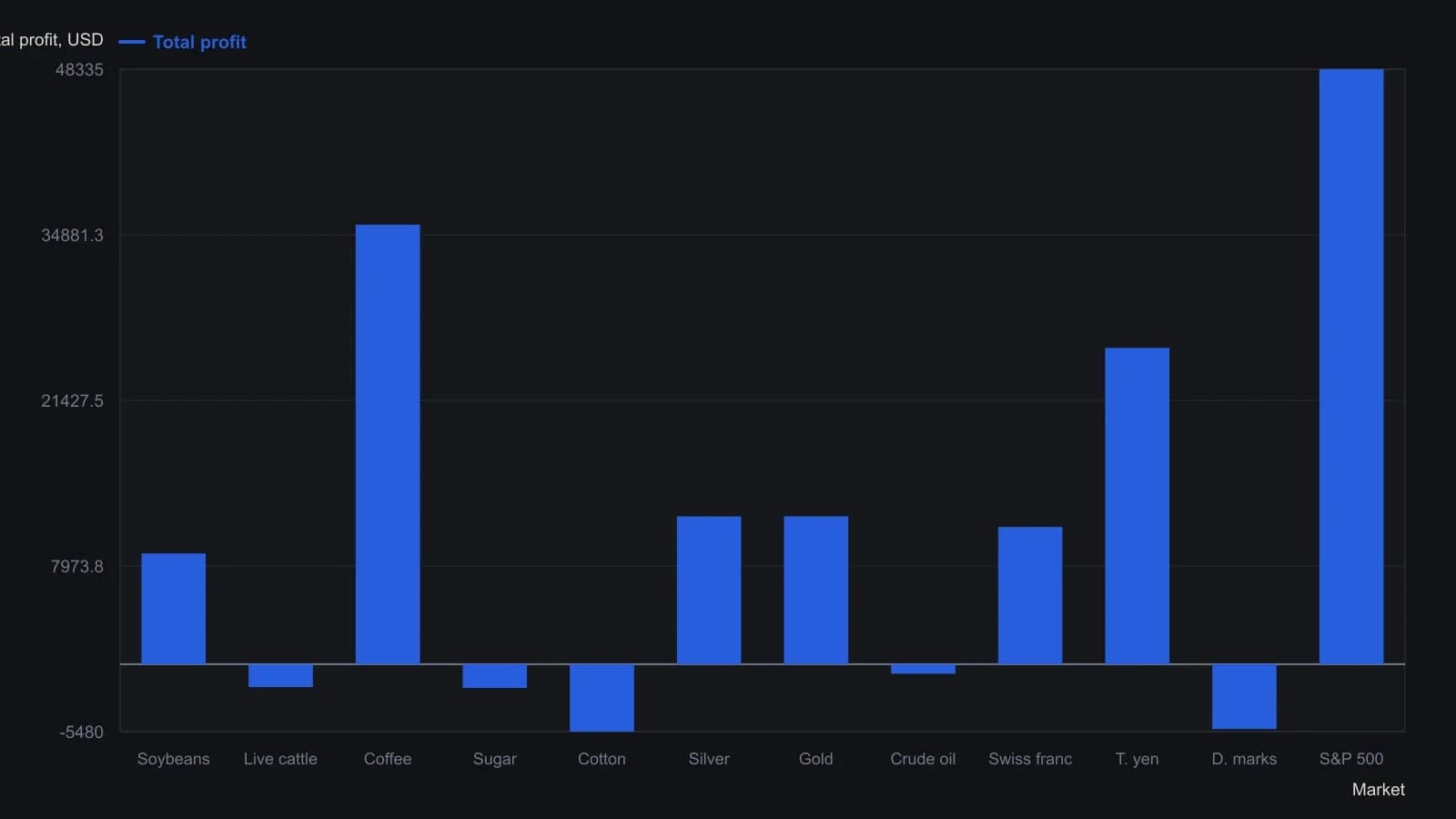
Five years of perpetual futures, Omega System Writer Plus, $100 per trade. Parameters swept 5–40 days for the extreme filter and 5–30 days for the high/low trailing stop; each row is that market’s reported best model.
All readings on this track · 36 readings
- 1988Half-day bars, a midpoint gate, and a bar-based trail
- 1989Packaging two-bar reversals into testable entry and exit rules
- 1989Weekly high and low averages as stop-and-reverse levels
- 1991Constant false-alarm rate for dominant-cycle stops
- 1992Tick-index extremes as continuation and turn hypotheses
- 1993Constructing layered stops from equity and structure
- 1993Filter crossovers with moving-average slope
- 1993Precommit stop bounds from equity and structure
- 1998Evaluating a trendline barrier that can only tighten a capped stop
- 1999Constructing common-number support and resistance
- 2001Four-step opening-hour bias and trailing stops
- 2004Make the trading system the star
- 2005A beginner stock case: stop, trail, and the pre-trade checklist
- 2006Sell stops that trail support after the buy
- 2006Treat a wave-3 label as unfunded until the stop rails are written
- 2008Test medium-term divergence with a trendline break and a trailing stop
- 2010Rule-based forex entry, stop and trail
- 2012Precommitting stops when one currency range templates another
- 2012Cat-ears as a downtrend continuation hypothesis
- 2013Three-average swing entry and a trailing average exit
- 2014Construct a dual quotient-copy trend filter under a frequency roof
- 2014Stop distance, size, and trailing swing invalidation
- 2014Long-only RSI pullback, reversal-bar-entry, and staged-trail construction
- 2015Dual-average regime, trigger candle, and trail as one daily script
- 2015Three-gate trend system: filter, trigger, and trailing stop
- 2016Construct HHLLS crossover and breakout entry rules
- 2017An appointment-trade around a scheduled political close
- 2017Golden-cross breakout rules for a swing entry
- 2017Breakout confirmation above round numbers, with nines as sell shelves
- 2018Classify diamond geometry before the breakout
- 2019When trails and stops betray the support read
- 2019One-triggers-the-other pairs for preplanned swing entries
- 2019One-triggers-the-other orders for a breakout and its stop
- 2019When the second decision unbounds planned risk
- 2020Last-Hour Breakout With a Same-Session Flatten
- 2020Couple the slow period to stop-loss and trailing-stop settings