2015issue C0541-43
Constructing weekly body-midpoint pattern codes
Weekly construction first assigns a pattern-code from body-polarity and from where the body sits on the range-midpoint of the dominant-range-week. The same midpoint then serves as a support or resistance rail, and entry is allowed only when zigzag-close-location versus the last 7% swing is also defined.
- Each weekly candle receives a pattern-code from body-polarity and from where its body sits relative to a range-midpoint, not from a conventional candlestick name.
- The range-midpoint is taken from the dominant-range-week and can later reject price as resistance or hold price as support.
- A second rule layer records zigzag-close-location versus the last peak or valley of a 7% zigzag before an entry is allowed.
- A weekly encoding is not made valid on a daily chart merely by changing periodicity, because weekly bars largely remove gaps and similar events that daily bars retain.
Two catalogs from body-polarity
Weekly candles are split into two eight-member catalogs. One catalog holds bars whose close is above the open. The other holds bars whose close is below the open. That split is body-polarity.
Each catalog member is identified by where the candle body sits relative to a range-midpoint, not by a conventional candlestick name. The identifier is a pattern-code from 1 to 16.
The range-midpoint and the dominant-range-week
The range-midpoint used for the comparison is the arithmetic mean of high and low on the dominant-range-week. That week is the one whose high-low span is the largest among the current bar and earlier bars, and its midpoint is the one applied to later candles.
On a weekly chart the same dominant-range midpoint can first reject price as resistance and later hold price as support.
Pattern 16 as a defining bar
Pattern 16 is the encoding in which the body covers the middle of the range. It is treated as a defining bar when both range and body are visibly larger than in preceding weeks so the midpoint runs through the body.
Weekly GM closes and the Haguro range-midpoint rail
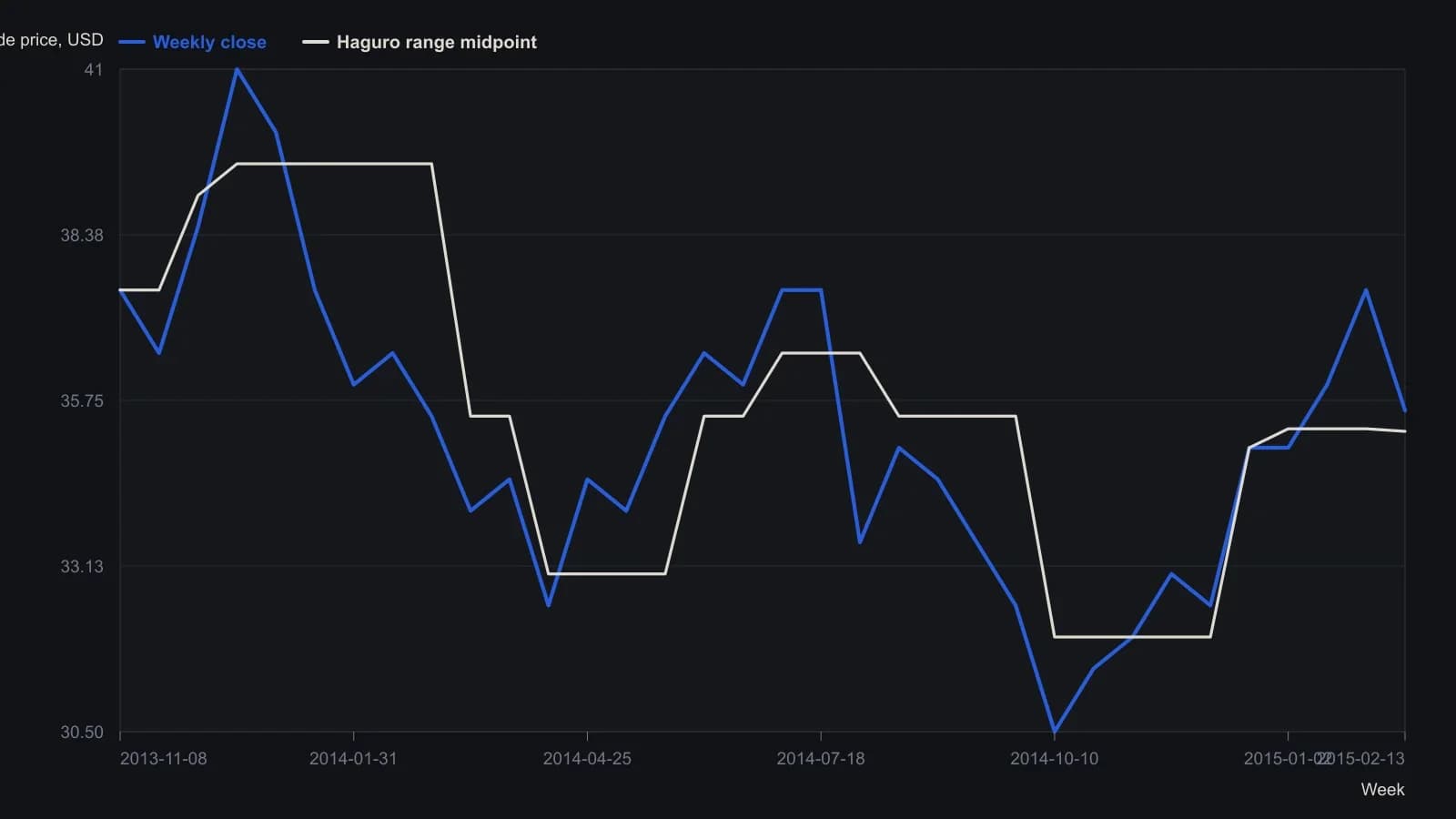
Midpoint is (high+low)/2 of the week with the largest recent range, not of the current bar. A 7% zigzag is the second-layer close filter and lives in a separate pane, so it is not plotted here. Candle-by-candle prices are approximate screenshot readings, not exchange prints.
Selected weekly encodings
Pattern 3 is treated as a frequent reversal encoding that typically appears two or three weeks before a trend change. It is treated as more significant when a range-zigzag overextension reading exceeds 7%.
Pattern 2 is classified as a long-side setup. It can appear on the bar where the midpoint flips from resistance to support.
Zigzag-close-location as the second rule layer
The second rule layer locates the week's close against the last peak or valley of a 7% zigzag, including as a percentage of the distance from that extreme. That reading is zigzag-close-location.
Editorial interpretation: this layer makes the weekly close's place versus the last 7% swing part of the same construction, rather than a separate chart judgment.
Weekly encodings stay on weekly bars
A weekly encoding is not made valid on a daily chart merely by changing periodicity, because weekly bars largely remove gaps and similar events that daily bars retain.
All readings on this track · 54 readings
- 1990Constructing three-session rally and reaction volume signals
- 1991Constructing candlestick real bodies and multi-session patterns
- 1991Treat a candlestick reversal as incomplete until %D confirms it
- 1991Filtering candlestick signals with stochastic percent-D
- 1991Constructing compressed candlestick summaries
- 1993Intraday candlestick confirmation with oscillators
- 1993Candlestick hypotheses from a 1993 reading list
- 1994License candlestick signals with oscillators and weekly vetoes
- 1995Real-body support, resistance, and close-through breakouts
- 1997Weekly reversal as a three-part hypothesis
- 1998Turning fear levels into testable rules with a psychological matrix
- 2000Evaluating three-bar reversal reliability
- 2000Prior-day candles, open confirmation, and same-session stops
- 2000Intraday candlestick volume confirmation for daytrading
- 2001Count the key reversal up before coding a mechanical exit
- 2001Rising and falling three continuation candle construction
- 2002Treat a moving average as a contested fence
- 2003Candlestick signals need support and a risk-reward screen
- 2003Constructing one-day reversal tops and bottoms
- 2003Chart sentiment as a regime filter for hourly stochastic entries
- 2004Confirming index reversals with candlesticks, stochastics and averages
- 2004The harami inner close as a reversal barometer
- 2004Constructing a true-range volume power-shift filter
- 2005Weighing reversal clusters against moving-average support
- 2005Candlestick exits confirmed by overbought stochastics
- 2005Confirming piercing patterns with stochastics and moving averages
- 2006Candlestick cluster exits confirmed by overbought stochastics
- 2007Three black crows become a trade hypothesis only after regime, trend and nearby levels
- 2008Asymmetrical RSI lookbacks for divergence and candle confirmation
- 2008A permission checklist for the end of a trend
- 2010Mechanical entries still need confirmation gates
- 2010Crude oil as a case study in candlestick session reading
- 2010Gold weekly candles and the thousand resistance breakout
- 2010A three-layer gold chart drill from waves to candle confirmation
- 2011Why entry scans fail without trend filters
- 2011Price-zone oscillator trend-regime rules
- 2011A candlestick checklist before commodity entries
- 2013Step candle construction at price turning points
- 2013Two-bar step-candle construction
- 2014Small-range bars as a timed volume-climax hypothesis
- 2014Constructing volume-scaled candlestick charts
- 2015Weekly range midpoints as support and resistance
- 2015Constructing weekly body-midpoint pattern codes
- 2015Evaluating encoded candlestick sequence hypotheses
- 2015Constructing a breakout relative-strength index from two-day range candles
- 2016A three-gate classroom on hourly sterling
- 2016Fibonacci retracement as a pre-commitment stop map
- 2017Nine-zone filter for decade-level breakouts
- 2017Constructing pin-bar and inside-bar setups
- 2017Two-bar soldier and crow rules become a system only after filters and exits
- 2017Confirm a one-white-soldier or one-black-crow before entry
- 2018Session control from marubozu and engulfing geometry
- 2019Volume, acceleration, and candle filters on a completed double bottom
- 2019Sector-filtered candlestick scans and predrawn stops