1989issue C061-4
Next-session opening-range rules after a bear hook
A bear hook opens below the prior session low, closes above the prior session close, and posts a narrower range. The archive applies that bar as a next-session filter on opening-range-breakout variants rather than as a same-session entry.
- A bear hook opens below the prior session low, closes above the prior session close, and posts a narrower range than the prior session.
- The condition is a next-session filter on opening-range-breakout variants, not a same-session entry signal.
- The following session still measures stretch from the opening range, but the procedure may fade a stretch and studies only the downside breakout.
- The default first-fill continuation rule is treated as an exception after this prior-bar condition.
The prior-bar bear hook
A bear hook is a session that opens below the prior session's low, closes above the prior session's close, and has a narrower range than the prior session. That single-session open-high-low-close condition is the candlestick pattern used here. It is the prior-bar filter that changes the next session's stretch rules. It does not fire an entry on the bar that prints it.
A next-session filter, not a same-session entry
The bear hook is applied as a next-session filter on opening-range-breakout variants, not as a same-session entry signal. A rule-based entry fires only when the defined prior-session bear-hook condition and a same-session stretch level are both present.
Opening range and stretch
The opening range in this breakout procedure is the price interval formed in the first 30 seconds to 5 minutes of the session. Stretch is the 10-session average of the distance from each session's open to the nearer extreme of that session. It is used as the offset from the opening range.
The default opening-range-breakout entry places a buy stop one stretch above the opening-range high and a sell stop one stretch below the opening-range low, and takes whichever stop fills first.
Which stop may be taken
After a bear hook, the next-session procedure also tests fading the stretch: selling the upper stretch or buying the lower stretch instead of always treating the first stretch touch as continuation. Fade-at-stretch means taking the opposite side at a stretch level instead of treating that level as a continuation breakout.
The tested procedure does not treat the pattern as a two-way opening-range setup and restricts the following session's studied breakout direction to the downside. The pattern is presented as an exception to the default assumption that the first move away from the open continues in that same direction.
Next-session opening-range P&L after a bear hook
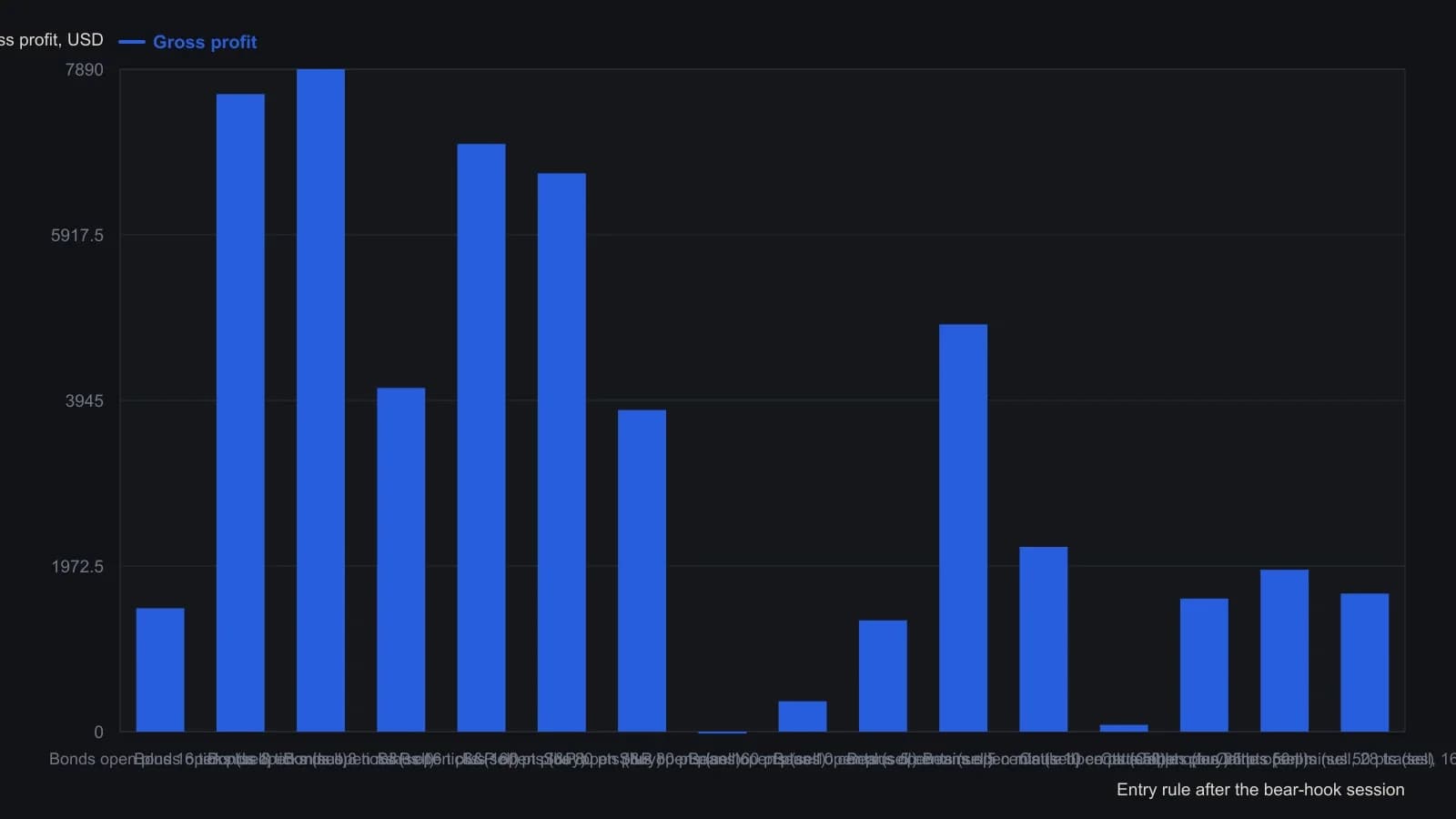
Test windows differ by market: bonds 1978–86, S&P 1982–88, soybeans and cattle 1970–88. Stretch is the 10-day average of the open-to-nearest-extreme gap. Two cattle sell rows print the same 50-point stretch and are kept as separate bars by sample size.
When the procedure stands aside
One stated exception, from tests not shown on the supplied pages, is an upside gap after the bear-hook session that holds through mid-session after a move above the open. Editorial reading: that case is when the next-session procedure stands aside rather than taking the restricted downside breakout or a fade at stretch.
Illustrated next-session paths after bear-hook days include a tendency for the following open to sit at that day's high in the interest-rate futures example.
Editorial reading
TradersWeek editorial reading: the one-bar weak-open recovery is a permission change for the next session, not a new opening-range geometry. The stretch offsets stay in place. The archive then limits the studied breakout to the downside, allows a fade at stretch, and states an upside-gap exception after a move above the open that holds through mid-session. That synthesis is editorial and is not attributed to the archive.
All readings on this track · 25 readings
- 1988Early entry as the session switch for an opening-range breakout
- 1989Evaluating inside-day filters on opening-range breakouts
- 1989Opening-range breakout after a narrow-range-four session
- 1989A joint contraction setup as the arming switch for an opening-range breakout
- 1989Next-session opening-range rules after a bear hook
- 1989Same-session exits from multi-day open-close codes
- 1989A close-to-close sequence is a bias label, not a trigger
- 1989Inside-day contraction as a same-session open-to-close rule
- 1990Evaluating five-day soybean open-to-close rules
- 1990Hourly breakouts gated by absolute tick volume
- 1993Premarket setup selection and opening-range rules
- 1994First-hour opening-range construction as a refusal problem
- 1995Why historically tested rules fail without a decision process
- 2001The opening range as a measuring stick for a ladder breakout
- 2001Evaluating an opening reaction as one timed stop procedure
- 2003Swing trading, opening-range checks, and the decision to stand aside
- 2006Monitor each opening-range setup as its own regime
- 2006Midday breakout rules from the opening range
- 2007Opening-range breakout as one session procedure
- 2007Evaluating same-day opening range entry rules
- 2008Overnight auction regimes and the intraday hold-or-exit choice
- 2010Construct a market-state-first range-breakout system as one procedure
- 2013Opening-hour stop as a session filter
- 2017Overnight volume as a construction step for the opening-range breakout
- 2017Night-volume gate for opening range breakouts