2000issue C061-4
A daily long-only confirmation stack on the tether line
A mechanical-long-procedure treats the 50-period tether-line as both the long trigger and the trailing-tether-stop. A buy is considered only when the volume-oscillator is positive and mbo is improving, after which a company-level fundamental review is still required.
- The mechanical-long-procedure is built to keep a long open through an extended favorable move and to close it when the rules say the move has failed, without trying to locate tops or bottoms.
- A close above the tether-line is the long trigger and a close below it is the exit, so the same 50-period midpoint is the trailing-tether-stop while the position is open.
- Because the midpoint crossover alone is shown to produce repeated whipsaws, a long is considered only when the volume-oscillator is positive and today’s mbo exceeds yesterday’s.
- The rules are specified for end-of-day long equity trades in large-cap index members only, not for futures, fixed-income instruments, short sales, or other bar lengths.
One procedure for entry, hold, and exit
The archive describes a mechanical-long-procedure for end-of-day long equity trades. It is built to keep a long open through an extended favorable move and to close it as soon as the rules say the move has failed, without trying to locate tops or bottoms.
The core price line is the tether-line: half the sum of the highest high and lowest low of the last 50 periods. Prices are described as clustering around that midpoint and returning to it. A close crossing above the tether-line is the long trigger. A close crossing below it is the long exit. After a long is open, the same line is the trailing-tether-stop: hold while the close stays above it and leave when the close crosses below.
Compaq daily price against the 50-period tether line
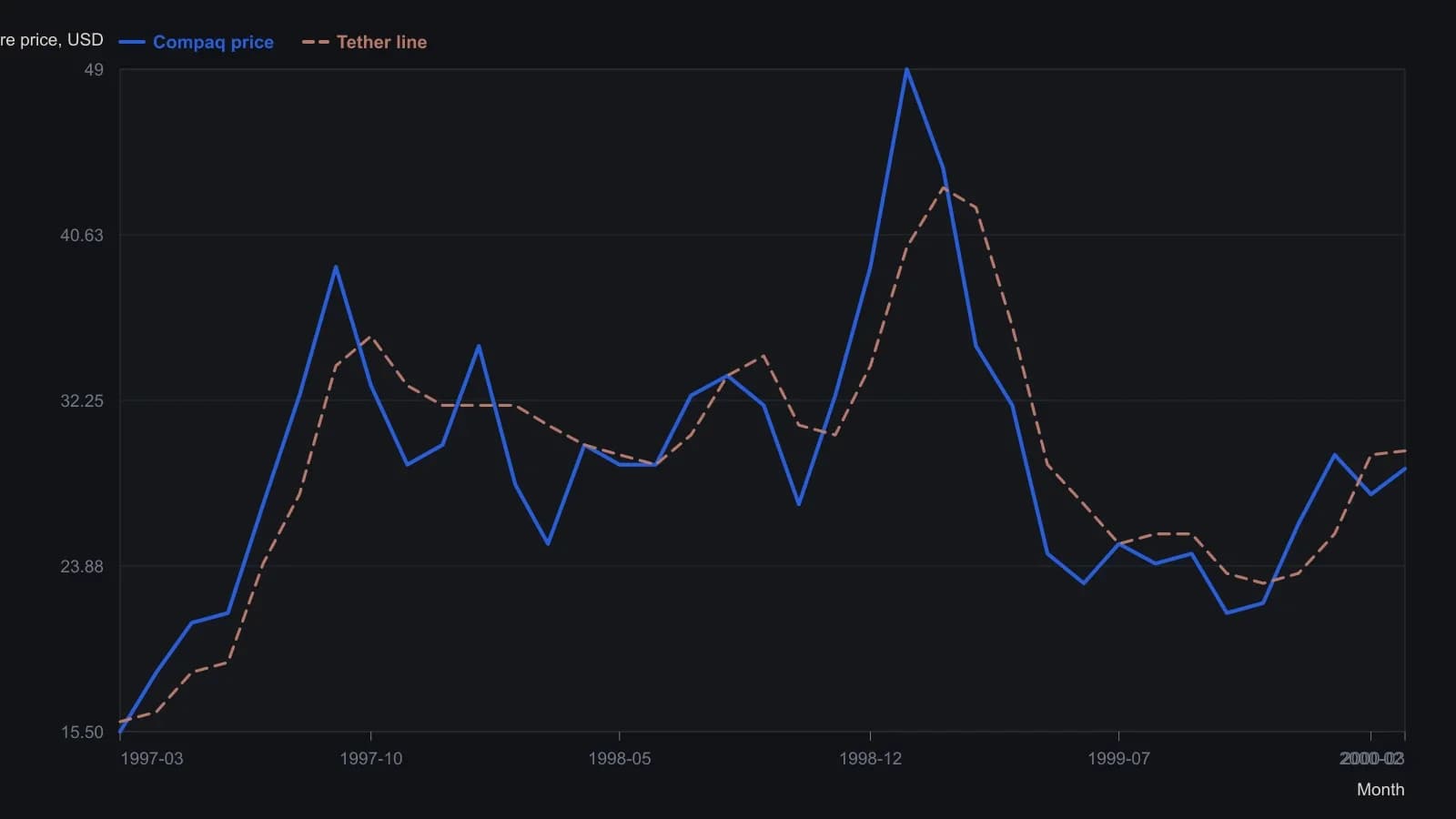
Tether = (50-day highest high + 50-day lowest low) / 2. Sampled about once a month from the daily Compaq screenshot; the quote bar on that plot prints a last close of 28.75 against a 29.6875 tether.
Why the tether-line needs confirmation
The midpoint crossover by itself is shown to produce repeated whipsaws, so extra filters are required before a buy is taken.
The volume-oscillator is a seven-period simple average of volume signed by the open-to-close relationship. Volume is signed positive when the close is above the open, negative when the close is below the open, and zero when they are equal. That average must be positive when the close crosses above the tether-line. The signed-volume construction is presented as an on-balance-volume-analogy: accumulate volume according to the direction of the bar. The archive uses this reading only as confirmation of buying pressure, not as a standalone entry.
The third filter is mbo, which subtracts a 200-period simple moving average of the close from a 25-period simple moving average of the close. Today’s value must exceed yesterday’s before a long is considered. That requirement is intended to block entries during volatile swings or consolidation.
After the three mechanical conditions agree, a company-level fundamental review is still required before the long is taken.
Where the rules are specified to apply
The rules are specified for end-of-day long equity trades only. They are not specified for futures, fixed-income instruments, or short sales. Other bar lengths were not tested.
The procedure is applied only to a large-cap equity index membership, on the stated premise that those names trend more consistently than a broader universe.
All readings on this track · 61 readings
- 1988Cumulative volume trend and 200-session polarity
- 1988Three clocks when cumulative volume led price
- 1988Payoff index checkpoints for open interest and divergence
- 1988Relative strength, stochastics, and on-balance volume as a turning-point stack
- 1988Signing volume by open interest change
- 1988Case study: weekly on-balance volume with trendlines and a 21-period average
- 1988Combining weekly and daily MACD divergences with on-balance volume
- 1988Restoring the original tests for market breadth, on-balance volume, and trendlines
- 1989Evaluating volume-weighted breadth extremes
- 1989Demand oscillator construction with a momentum overlay
- 1989Constructing a volume percentage ratio from advance-decline flow
- 1990Constructing net positive volume as On-balance volume
- 1990Buying-share scale with on-balance volume
- 1990Friday-filtered on-balance confirmation lines
- 1991Constructing rate-market volume breadth from on-balance volume
- 1991Building a breadth composite from on-balance volume breakouts
- 1992Constructing a rate-complex volume-breadth index
- 1992Constructing a breadth index from on-balance volume
- 1992Constructing signed market thrust from issue volume
- 1992Constructing indicator phase across averages, volume and bands
- 1993Force on-balance volume to agree with itself at slower horizons
- 1993Three transforms of market thrust from breadth and volume
- 1994Constructing a tick-line momentum oscillator
- 1994Constructing a smoothed on-balance tick momentum oscillator
- 1994Histogram confirmation and a second-series veto for MACD-family alerts
- 1994Constructing a 40-period envelope on on-balance volume
- 1996Constructing a matched percent-B volume disparity
- 1997Constructing calendar regime overlays and volume-weighted rules
- 1997Constructing market thrust from breadth and volume
- 1997Constructing on-balance volume as a signed running total
- 1997A three-layer construction for a signed volume-force oscillator
- 1997Constructing a range-sum volume-force oscillator
- 1999On-balance volume confirmation, price-indicator divergence, and bounded exits
- 2000A daily long-only confirmation stack on the tether line
- 2000A three-filter tether and volume trend system
- 2003Constructing finite volume elements as a finite-period money-flow filter
- 2003Constructing on-balance volume from signed session volume
- 2003On-balance volume as a market-breadth participation ledger
- 2003Construct a volatility-adjusted on-balance volume filter before confirming a breakout
- 2004Opening and midday ranges as an on-balance-volume breakout case
- 2004Constructing a volatility-gated volume-flow measure
- 2004Constructing a volume-flow series from on-balance volume
- 2004Volume-flow indicator construction from on-balance volume
- 2004Volume-flow slope divergence, then separate on-balance-volume and crossover rules
- 2004Volume flow and band construction as one inspectable problem
- 2004Auditing advance-decline confirmation for scale, horizon, and composition
- 2005Bounded market breadth from the Arms index to BRIN
- 2006Overnight-hold entry and exit construction
- 2007Evaluating Volume-price confirmation versus On-balance volume and MACD
- 2009Volume confirmation versus a price advance
- 2010Typeahead retrieval of a moving average, on-balance volume, and a stochastic oscillator
- 2010Modified volume-price trend and log-price scale alignment
- 2010Constructing liquidity accelerometers from advance-decline averages
- 2012Failed short cycles as breadth and volume tests
- 2016Earnings straddles, implied volatility, and money-flow filters
- 2017A volume residual filter and a price projection matrix
- 2019Volume-volatility parabola and signed-volume momentum
- 2019Separating on-balance volume into breadth and volume
- 2020Constructing the obvm signal line
- 2020Constructing smoothed on-balance volume with a signal line
- 2020Keep neutrality as a first-class input in three-state market data