1990issue C021-8
Fair-value gaps and a copper moving-average channel
This case study pairs a regression-built obstat path with technical timing. A valuation-gap is used only to change risk posture. A 13-day long-or-cash moving-average and an upper price-channel then form one copper trend-following procedure.
- Price was modeled as a regression effect and the resulting obstat path was paired with technical timing, not used as a standalone entry clock.
- A valuation-gap was treated as a warning, as in the 1987 Standard & Poor's 500 episode and the 1989 palladium overshoot, without specifying when the next move would start.
- At the September close copper showed the largest actual-versus-obstat gap after a rally into the 1.40 area, a five-month stall, and a later drop, and its mean and median intraday volatility exceeded the other futures compared.
- The copper trend-following rule was long-or-cash on a 13-day moving-average, with an upper price-channel of a six-day average multiplied by 1.05 added to flag when to tighten stops.
A statistical path and a timing rule
Price was modeled as an effect in a multiple-regression framework. The resulting statistical path was then paired with technical timing rather than used alone.
TradersWeek editorial reading: treat the two pieces as layers, not as substitutes. The regression-built path changes risk posture only when price leaves that equilibrium. A long-or-cash moving-average plus an upper price-channel then turns the posture into one copper trend-following procedure whose entry, exit, and abstention rules can be tested together.
What an obstat path is for
An obstat path is an objective statistical price path from a multiple-regression model that treats the traded price as the effect of candidate macroeconomic and related causes.
A valuation-gap is the difference between the traded price and the contemporaneous obstat path. In the archive workflow that gap was a warning to tighten technical filters, not a timed entry.
For gold after early 1983, foreign-exchange rates ranked as more important than domestic inflation among the regression causes of price. TradersWeek editorial reading: that ranking belongs to the cause layer of the model. It does not, by itself, specify a long-or-cash stance.
Gaps that warned without a start time
During 1987, a widening gap between the Standard & Poor's 500 and its obstat path was treated as a downside-risk warning that did not, by itself, specify when a decline would start.
Palladium in 1989 rose far above its obstat value on cold-fusion demand news and then fell back toward that value once immediate new demand was judged unlikely.
Gold, silver, and platinum models pointed to further declines in obstat values after September 1989 and did not show that the bear phase had already been overdone.
Copper at the September close
At the September close, copper had the largest actual-versus-obstat gap after a rally into the 1.40 area, a five-month stall, and a later drop.
Copper's mean and median intraday volatility exceeded the other futures compared and was described as more than twice the S&P 500 contract figures shown.
TradersWeek editorial reading: copper is the market in which the valuation-gap warning meets a contract that had already shown wider mean and median intraday movement than the other futures compared.
Copper futures and the obstat path, 1983–1989
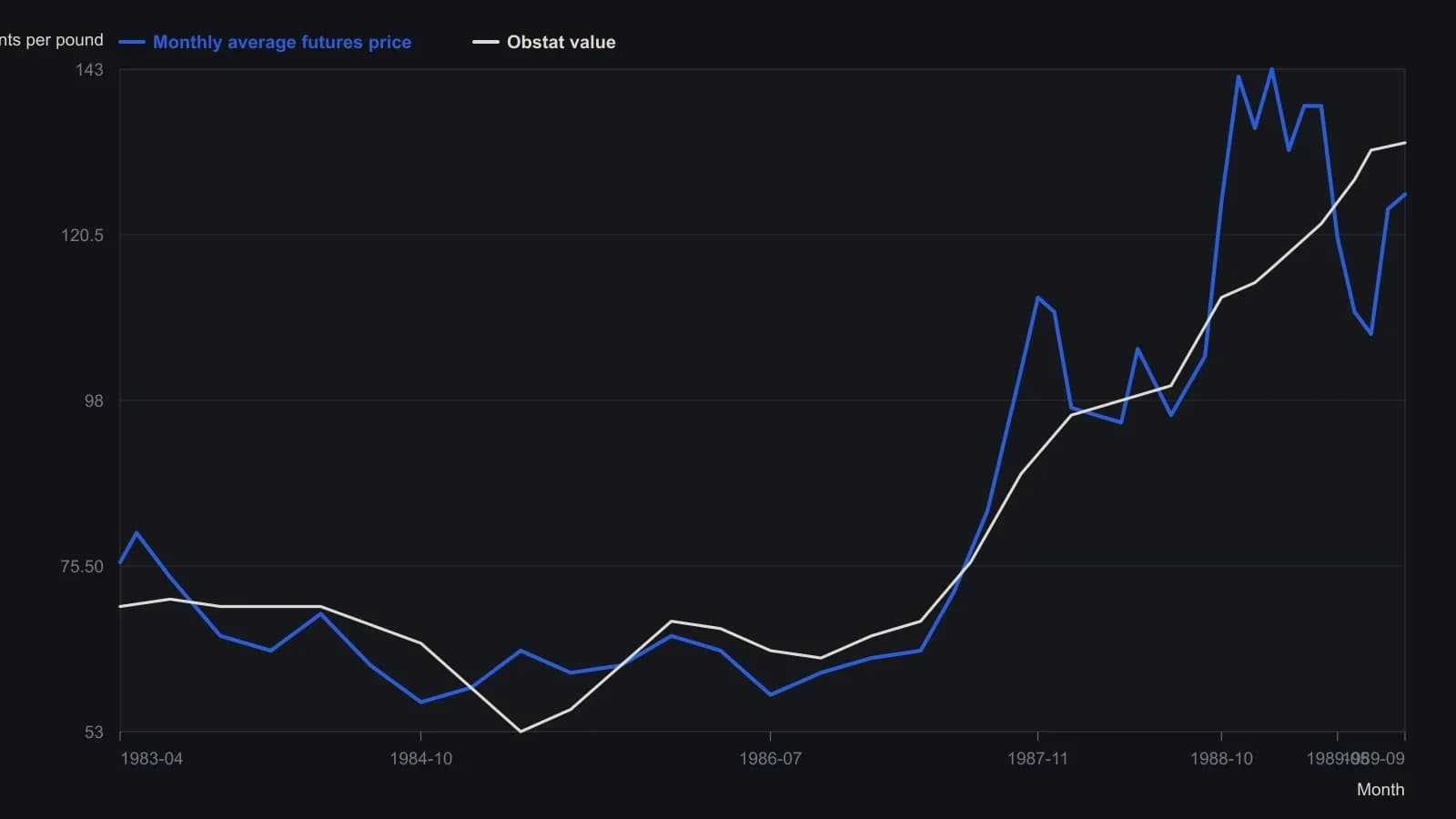
Values are approximate readings from the printed monthly chart, rounded to the nearest cent. Sharp’s obstat series is a multiple-regression estimate using industrial production, inflation, interest rates and foreign exchange; a wide gap is only a reason to change risk posture.
A long-or-cash moving-average and an upper channel
A span of moving-average lengths was tested on copper. The rule carried forward used a 13-day average and went to cash at the next open if the prior close was below that average.
The copper trend-following procedure stayed long the nearest contract, or the second nearest in the expiration month, or else held cash. Rollover days were treated as a cash day and transaction costs were omitted. The base rule is long-or-cash: either long a nearby futures contract or entirely flat, with no required short sale.
Short-term pullbacks after sharp advances produced large drawdowns in the moving-average tests, so an upper price-channel of a six-day average multiplied by 1.05 was added to flag when to tighten stops.
All readings on this track · 55 readings
- 1988Constructing price channels from trendlines
- 1988Three-point curved trend channel construction
- 1988Least-squares construction of channel trendlines
- 1988Three-zone price channel from quadratic smoothing
- 1989A variable-sensitivity stochastic built on three-sigma bounds
- 1989Close-minus-average oscillator for channel extremes
- 1989The six-stage hunt as a critique of one-click heroics
- 1990Fair-value gaps and a copper moving-average channel
- 1990Diversify markets, not systems, to cut trend-system variance
- 1991Constructing trendlines, price channels, and close-based breakouts
- 1991Constructing seasonal-cycle overlays with channel confirmation
- 1993Lag-compensated exponential trend channel construction
- 1993Constructing a lead-lag filter and price channel as one stack
- 1993Three stochastic warnings still need price-channel confirmation
- 1993Lead-lag smoothing for weekly trend-channel construction
- 1993Constructing zero-net-lag price channels
- 1995From a downtrend-line break to a regression channel
- 1995Validated trendline and price channel construction
- 1995Constructing price envelopes from averages, volatility, and regression
- 1996Constructing trendlines and channels from explicit swings
- 1998Fifty percent retracement as a channel regime test
- 1998Close-based channel rails as daily scenario maps
- 1999Constructing support, resistance, trendlines, and price channels
- 2001Cycle composites, price channels, and two-sided signals
- 2001Testing horizontal price channels with stops and scale
- 2002A two-stage momentum-shift and price-channel process
- 2002Wave-by-wave channel construction for Elliott counts
- 2002Affine channels as reusable trade hypotheses
- 2004Stress-test seasonal windows across regimes, then add channels
- 2004Regime permission from trendlines, channels, and range edges
- 2004Weekly-average and price-channel states on sector depositary baskets
- 2005Oil services catch-up after channel resistance breaks
- 2005Constructing a volatility-normalized cycle index
- 2005How a Darvas channel becomes a complete entry and exit procedure
- 2005Clustered Fibonacci and channel levels in news-driven forex
- 2005Treat a consolidating currency market as a time-frame problem
- 2005Channel walls that flip roles or recapture price
- 2006Stacking candlesticks, crossovers, and price channels
- 2006Failed uptrend channel breakout left the euro rangebound
- 2006Constructing a Wilson relative price channel from a range-bound strength index
- 2007Range bars change when a Bollinger squeeze counts as a breakout
- 2009One testable SPY procedure for a price channel, a trend rule, and a seasonal overlay
- 2010A gold-miner channel plan from value to false breakouts
- 2010A multi-timeframe channel from value to an overvalued zone
- 2010Asymmetric price channel construction for congested markets
- 2011Phasing many cycles at once with nested envelopes
- 2012Constructing adaptive horizontal price channels
- 2014Confirming support with trendlines, channels, and retracements
- 2015News-sentiment confirmation for support, channel, and volume tests
- 2015A three-layer permission stack: moving averages, a price channel, and weekly levels
- 2016Entropy-diff as a regime switch between trend following and a price channel
- 2017Competing rulers on a pound chart after Brexit
- 2017Test consolidation channel breakouts as one procedure
- 2020Constructing late-trend longs with a price channel, gap breakout, and trailing stop
- 2025Using IBM's multi-year price channel as a breakout teaching case