2005issue C021-4
Oil services catch-up after channel resistance breaks
In the 2003-2005 oil complex, producers led inside rising price channels while services lagged below their 2001 highs. The case teaches a two-index drill: read high-low nonconfirmation first, then withhold the catch-up label until the lagging group's own channel, range, or triangle line breaks.
- In 2003-2005 both oil indexes rose inside rising price channels, but the producer index made a 20-year high while services still sat below their 2001 highs.
- A 2001 services lower high versus a producer break of the 2000 high preceded later weakness; a 2002 services higher low versus a producer lower low preceded the next advance.
- A 2004 services triangle-line break pointed first to the 2001 high near 145, then toward a parallel-channel band near 180-190 by mid-2005.
- Rowan, Tidewater, and Cooper Cameron still needed their own ceiling breaks; a crude hold above a 35-40 shelf did not close those tests.
A two-index confirmation drill
In the 2003-2005 oil complex, the integrated-producer index was outrunning the oil-services index even though both series were advancing inside rising price channels. From March 2003 the producer index rose from the low 400s into the low 700s, cleared its 2001 peak, and printed a 20-year high. The services index doubled from its September 2001 low and surpassed its 2002 high, yet it remained below its 2001 highs and trailed the producer index on the same chart.
That pairing is the archive example of a catch-up-setup. A lagging services complex can close a relative-strength gap only after its own resistance events fire, not merely because the commodity stays elevated. Editorial reading: first decide whether the lagging group historically led through high-low nonconfirmation, then withhold the catch-up label until the long channel, range ceiling, or triangle line actually breaks.
High-low nonconfirmation as the first screen
Over five years, a 2001 lower high in services against a producer break of the 2000 high preceded 2001-2002 weakness, while a 2002 higher low in services against a producer lower low preceded the 2003-2004 advance. Nonconfirmation means a related index failing to match the other's new high or new low. In this case it is a lead-lag clue rather than a finished trend call.
Rising channels and measured rails
A rising-price-channel is an advance held between parallel trendlines, where a later interior breakout is measured toward the upper boundary rather than treated as an open-ended trend. After the producer index broke above 600, a rising channel drawn from 1986 placed the next resistance test near the upper rail around 800 in 2005.
A 2004 trendline break from the services index's 2001-2002 triangle pointed first to the 2001 high near 145, then toward a parallel-channel band near 180-190 by mid-2005. That move is breakout-confirmation: a decisive move through a repeatedly tested ceiling that ends a coil and reopens a prior measured path.
OSX doubled off the 2001 low but is still under the 2001 high
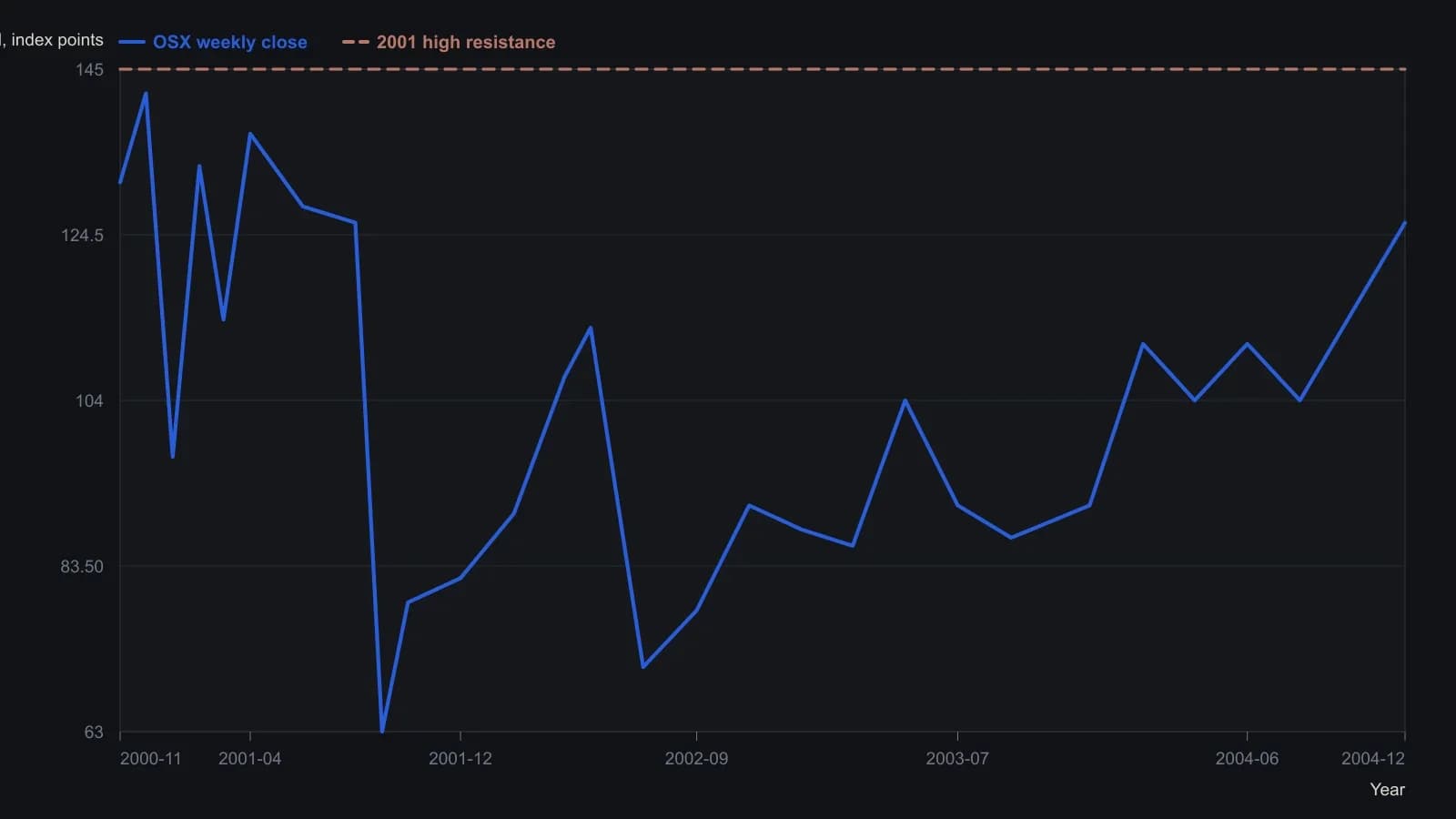
Closes are raster readings from weekly candlesticks, not official prints. Hill’s first objective is 140–150 at the 2001 high; a second channel projection sits near 180–190 by mid-2005.
Name-level support and resistance
Support-resistance marks recurring demand and supply prices that form the edges of a rectangle, triangle, or channel and can be treated as pass-fail levels. The archive kept those tests at the name level after the services index began to resolve its triangle.
Rowan coiled after an 11.10-to-27.06 advance, printing higher lows against equal highs near 27. A break of that supply line was the stated condition for a later test of the mid-30s or the 2001 high.
Tidewater boxed for more than two years between support near 25 and resistance near 35, with four tests of the ceiling and three of the floor. A move through 35 was the condition that would reopen the 2001-2002 highs.
Cooper Cameron had already left a May 2002-March 2004 triangle after a roughly 30-to-60 run, with leftover supply near 55-60 and a 2001-high plus channel projection above 70 for mid-2005.
Crude as backdrop, not confirmation
Crude's March 2002-December 2003 rectangle break preceded a multi-month hold above 40. Even a failure to stay above 50 left a 35-40 support shelf as the chart basis for prices remaining high enough that lagging services names would still have to resolve their own resistance lines. Editorial reading: a firm crude shelf can keep the catch-up-setup alive, but it does not fire the breakout-confirmation on the services side.
All readings on this track · 55 readings
- 1988Constructing price channels from trendlines
- 1988Three-point curved trend channel construction
- 1988Least-squares construction of channel trendlines
- 1988Three-zone price channel from quadratic smoothing
- 1989A variable-sensitivity stochastic built on three-sigma bounds
- 1989Close-minus-average oscillator for channel extremes
- 1989The six-stage hunt as a critique of one-click heroics
- 1990Fair-value gaps and a copper moving-average channel
- 1990Diversify markets, not systems, to cut trend-system variance
- 1991Constructing trendlines, price channels, and close-based breakouts
- 1991Constructing seasonal-cycle overlays with channel confirmation
- 1993Lag-compensated exponential trend channel construction
- 1993Constructing a lead-lag filter and price channel as one stack
- 1993Three stochastic warnings still need price-channel confirmation
- 1993Lead-lag smoothing for weekly trend-channel construction
- 1993Constructing zero-net-lag price channels
- 1995From a downtrend-line break to a regression channel
- 1995Validated trendline and price channel construction
- 1995Constructing price envelopes from averages, volatility, and regression
- 1996Constructing trendlines and channels from explicit swings
- 1998Fifty percent retracement as a channel regime test
- 1998Close-based channel rails as daily scenario maps
- 1999Constructing support, resistance, trendlines, and price channels
- 2001Cycle composites, price channels, and two-sided signals
- 2001Testing horizontal price channels with stops and scale
- 2002A two-stage momentum-shift and price-channel process
- 2002Wave-by-wave channel construction for Elliott counts
- 2002Affine channels as reusable trade hypotheses
- 2004Stress-test seasonal windows across regimes, then add channels
- 2004Regime permission from trendlines, channels, and range edges
- 2004Weekly-average and price-channel states on sector depositary baskets
- 2005Oil services catch-up after channel resistance breaks
- 2005Constructing a volatility-normalized cycle index
- 2005How a Darvas channel becomes a complete entry and exit procedure
- 2005Clustered Fibonacci and channel levels in news-driven forex
- 2005Treat a consolidating currency market as a time-frame problem
- 2005Channel walls that flip roles or recapture price
- 2006Stacking candlesticks, crossovers, and price channels
- 2006Failed uptrend channel breakout left the euro rangebound
- 2006Constructing a Wilson relative price channel from a range-bound strength index
- 2007Range bars change when a Bollinger squeeze counts as a breakout
- 2009One testable SPY procedure for a price channel, a trend rule, and a seasonal overlay
- 2010A gold-miner channel plan from value to false breakouts
- 2010A multi-timeframe channel from value to an overvalued zone
- 2010Asymmetric price channel construction for congested markets
- 2011Phasing many cycles at once with nested envelopes
- 2012Constructing adaptive horizontal price channels
- 2014Confirming support with trendlines, channels, and retracements
- 2015News-sentiment confirmation for support, channel, and volume tests
- 2015A three-layer permission stack: moving averages, a price channel, and weekly levels
- 2016Entropy-diff as a regime switch between trend following and a price channel
- 2017Competing rulers on a pound chart after Brexit
- 2017Test consolidation channel breakouts as one procedure
- 2020Constructing late-trend longs with a price channel, gap breakout, and trailing stop
- 2025Using IBM's multi-year price channel as a breakout teaching case